
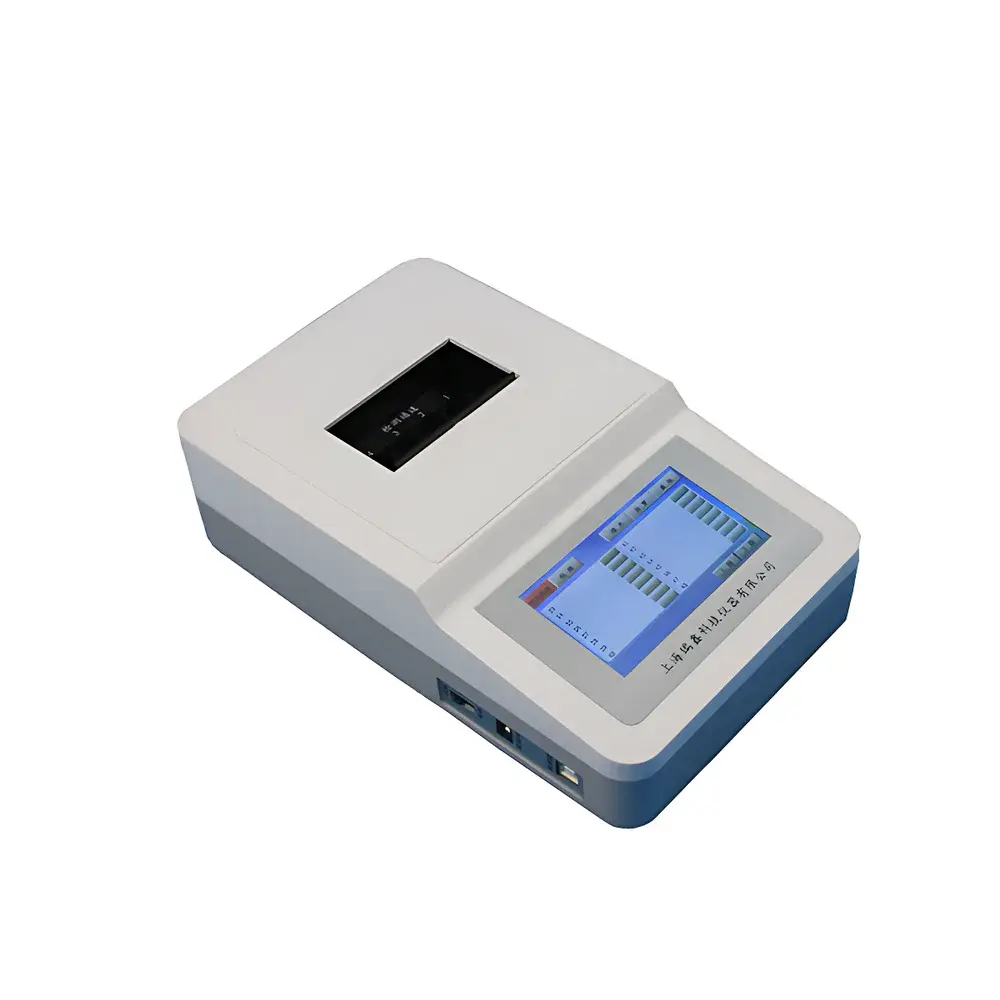
Ruixin SZ-G2 Mercury Analyzer
| Brand | Ruixin |
|---|---|
| Origin | Shanghai, China |
| Manufacturer Type | Authorized Distributor |
| Country of Origin | China |
| Model | SZ-G2 |
| Price Range | USD 4,200 – 7,000 (FOB Shanghai) |
| Function Type | Single-Analyte Dedicated Instrument |
| Sample Format | Single-Sample Batch Mode |
| Wavelength Range | 380–630 nm |
| Analysis Time | ≤ 180 seconds |
| Photometric Repeatability | ≤ 0.2% (at 546 nm, neutral density filter) |
| Optical Channels | 1 |
Overview
The Ruixin SZ-G2 Mercury Analyzer is a portable, single-wavelength spectrophotometric instrument engineered for rapid, on-site quantification of total mercury (Hg²⁺) in potable water matrices—including bottled mineral water, purified drinking water, and municipal tap water. It operates on the principle of visible-light absorption spectroscopy, utilizing a stable tungsten-halogen light source and a fixed-wavelength optical path optimized for the dithizone-mercury complex formation at 490 nm (within its 380–630 nm spectral window). The instrument implements a validated colorimetric method compliant with national standard GB/T 5750.6–2023 (Standard Methods for Examination of Drinking Water – Metals), enabling trace-level detection in the range of 0.05–0.50 mg/L with high photometric stability (≤0.3% drift over 3 minutes) and calibrated linearity across five preloaded calibration curves. Its compact aluminum alloy chassis (220 × 120 × 85 mm, <1.2 kg) supports field deployment without external benchtop infrastructure.
Key Features
- 4.5-inch high-resolution TFT color touchscreen with full Chinese GUI—enabling intuitive navigation, real-time absorbance/percent transmittance display, and direct annotation via integrated soft keyboard or stylus input
- Dual-mode power architecture: AC 220 V ±10%, DC 5 V regulated input, or internal rechargeable lithium-ion battery (≥6 hours continuous operation)
- Integrated thermal printer for immediate hard-copy reporting—supports automatic printout of sample ID, test time, concentration result (mg/L), curve ID, and operator stamp
- Onboard data management: Stores ≥1,000 test records with timestamp, sample name, calibration curve used, and raw absorbance values; recallable via chronological or alphanumeric search
- Dual communication interfaces: RS-232 serial port for legacy lab peripherals and USB 2.0 host/device mode for PC connectivity, firmware updates, or mass data export to CSV files
- Optical performance certified per JJG 178–2015 (Chinese Verification Regulation for Visible Spectrophotometers): Absorbance range 0.000–4.000 (0.001 resolution), transmittance 0.00–100.00% (0.01% resolution), photometric accuracy ±2.0% T
Sample Compatibility & Compliance
The SZ-G2 is validated exclusively for aqueous samples meeting ISO 5667-3:2018 (Water quality — Sampling — Part 3: Guidance on preservation and handling of water samples) requirements. It requires pretreatment using standardized acid digestion (HNO₃/H₂SO₄/KMnO₄) followed by dithizone color development under controlled pH (1.5–2.0) and temperature (25 ± 2°C). No filtration or centrifugation is needed post-reaction. The system complies with China’s GB 5749–2022 (Hygienic Standard for Drinking Water) maximum contaminant level (MCL) of 0.001 mg/L for mercury, delivering results traceable to NIM (National Institute of Metrology, China) reference materials. While not FDA 21 CFR Part 11–compliant out-of-box, audit trails and electronic signatures can be implemented via optional PC-based software modules aligned with GLP documentation workflows.
Software & Data Management
Embedded firmware supports local data logging with auto-timestamping, user-defined sample naming, and selectable calibration curve selection (five factory-loaded curves covering low-, mid-, and high-range mercury concentrations). Exported datasets (via USB) include metadata headers compatible with LIMS integration (e.g., LabWare, Thermo Fisher SampleManager). Optional Windows-compatible desktop software provides trend analysis, QC charting (X-bar/R charts), report templating (PDF/Excel), and batch export with configurable fields (operator ID, location tag, instrument serial number). All data modifications are logged with immutable timestamps and user IDs—meeting basic ALCOA+ principles for data integrity.
Applications
- Routine surveillance of municipal water distribution points and bottling line QC checkpoints
- Emergency response testing during industrial spill incidents involving mercury-contaminated groundwater
- Field verification of activated carbon or ion-exchange resin treatment efficacy in small-scale purification units
- Regulatory compliance screening for food processing facilities sourcing process water from private wells
- Educational use in environmental science laboratories for method validation and student-led water quality projects
FAQ
Is the SZ-G2 suitable for wastewater or seawater analysis?
No. It is validated only for low-turbidity, low-salinity potable water matrices. High chloride, organic load, or suspended solids interfere with dithizone complex formation and require matrix-matched calibration or alternate methods (e.g., cold vapor atomic absorption).
Can calibration curves be customized or uploaded?
Yes—up to five user-defined curves may be programmed via USB using the provided configuration utility; each curve must include at least six concentration points with R² ≥ 0.999.
What maintenance is required for long-term photometric stability?
Monthly verification with NIST-traceable neutral density filters (OD 1.0 and 2.0) is recommended; optical path cleaning with lens-grade tissue and anhydrous ethanol every 200 tests ensures consistent transmittance accuracy.
Does the instrument support remote monitoring or IoT integration?
Not natively. However, the RS-232 interface enables connection to SCADA systems or custom Python/Node-RED scripts for periodic polling and cloud upload via edge gateway devices.
Is reagent kit supply included or separately certified?
Reagents (dithizone solution, mercury standard stock, masking agents) are supplied as RUINEX-certified kits (Cat. No. RX-MH-2024) with CoA specifying shelf life, lot-specific LOD/LOQ, and compatibility validation against GB/T 5750.6–2023.





