
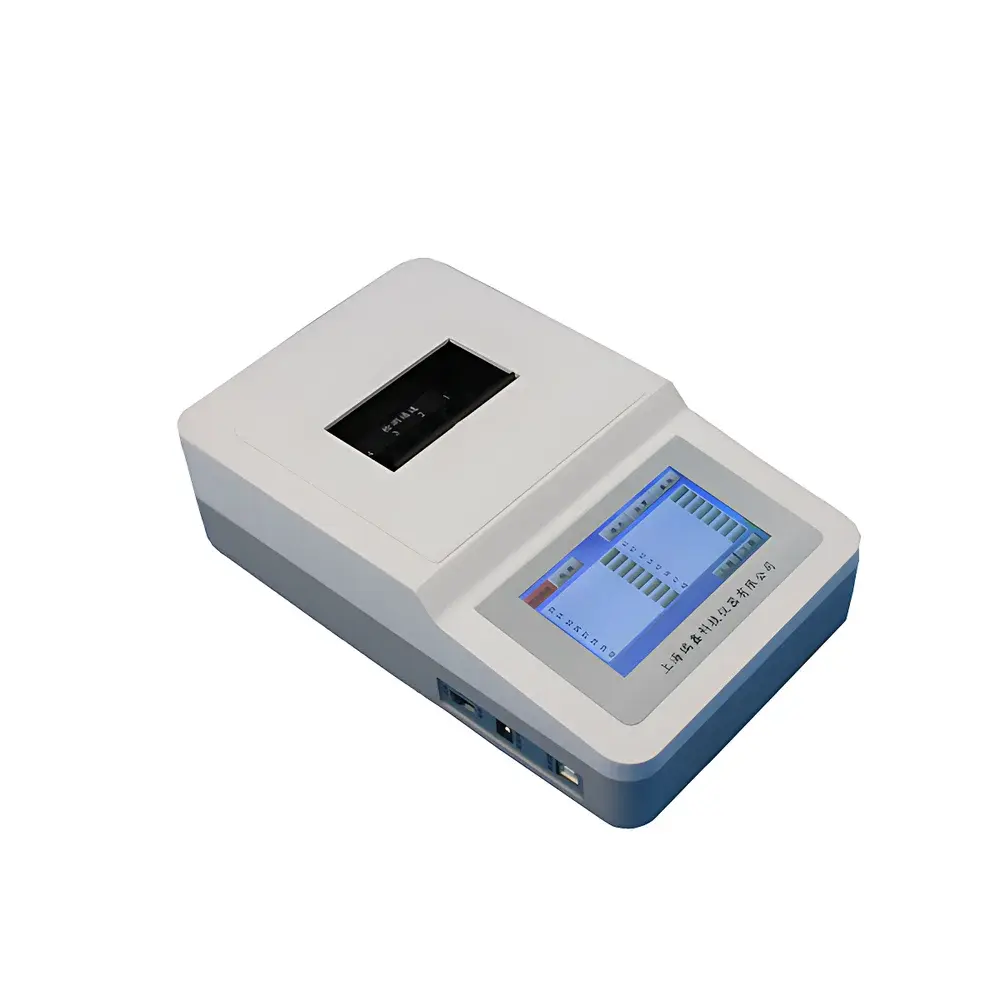
Ruixin SZ-Gd2 Cadmium Analyzer
| Brand | Ruixin |
|---|---|
| Origin | Shanghai, China |
| Manufacturer Type | Authorized Distributor |
| Region of Manufacture | Domestic (China) |
| Model | SZ-Gd2 |
| Price Range | USD 4,200 – 7,000 |
| Function Type | Single-Analyte Detection |
| Sample Format | Single-Sample Dedicated |
| Wavelength Range | 380–630 nm |
| Analysis Time | ≤ 3 min |
| Photometric Repeatability | ≤ 0.2% |
| Optical Channels | 1 |
Overview
The Ruixin SZ-Gd2 Cadmium Analyzer is a portable, single-analyte spectrophotometric instrument engineered for rapid, field-deployable quantification of cadmium (Cd²⁺) in aqueous matrices. It operates on the principle of visible-light absorbance spectroscopy—specifically, the colorimetric reaction between cadmium ions and a selective chromogenic reagent (e.g., dithizone or 1-(2-pyridylazo)-2-naphthol), forming a stable colored complex whose absorbance intensity at a defined wavelength (within the 380–630 nm range) is directly proportional to cadmium concentration. Designed for compliance with standard methods including EPA Method 200.7 (ICP-OES reference) and ISO 8692:2012 (for water quality testing), the SZ-Gd2 delivers trace-level detection (0.01–1.5 mg/L) with high photometric fidelity and minimal operator dependency. Its compact aluminum chassis, integrated rechargeable lithium battery, and dual AC/DC/USB power support enable seamless transition between laboratory benchtop use and on-site environmental monitoring—making it particularly suitable for municipal water utilities, food processing QA/QC labs, and third-party environmental testing providers requiring GLP-aligned documentation.
Key Features
- 4.5-inch high-resolution color TFT touchscreen with full Chinese GUI—optimized for glove-compatible operation and intuitive navigation under variable lighting conditions.
- Integrated micro-thermal printer for immediate hardcopy generation of calibration curves, sample IDs, timestamps, and quantitative results—supporting audit-ready record retention.
- Pre-loaded multi-point calibration curves optimized for common water matrices (potable water, surface water, treated wastewater), minimizing manual curve-fitting and reducing inter-operator variability.
- Dual-mode photometric readout: simultaneous display of absorbance (0.000–4.000 AU, resolution 0.001) and transmittance (0.00–100.00%, resolution 0.01%), with photometric accuracy ±2.0% T and stability ≤0.3% over 3 minutes.
- Embedded data management: automatic timestamped storage of ≥1,000 test records; searchable by sample ID, date, or concentration range; exportable via USB or RS232 to LIMS or Excel-compatible formats.
- Multi-source power architecture: supports 220 VAC mains, 5 VDC external supply, and internal Li-ion battery (≥8 hours continuous operation)—enabling uninterrupted deployment during field surveys or mobile lab operations.
Sample Compatibility & Compliance
The SZ-Gd2 is validated for direct analysis of clarified, low-turbidity aqueous samples—including drinking water, groundwater, surface water, and post-treatment effluents—without dilution or pre-concentration in the 0.01–1.5 mg/L range. Samples requiring pretreatment (e.g., acid digestion for solid food extracts or suspended particulates) must follow standardized protocols (e.g., EPA 3050B or ISO 11047) prior to filtration and analysis. The instrument meets core performance criteria outlined in ISO/IEC 17025:2017 for testing laboratories, and its data logging architecture supports basic 21 CFR Part 11 readiness through user-accessible audit trails, password-protected method editing, and immutable result archiving. While not certified for regulatory submission without method validation, it serves as a robust screening tool aligned with Codex Alimentarius GL 23–2022 and China’s GB 5749–2022 drinking water standards.
Software & Data Management
No external PC software is required for routine operation; all calibration, measurement, and reporting functions are executed onboard. Internal firmware supports up to 10 user-defined calibration sets, each with editable slope/intercept parameters and acceptance criteria for QC checks. Raw absorbance values, calculated concentrations, and pass/fail flags against preset limits are stored with ISO 8601 timestamps. USB mass-storage mode allows direct file transfer of CSV-formatted datasets; RS232 output enables integration with SCADA systems or centralized telemetry platforms for real-time environmental monitoring networks. Firmware updates are delivered via USB stick—no internet connection required—ensuring secure, air-gapped maintenance in regulated environments.
Applications
- Routine surveillance of cadmium in municipal distribution systems and bottled water production lines.
- On-site verification of wastewater treatment plant effluent compliance prior to discharge.
- Screening of rice, edible fungi, and aquatic products (after acid digestion and filtration) per GB 2762–2022 contaminant limits.
- Field assessment of soil leachates and irrigation water in agricultural zones with historical heavy metal contamination.
- Educational use in university environmental science labs for teaching spectrophotometric quantification principles and QA/QC practices.
FAQ
Does the SZ-Gd2 require daily recalibration?
No—calibration is required only when changing reagent lots, after instrument transport, or per user-defined QC intervals (e.g., every 10 samples). Built-in zero and blank compensation minimizes drift.
Can it measure other heavy metals besides cadmium?
No—the optical path, reagent kit, and calibration curves are dedicated exclusively to cadmium. Cross-reactivity with Pb²⁺ or Zn²⁺ is minimized but not eliminated; confirm specificity via spike-recovery tests per ISO 11352.
Is the thermal printer compatible with standard label stock?
It accepts 57 mm wide thermal paper rolls only; adhesive-backed labels are not supported due to feed mechanism constraints.
What is the minimum detectable volume per test?
Each assay consumes 5.0 mL of prepared sample solution; pipetting accuracy must be verified using Class A volumetric glassware or calibrated positive-displacement pipettes.
How is data integrity ensured during battery-powered operation?
All measurements are written to non-volatile flash memory immediately upon completion; power loss during printing does not affect result storage.





