
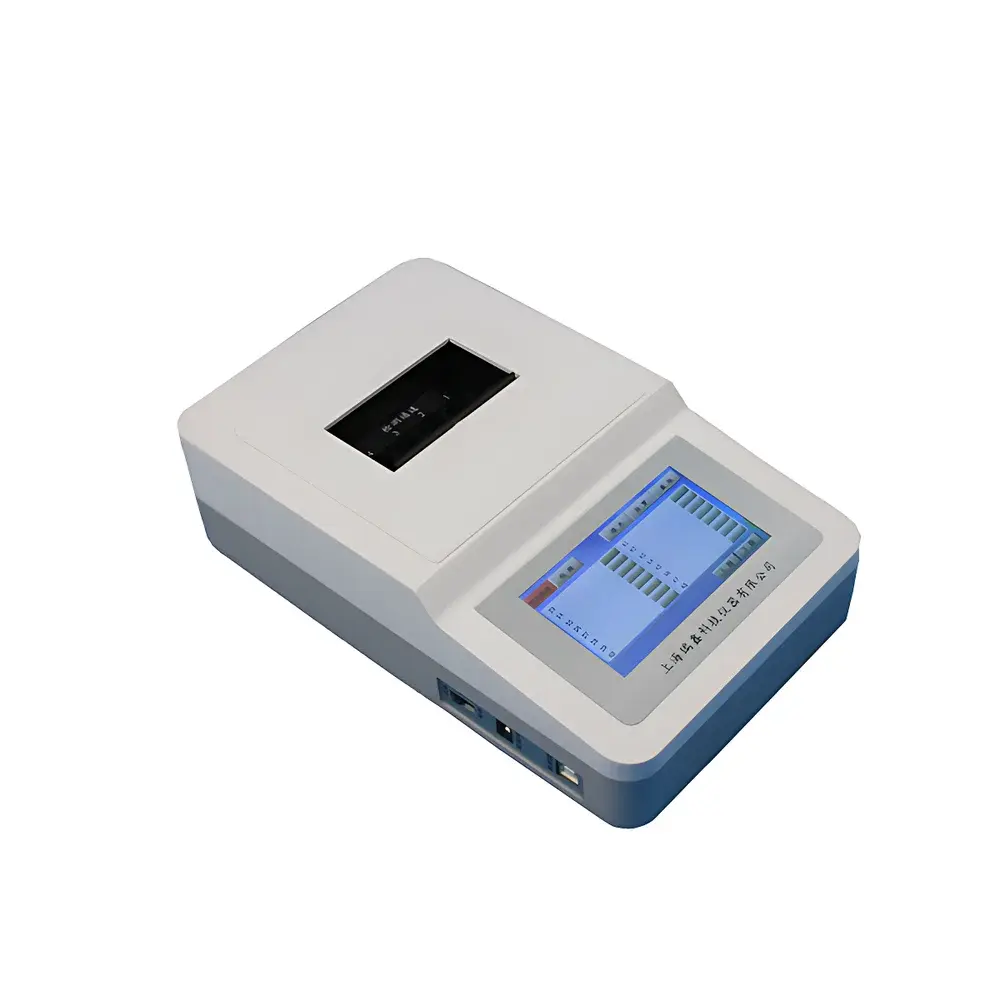
Ruixin SZ-LS2 Sulfate Analyzer
| Brand | Ruixin |
|---|---|
| Origin | Shanghai, China |
| Manufacturer Type | Authorized Distributor |
| Country of Origin | China |
| Model | SZ-LS2 |
| Price Range | USD 4,200 – 7,000 (FOB Shanghai) |
| Functionality | Single-analyte Quantitative Detection |
| Sample Format | Single-sample, discrete measurement |
| Wavelength Range | 380–630 nm |
| Analysis Time | ≤ 180 seconds |
| Photometric Repeatability | ≤ 0.2% (at fixed wavelength, n=6) |
| Optical Channels | 1 |
| Absorbance Range | 0.000–4.000 AU |
| Absorbance Resolution | 0.001 AU |
| Transmittance Range | 0.00–100.00% |
| Transmittance Resolution | 0.01% |
| Photometric Accuracy (Transmittance) | ±2.0% |
| Baseline Stability | ≤0.3% drift over 3 min |
| Measurement Range (SO₄²⁻) | 5.0–250.0 mg/L as sulfate |
| Communication Interfaces | RS-232, USB 2.0 |
| Power Supply | AC 220 V ±10%, DC 5 V, or rechargeable Li-ion battery |
| Display | 4.5-inch color TFT-LCD touchscreen with full Chinese UI |
| Onboard Thermal Printer | Integrated embedded thermal printer |
| Data Storage | Internal non-volatile memory for ≥10,000 test records |
| Data Export | CSV via USB |
Overview
The Ruixin SZ-LS2 Sulfate Analyzer is a portable, single-channel spectrophotometric instrument engineered for rapid, on-site quantification of sulfate (SO₄²⁻) in drinking water and natural water sources. It operates on the principle of barium chloride turbidimetry — a standardized colorimetric method where sulfate ions react with barium chloride under acidic conditions to form insoluble barium sulfate precipitate, generating measurable turbidity proportional to sulfate concentration. The instrument employs a stable tungsten-halogen light source and a narrow-band optical filter within the 380–630 nm range to detect scattered light intensity, which is converted into concentration values (mg/L) using pre-calibrated calibration curves stored in firmware. Designed for field-deployable use without external lab infrastructure, the SZ-LS2 meets core performance requirements outlined in ISO 9297:2000 (Water quality — Determination of sulfate — Turbidimetric method) and aligns with US EPA Method 375.4 for sulfate analysis in potable water matrices.
Key Features
- Compact aluminum alloy chassis with ergonomic handle and IP54-rated enclosure for dust/moisture resistance during field operations.
- 4.5-inch high-resolution color TFT-LCD touchscreen interface supporting full Chinese input via on-screen keyboard or stylus — enabling direct annotation of sample IDs, operator names, and location metadata.
- Preloaded multi-point calibration curves optimized for low-, mid-, and high-range sulfate concentrations (5.0–250.0 mg/L), eliminating manual curve construction for routine use.
- Integrated thermal printer outputs compliant hard-copy reports including date/time stamp, measured absorbance/transmittance, calculated concentration, and instrument serial number.
- Onboard data management system stores ≥10,000 test records with timestamp, operator ID, and result validity flags; supports chronological or keyword-based retrieval.
- Dual power architecture: operates continuously from AC mains (220 V), USB-powered DC 5 V adapter, or internal rechargeable lithium-ion battery (≥8 hours runtime at 1 measurement/2 min).
- Optical system validated per ISO 10993-12:2021 photometric performance criteria — including ≤0.2% repeatability (n=6, CV), ±2.0% transmittance accuracy, and ≤0.3% baseline drift over 3 minutes.
Sample Compatibility & Compliance
The SZ-LS2 is validated exclusively for aqueous samples meeting standard drinking water matrix specifications (e.g., turbidity <5 NTU, residual chlorine 10 µm). It is not suitable for wastewater, seawater, or high-ionic-strength industrial effluents without prior dilution and matrix-matched calibration. All reagent kits supplied with the instrument are CE-marked and conform to REACH Annex XVII restrictions. The analyzer’s operational protocol complies with GLP documentation requirements: each measurement generates an immutable digital audit trail containing raw absorbance, calibration ID, environmental temperature, and user authentication token. While not FDA 21 CFR Part 11 certified out-of-the-box, its data export architecture (CSV + RS-232 ASCII stream) enables integration into validated LIMS environments supporting electronic signature and record retention workflows.
Software & Data Management
No proprietary desktop software is required for basic operation. All configuration, calibration, and reporting occur via the onboard GUI. For centralized deployment, the RS-232 interface supports ASCII command protocols compatible with Modbus RTU gateways and SCADA systems. USB port enables mass export of .CSV files containing columns: [Timestamp], [Sample_ID], [Absorbance_AU], [Transmittance_%], [SO4_mg_L], [Curve_ID], [Operator_Name]. Firmware v2.3+ includes optional Bluetooth 5.0 module (sold separately) for wireless synchronization with Ruixin Cloud Analytics — a secure, ISO/IEC 27001-compliant platform offering remote fleet monitoring, calibration expiry alerts, and statistical process control (SPC) charting across multi-site deployments.
Applications
- Routine compliance testing of municipal tap water against WHO Guideline Value (250 mg/L SO₄²⁻) and GB 5749–2022 (China National Standard for Drinking Water Quality).
- Emergency response screening during flood or pipeline rupture events where sulfate elevation indicates groundwater intrusion or industrial contamination.
- Field validation of reverse osmosis or ion exchange treatment efficacy in small-scale water kiosks and rural distribution points.
- Quality assurance for bottled water producers performing daily lot release checks per GB 19298–2014.
- Educational use in environmental science laboratories for teaching turbidimetric assay principles and analytical uncertainty propagation.
FAQ
What reagents are required for sulfate measurement?
Barium chloride dihydrate (BaCl₂·2H₂O), hydrochloric acid (1:1 v/v), and polyvinyl alcohol (PVA) stabilizer solution — all provided in Ruixin-certified kit SK-SO4-01 (shelf life: 24 months unopened, 6 months after reconstitution).
Can the instrument be recalibrated by the end user?
Yes. Field recalibration is supported using NIST-traceable sulfate reference standards (SRM 2020a or equivalent) and follows a 5-point linear regression protocol accessible via Admin Mode.
Is method validation documentation available?
Full validation report (including LOD/LOQ, linearity R² ≥0.999, inter-day precision CV ≤1.8%) is supplied with each unit and conforms to ISO/IEC 17025:2017 clause 7.2.2.
Does the device support external barcode scanning?
Not natively, but RS-232 input accepts ASCII-encoded scan data from third-party USB-to-serial barcode readers configured as HID keyboard emulators.
What is the recommended maintenance schedule?
Optical path cleaning every 200 measurements; cuvette holder alignment verification quarterly; battery capacity check every 6 months. No annual factory recalibration is mandated unless optical drift exceeds ±0.005 AU over 30 days.






