
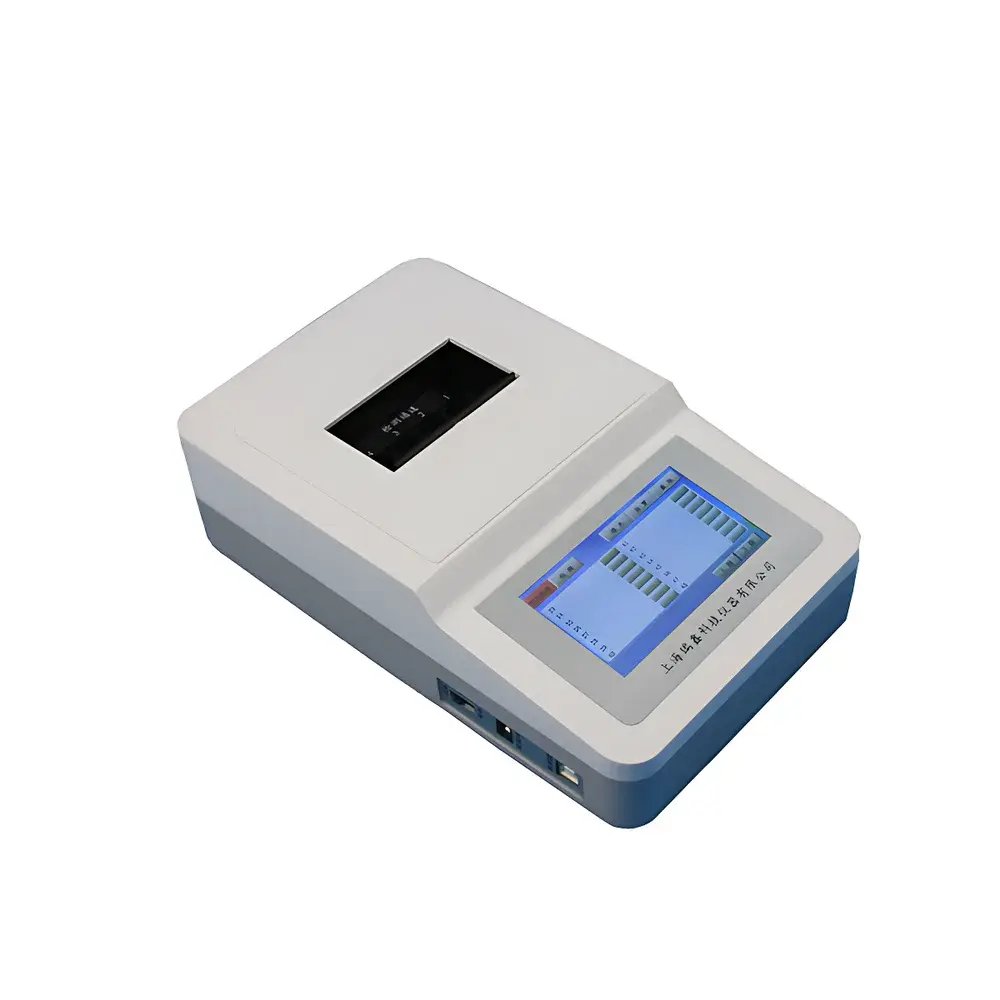
Ruixin SZ-Q2 Lead Analyzer
| Brand | Ruixin |
|---|---|
| Origin | Shanghai, China |
| Manufacturer Type | General Distributor |
| Product Origin | Domestic (China) |
| Model | SZ-Q2 |
| Price Range | USD 4,200 – 7,000 |
| Functionality | Single-analyte (lead-only) detection |
| Sample Type | Single-sample dedicated use |
| Wavelength Range | 380–630 nm |
| Detection Time | ≤ 3 minutes |
| Repeatability | ≤ 0.2% |
| Detection Channels | 1 |
Overview
The Ruixin SZ-Q2 Lead Analyzer is a portable, single-parameter spectrophotometric instrument engineered for rapid, on-site or laboratory-based quantification of lead (Pb²⁺) in aqueous matrices. It operates on the principle of visible-light absorbance spectroscopy, utilizing colorimetric reaction chemistry—typically based on dithizone or similar chromogenic reagents—to generate a measurable optical signal proportional to lead concentration. The analyzer employs a fixed-wavelength optical path within the 380–630 nm spectral window, optimized for high selectivity against common interferents (e.g., Cu²⁺, Fe³⁺, Zn²⁺) under standardized reaction conditions. Designed for field-deployable operation, it integrates a rugged aluminum alloy chassis, low-power electronics, and dual-mode power support (AC 220 V, DC 5 V, and rechargeable lithium battery), enabling uninterrupted use during mobile environmental monitoring, water utility inspections, or food processing facility audits.
Key Features
- 4.5-inch high-resolution color TFT touchscreen with full Chinese GUI—enabling intuitive navigation, real-time parameter adjustment, and direct data annotation.
- Integrated intelligent Chinese input system supporting both virtual keyboard and stylus entry—facilitating precise sample labeling, operator ID logging, and contextual note capture.
- Pre-loaded calibration curves for multiple concentration ranges (0.5–3.0 mg/L), each validated per ISO 8466-1:2021 guidelines for univariate calibration model verification.
- Embedded thermal printer delivering immediate hard-copy reports compliant with GLP documentation requirements—including date/time stamp, sample ID, measured absorbance (0.000–4.000 AU), transmittance (0.00–100.00%), calculated Pb concentration, and operator signature field.
- Onboard data storage supporting ≥1,000 test records with timestamp, channel ID, and raw optical values—accessible via scrollable history browser with search-by-sample-ID functionality.
- Dual communication interfaces (RS-232 and USB 2.0) enabling bidirectional data exchange with LIMS, centralized QA dashboards, or regulatory reporting platforms—compatible with ASTM D3559-22 data export protocols.
Sample Compatibility & Compliance
The SZ-Q2 is validated for use with clarified liquid samples including potable water, surface water, treated wastewater, and process rinse waters from food manufacturing lines. Sample preparation follows standardized digestion-free protocols per EPA Method 200.7 (for dissolved lead) or ISO 11885:2016 Annex A (colorimetric screening). While not intended for solid or turbid matrices without pretreatment, its ≤0.2% photometric repeatability and ≤0.3% baseline drift (over 3 min) meet minimum performance criteria outlined in USP for semi-quantitative heavy metal screening devices. Instrument design conforms to IEC 61010-1:2010 safety standards for portable electrical equipment used in laboratory and field environments.
Software & Data Management
Firmware supports audit-trail-enabled operation: all critical events—including calibration updates, method selection changes, and result overrides—are time-stamped and non-erasable within internal memory. Data export files (CSV format) include metadata headers aligned with FDA 21 CFR Part 11 Annex A requirements for electronic records. Optional PC software (provided separately) enables batch calibration curve validation, statistical trend analysis across sampling campaigns, and automated report generation compliant with ISO/IEC 17025:2017 clause 7.8.2 (result reporting).
Applications
- Routine surveillance of municipal drinking water distribution systems per WHO Guideline Limits (10 µg/L) and GB 5749–2022 (China National Standard).
- Pre-shipment verification of bottled water, dairy effluents, and fruit juice processing rinse waters for Pb contamination.
- Field-based compliance checks at wastewater discharge points regulated under China’s “Water Pollution Prevention and Control Action Plan” (2015).
- Quality control in ceramic glaze production facilities where lead leaching risk requires rapid lot-release testing.
- Educational use in university environmental science labs for teaching spectrophotometric quantification principles and method validation protocols.
FAQ
Is the SZ-Q2 compliant with international regulatory standards for food safety testing?
Yes—it meets foundational metrological requirements referenced in Codex Alimentarius CXG 193-1995 and supports workflows aligned with HACCP Principle 4 (critical limit monitoring) when deployed in food processing environments.
Can the instrument be recalibrated using user-prepared standards?
Yes—calibration is fully user-accessible via password-protected service mode; reference standards must be traceable to NIST SRM 1643e or equivalent certified reference materials.
What is the expected lifetime of the optical source and detector assembly?
The LED light source and silicon photodiode detector are rated for ≥50,000 measurements under typical usage conditions, with no scheduled replacement required within the first 3 years of operation.
Does the device support multi-language firmware beyond Chinese?
Current firmware is Chinese-only; English-language UI is available upon OEM request with minimum order quantity (MOQ) of 50 units.
How is measurement uncertainty estimated for reported results?
Total uncertainty is derived per GUM (JCGM 100:2008) using contributions from repeatability (≤0.2%), wavelength accuracy (±2 nm), reagent batch variability (±3.5%), and calibration curve fit residuals (R² ≥ 0.999).




