
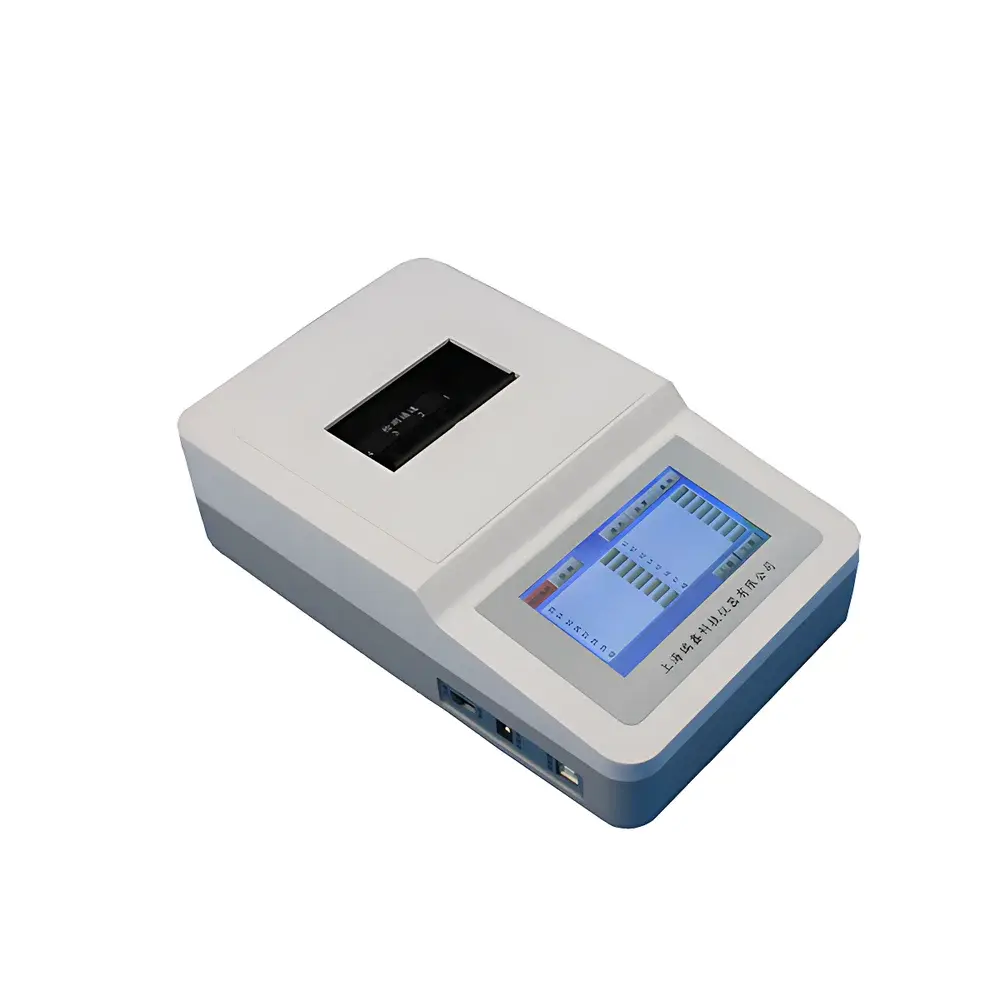
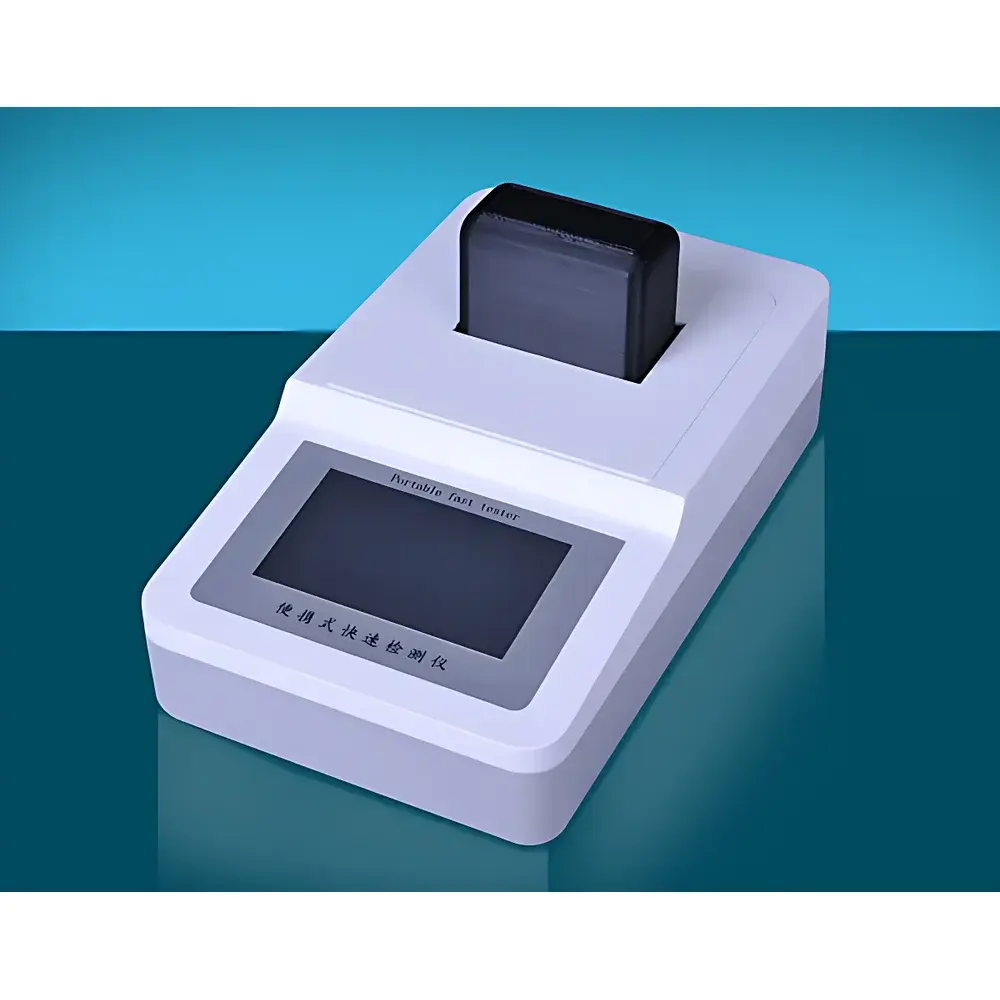
Ruixin SZ-RJ2 Portable Dissolved Oxygen Analyzer
| Brand | Ruixin |
|---|---|
| Origin | Shanghai, China |
| Manufacturer Type | Distributor |
| Country of Origin | Domestic (China) |
| Model | SZ-RJ2 |
| Price | ¥5600 |
| Display | 4.5-inch color LCD touchscreen |
| Absorbance Range | 0.000–4.000 |
| Transmittance Range | 0.00–100.00% |
| Transmittance Resolution | 0.01% |
| Absorbance Resolution | 0.001 |
| Photometric Accuracy | ±2.0% |
| Photometric Repeatability | ≤0.2% |
| Baseline Stability | ≤0.3% (3 min) |
| DO Measurement Range | 1.0–10.0 mg/L |
| Communication Interface | USB |
| Power Supply | AC 220 V / DC 5 V / Rechargeable Li-ion battery |
Overview
The Ruixin SZ-RJ2 Portable Dissolved Oxygen Analyzer is a field-deployable, optical-based water quality instrument engineered for rapid, on-site quantification of dissolved oxygen (DO) concentration in aqueous matrices. Unlike electrochemical Clark-type sensors—which require membrane replacement, electrolyte refilling, and polarization time—the SZ-RJ2 employs a stable, factory-calibrated optical sensing principle based on luminescence quenching (ruthenium-complex fluorescence lifetime detection). This method eliminates oxygen consumption during measurement, ensures zero drift over extended operation, and delivers high reproducibility without routine recalibration under standard environmental conditions. Designed for dual-use flexibility, the analyzer meets the operational demands of municipal water utilities, environmental monitoring agencies, aquaculture facilities, and academic field research teams requiring reliable DO data across diverse sample types—including potable water, surface water, seawater, wastewater effluents, and distilled water.
Key Features
- 4.5-inch high-resolution color LCD touchscreen with full Chinese GUI—enabling intuitive navigation, real-time parameter visualization, and direct on-screen data annotation.
- Integrated embedded thermal printer for immediate hard-copy generation of measurement reports, including timestamp, sample ID, DO concentration (mg/L), and instrument serial number—supporting GLP-compliant documentation workflows.
- Multi-curve calibration library preloaded into firmware, accommodating variable DO ranges and matrix-specific compensation (e.g., salinity correction for marine samples).
- Intelligent Chinese input system supporting both virtual keyboard and stylus entry—facilitating precise sample labeling and contextual field notes without external devices.
- Automated data logging with internal memory capable of storing ≥500 test records; each entry includes date/time stamp, measured value, operator ID (optional), and measurement mode flag.
- Triple power architecture: AC 220 V mains adapter, DC 5 V external supply, and built-in rechargeable lithium-ion battery (≥8 hours continuous operation)—ensuring uninterrupted use during extended field campaigns or lab bench deployment.
Sample Compatibility & Compliance
The SZ-RJ2 is validated for use with clear to moderately turbid aqueous samples conforming to ISO 5814:2012 (Water quality — Determination of dissolved oxygen — Electrochemical probe method) and ASTM D888-22 (Standard Test Methods for Dissolved Oxygen in Water), though its optical methodology inherently avoids interference from sulfide, chlorine, or heavy metal ions that commonly affect amperometric sensors. It complies with CE marking requirements for portable electrical equipment (2014/30/EU EMC Directive and 2014/35/EU LVD Directive). While not certified to FDA 21 CFR Part 11, its audit-trail-capable data storage and user-accessible calibration logs support basic GMP-aligned recordkeeping for non-regulated environmental applications.
Software & Data Management
Data export is supported via USB 2.0 interface to Windows-compatible PCs using Ruixin’s proprietary desktop utility (v3.2+), which enables batch report generation, trend graphing, CSV export, and comparative analysis across multiple sampling events. The device stores all measurements with immutable timestamps and does not permit manual editing of logged results—preserving data integrity. Firmware updates are delivered via signed binary packages verified through SHA-256 checksum validation. No cloud connectivity or remote firmware update capability is implemented, ensuring air-gapped security for sensitive field deployments.
Applications
- Regulatory compliance monitoring of DO levels in municipal drinking water distribution systems per national standards (e.g., GB/T 5750.5-2023 in China).
- Routine assessment of oxygen saturation in aquaculture ponds and hatcheries to prevent hypoxic stress in finfish and shellfish.
- Field verification of aeration efficiency in activated sludge processes at wastewater treatment plants.
- Ecological surveys of rivers, lakes, and estuaries—correlating DO profiles with temperature, pH, and biological oxygen demand (BOD) trends.
- Educational laboratory instruction in environmental science curricula, where robustness, ease of use, and visual feedback enhance student engagement with core water chemistry concepts.
FAQ
Does the SZ-RJ2 require sensor membrane replacement or electrolyte refilling?
No—its solid-state optical sensor contains no consumable membranes or liquid electrolytes, eliminating routine maintenance associated with electrochemical DO probes.
Can the instrument compensate for temperature and salinity variations during measurement?
Yes—manual input of sample temperature and salinity is supported, and internal algorithms apply standardized corrections per Winkler-derived solubility models (Weiss, 1970) and UNESCO seawater equations.
Is calibration traceable to NIST or other national metrology institutes?
Factory calibration is performed against gravimetrically prepared saturated air/water standards; however, end-user traceability requires periodic verification using certified reference materials (e.g., NIST SRM 3194) and documented two-point calibration procedures.
What is the expected service life of the optical sensor module?
Rated for ≥30,000 measurement cycles or five years of typical field use under ambient storage conditions (10–35°C, <80% RH), with no degradation in luminescence response linearity.
Does the device support Bluetooth or Wi-Fi connectivity?
No—only wired USB communication is provided to maintain electromagnetic compatibility in industrial and outdoor environments and avoid RF-related signal interference with optical detection.







