
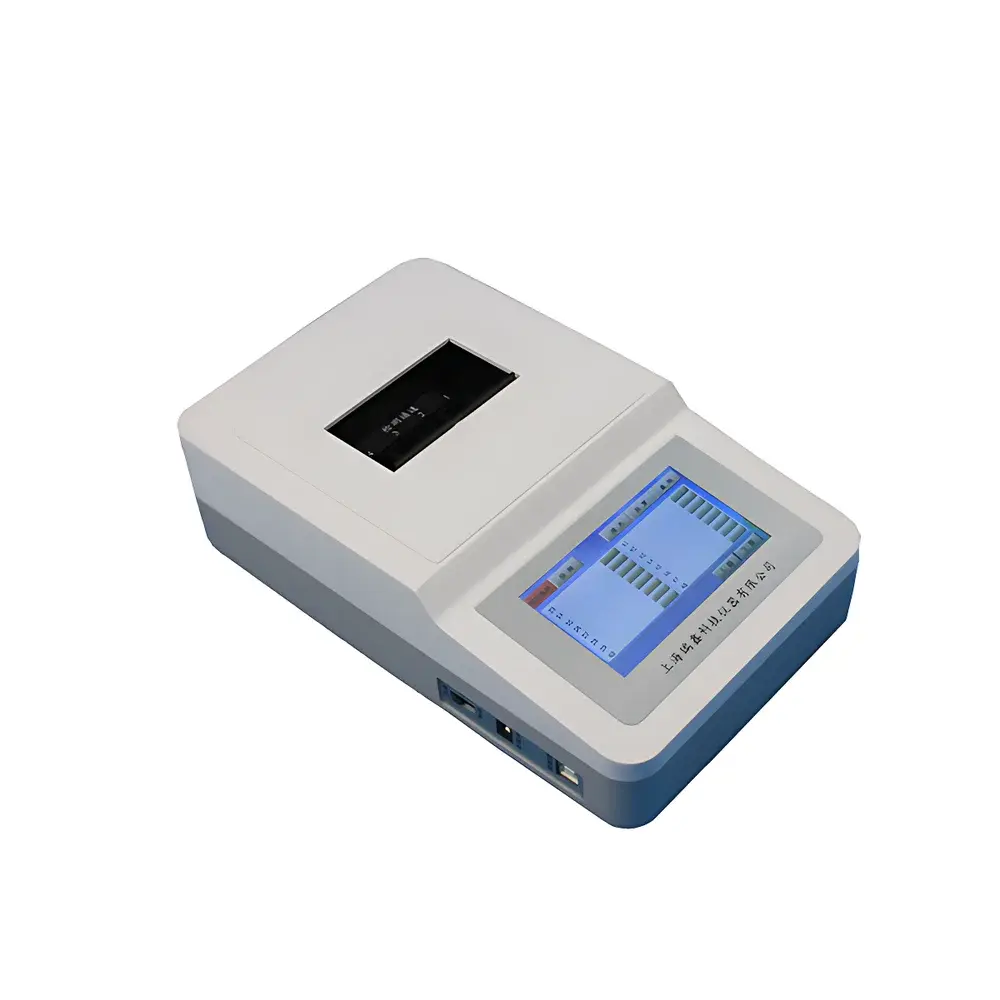
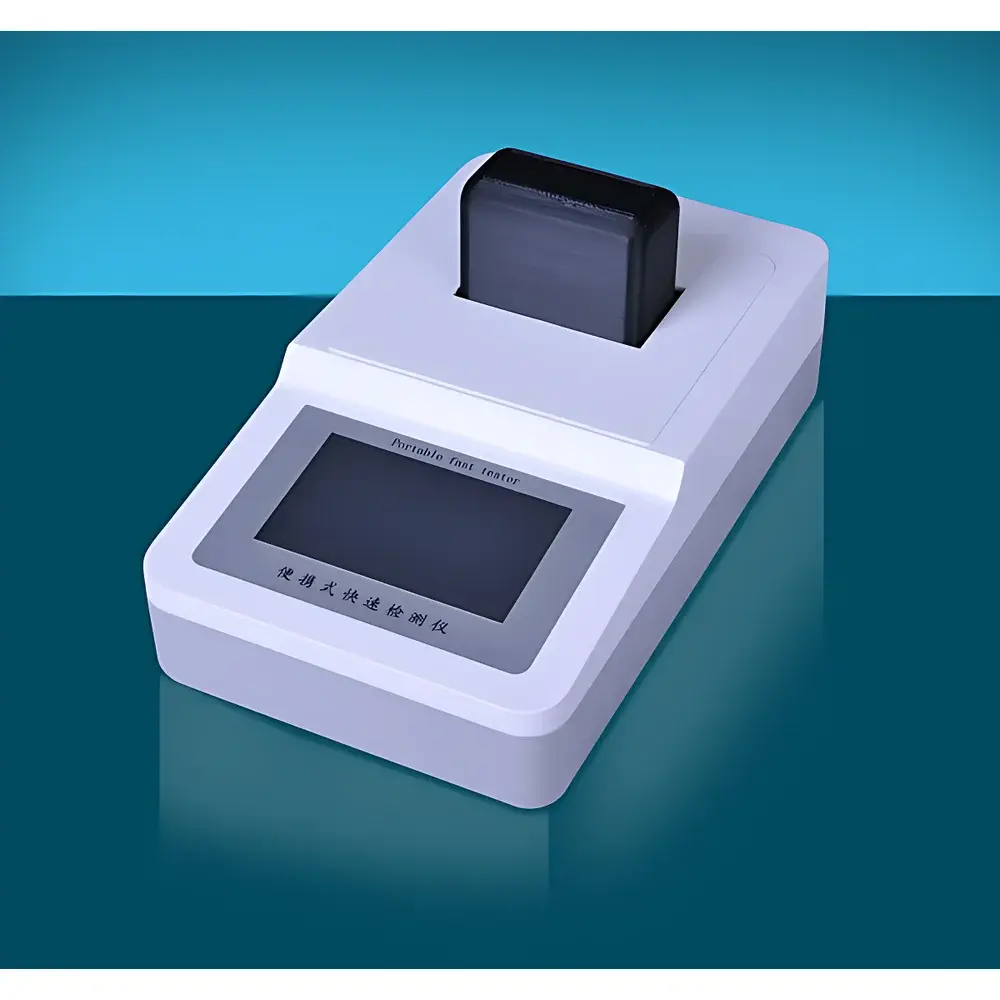
Ruixin SZ-YL2 Residual Chlorine Analyzer
| Brand | Ruixin |
|---|---|
| Origin | Shanghai, China |
| Manufacturer Type | Authorized Distributor |
| Region of Manufacture | Domestic (China) |
| Model | SZ-YL2 |
| Price | USD 495 (FOB Shanghai) |
| Functionality | Single-analyte Quantitative Detection |
| Sample Format | Single-sample Cuvette-Based Measurement |
| Wavelength Range | 380–630 nm |
| Assay Time | ≤ 180 seconds |
| Photometric Repeatability | ≤ 0.2% (at 546 nm, using neutral density filters) |
| Optical Channels | 1 fixed-wavelength photometric channel |
| Absorbance Range | 0.000–4.000 AU |
| Transmittance Range | 0.00–100.00% |
| Transmittance Resolution | 0.01% |
| Absorbance Resolution | 0.001 AU |
| Photometric Accuracy (Transmittance) | ±2.0% T |
| Baseline Stability | ≤0.3% T drift over 3 min |
| Detection Range (Residual Chlorine as Cl₂) | 0.05–5.00 mg/L |
| Communication Interfaces | RS-232, USB-B |
| Power Supply Options | AC 220 V ±10%, DC 5 V (external adapter), or internal rechargeable Li-ion battery (7.4 V, 2600 mAh) |
| Display | 4.5-inch TFT LCD capacitive touchscreen (480 × 272 pixels), full Chinese UI |
Overview
The Ruixin SZ-YL2 Residual Chlorine Analyzer is a portable, single-channel spectrophotometric instrument engineered for rapid, on-site or laboratory-based quantification of free and total residual chlorine in aqueous matrices. It operates on the principle of colorimetric analysis using the N,N-diethyl-p-phenylenediamine (DPD) method—standardized in ISO 7393-2:2018 and EPA Method 334.0—where residual chlorine oxidizes DPD to form a stable magenta-colored complex measurable at wavelengths between 510–530 nm. The device integrates a fixed-wavelength optical path within its 380–630 nm spectral window, optimized for high signal-to-noise ratio under ambient lighting conditions. Its compact aluminum chassis (195 × 105 × 65 mm, 0.82 kg) supports field deployment without compromise to optical alignment stability or thermal drift performance. Designed for routine compliance monitoring, the SZ-YL2 delivers traceable results aligned with national drinking water standards (e.g., GB 5749–2022) and international regulatory frameworks governing potable water safety.
Key Features
- 4.5-inch capacitive touchscreen interface with native Chinese language support, enabling direct annotation of sample IDs, operator names, and site metadata via on-screen keyboard or stylus input
- Embedded thermal printer (58 mm width) for immediate hard-copy generation of test reports including date/time stamp, calibration status, absorbance value, concentration result, and method identifier
- Preloaded calibration curves for residual chlorine across three concentration ranges (0.05–0.50 mg/L, 0.50–2.50 mg/L, 2.50–5.00 mg/L), each validated against NIST-traceable chlorine standard solutions
- Automated data logging with internal memory capacity for ≥2,000 test records, each timestamped and indexed by unique batch ID
- Dual-mode power architecture supporting uninterrupted operation via integrated Li-ion battery (≥8 hours continuous use) or AC/DC inputs—enabling seamless transition between mobile surveying and benchtop QA/QC workflows
- Optical system certified to meet photometric repeatability ≤0.2% and baseline stability ≤0.3% over 3 minutes, per ISO 8466-1:2021 verification protocols
Sample Compatibility & Compliance
The SZ-YL2 is validated for use with clarified liquid samples including distilled water, municipal tap water, treated surface water, and low-turbidity process water (turbidity < 5 NTU). It requires standard 10-mm square quartz or optical-grade plastic cuvettes and is compatible with commercially available DPD reagent tablets (e.g., Hach 21055–69, Palintest 100025). Instrument performance complies with ISO/IEC 17025:2017 general requirements for competence of testing and calibration laboratories. Data integrity safeguards include audit-trail-capable storage (user-initiated record deletion prohibited), and all measurement events are time-stamped with firmware-controlled real-time clock (RTC) synchronized to UTC. While not FDA 21 CFR Part 11–compliant out-of-the-box, the device supports export of CSV-formatted datasets for integration into LIMS platforms meeting GLP/GMP documentation requirements.
Software & Data Management
No proprietary PC software is required for basic operation; however, the RS-232 and USB-B interfaces enable bidirectional communication with external hosts. A vendor-provided Windows-compatible utility (v2.3+) allows bulk download of stored results, firmware updates, and user-defined curve import/export in CSV format. All exported files contain uneditable metadata fields: instrument serial number, firmware version, calibration certificate ID, and operator login hash. Internal memory retains full measurement history even during power loss due to non-volatile flash architecture. Remote monitoring capability is limited to local network polling via USB-serial bridge—no cloud connectivity or IoT functionality is implemented.
Applications
- Routine verification of disinfection efficacy at water treatment plant effluent points
- Field validation of residual chlorine levels in distribution networks and point-of-use locations
- Quality control testing in bottled water production facilities prior to packaging
- Emergency response screening during flood-related contamination incidents
- Educational laboratory instruction for environmental chemistry and public health curricula
- Regulatory sampling by municipal health departments conducting GB 5749–2022 compliance audits
FAQ
What reagents are required for residual chlorine measurement?
The SZ-YL2 requires DPD-based reagents—either tablet or powder formulations—in accordance with ISO 7393-2. Reagent compatibility is confirmed for Hach, Palintest, and Merck DPD No. 1 kits.
Is calibration verification traceable to national standards?
Yes. Each factory calibration is performed using NIST SRM 2822 (chlorine standard solution) and documented in the Certificate of Conformance shipped with the instrument.
Can the instrument store calibration curves created by the user?
No. Only pre-installed multi-range DPD curves are active; custom curve programming is disabled to ensure method fidelity and regulatory defensibility.
What is the expected service life of the internal Li-ion battery?
Rated for ≥300 charge cycles with ≥80% capacity retention when maintained per IEC 62133 guidelines; typical field use yields 2–3 years before replacement.
Does the device support automatic dilution calculation?
No. Sample dilution must be performed manually; concentration results reflect undiluted readings unless adjusted post-acquisition using the built-in arithmetic function.






