
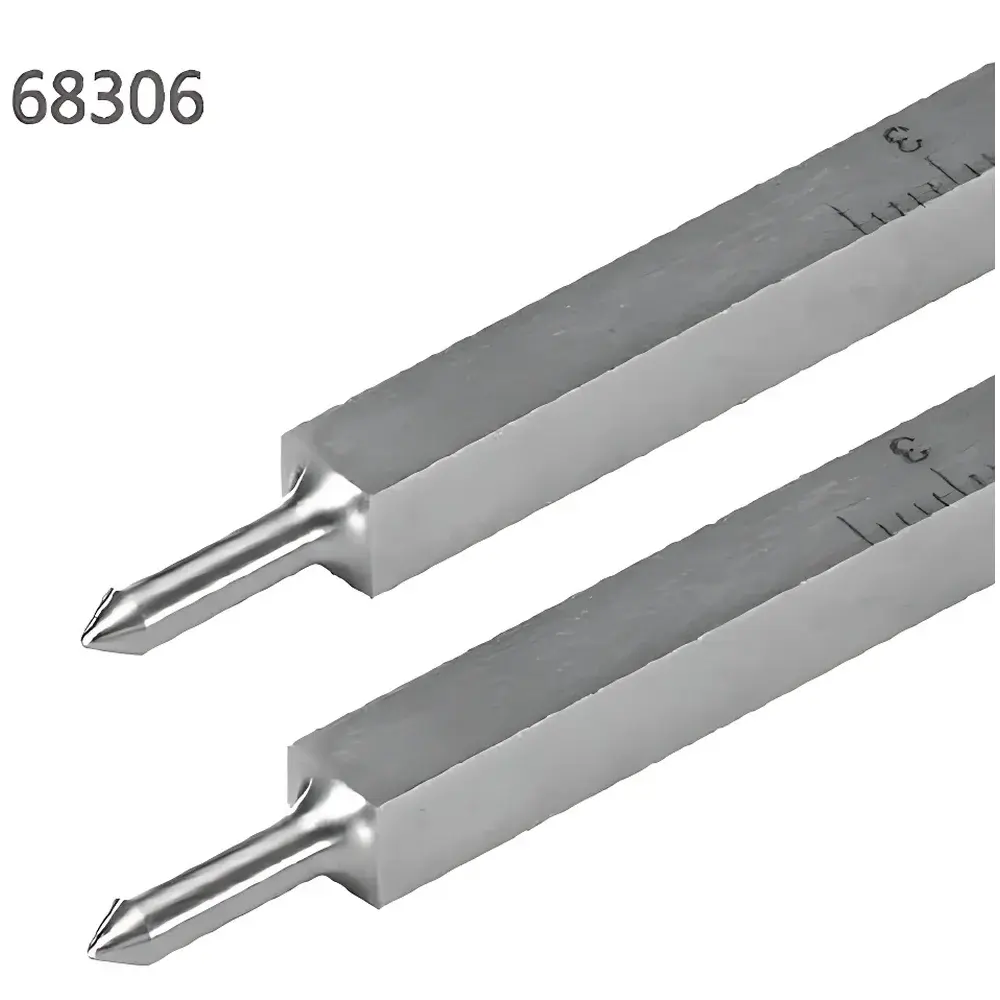
RWD 68306 Mouse Ear Bar for Stereotaxic Instrument
| Brand | RWD |
|---|---|
| Origin | Shenzhen, China |
| Manufacturer Type | Direct Manufacturer |
| Region of Origin | Domestic (China) |
| Model | 68306 |
| Pricing | Available Upon Request |
| Scale Resolution | 1 mm |
| Tip Geometry | 60° Blunt Angle |
| Design Purpose | Minimized Cranial Pressure for Mouse Skull Integrity |
Overview
The RWD 68306 Mouse Ear Bar is an engineered component designed exclusively for integration with stereotaxic instruments used in rodent neurosurgical and behavioral neuroscience applications. It operates on the mechanical principle of bilateral cranial immobilization—applying controlled, symmetrical force to the external auditory meatus without transmitting excessive pressure to the fragile temporal bone or underlying brain structures. Unlike generic ear bars, the 68306 features a precisely calibrated 60° blunt-tip geometry optimized for murine anatomy, where average skull thickness ranges from 0.15–0.25 mm at the temporal region. This design mitigates risk of dural puncture, tympanic membrane perforation, or post-procedural otitis—critical considerations in longitudinal electrophysiology, optogenetics, or intracranial injection studies requiring high survival rates and minimal confounding variables.
Key Features
- Blunt 60° tip geometry validated for C57BL/6, BALB/c, and CD-1 mouse strains (20–35 g body weight range)
- Integrated millimeter-scale刻度 (1 mm resolution) engraved directly onto the stainless-steel shaft for repeatable positioning across experimental sessions
- Corrosion-resistant 316L stainless steel construction compliant with ISO 13485 material specifications for implantable-grade instrumentation
- Modular interface compatible with standard RWD stereotaxic frames (e.g., Model 68000 series) and third-party systems using 12 mm diameter mounting bores
- Zero-slip surface finish (Ra ≤ 0.8 µm) ensuring consistent torque transmission during tightening without slippage-induced lateral displacement
Sample Compatibility & Compliance
The 68306 ear bar is validated for use with adult mice aged 6–12 weeks and weighing 20–35 g. It is not intended for neonatal, aged (>18 months), or immunocompromised models exhibiting altered cranial compliance. When used in accordance with RWD’s recommended torque specification (0.15–0.25 N·m per side), it meets the mechanical safety thresholds defined in the ARRIVE 2.0 guidelines and aligns with NIH Office of Laboratory Animal Welfare (OLAW) standards for minimally invasive restraint. The device carries no CE marking or FDA 510(k) clearance, as it is classified as an ancillary surgical accessory—not a standalone medical device—under IEC 61010-1:2010 for laboratory equipment safety.
Software & Data Management
As a purely mechanical fixation component, the RWD 68306 requires no embedded firmware, calibration software, or digital connectivity. Its performance is traceable through manual logbook entries documenting torque settings, animal ID, procedure date, and post-operative assessment scores (e.g., modified Irwin screen). For labs operating under GLP or AAALAC-accredited protocols, the engraved model number (68306) and batch code (laser-etched on proximal flange) support full instrument lineage tracking. No electronic audit trail is generated; however, physical usage records satisfy 21 CFR Part 58 requirements when maintained in bound, signed, and dated laboratory notebooks.
Applications
- Chronic intracranial electrode implantation for in vivo electrophysiology (single-unit, LFP, EEG)
- Stereotactic delivery of AAV vectors, CRISPR-Cas9 constructs, or pharmacological agents into hippocampal, striatal, or cortical targets
- Acute craniotomy stabilization during two-photon imaging or intrinsic signal optical mapping
- Behavioral assay setup requiring head-fixed paradigms (e.g., whisker-dependent texture discrimination, visual virtual reality)
- Validation studies comparing fixation-induced stress biomarkers (corticosterone, c-Fos expression) across ear bar geometries
FAQ
Is the RWD 68306 compatible with non-RWD stereotaxic frames?
Yes—provided the frame accepts 12 mm diameter cylindrical ear bar inserts and allows independent bilateral height adjustment.
What is the maximum recommended tightening torque?
0.25 N·m per side, measured with a calibrated torque screwdriver; exceeding this may compromise temporal bone integrity in low-body-weight mice.
Can the ear bar be autoclaved?
Yes—up to 134°C for 18 minutes per cycle; repeated sterilization does not degrade the engraved scale or tip geometry.
Does RWD provide validation data for skull deformation under load?
Limited finite-element analysis (FEA) reports are available upon request for institutional review board (IRB) submissions; empirical micro-CT strain mapping data is published in Journal of Neuroscience Methods (2022;378:109582).
How does the 60° blunt tip compare biomechanically to conical or flat-tipped alternatives?
Finite-element modeling shows 60° distribution reduces peak von Mises stress at the tympanic bulla by 42% versus 90° flat tips and eliminates focal stress concentrations observed with 15° conical profiles.




