
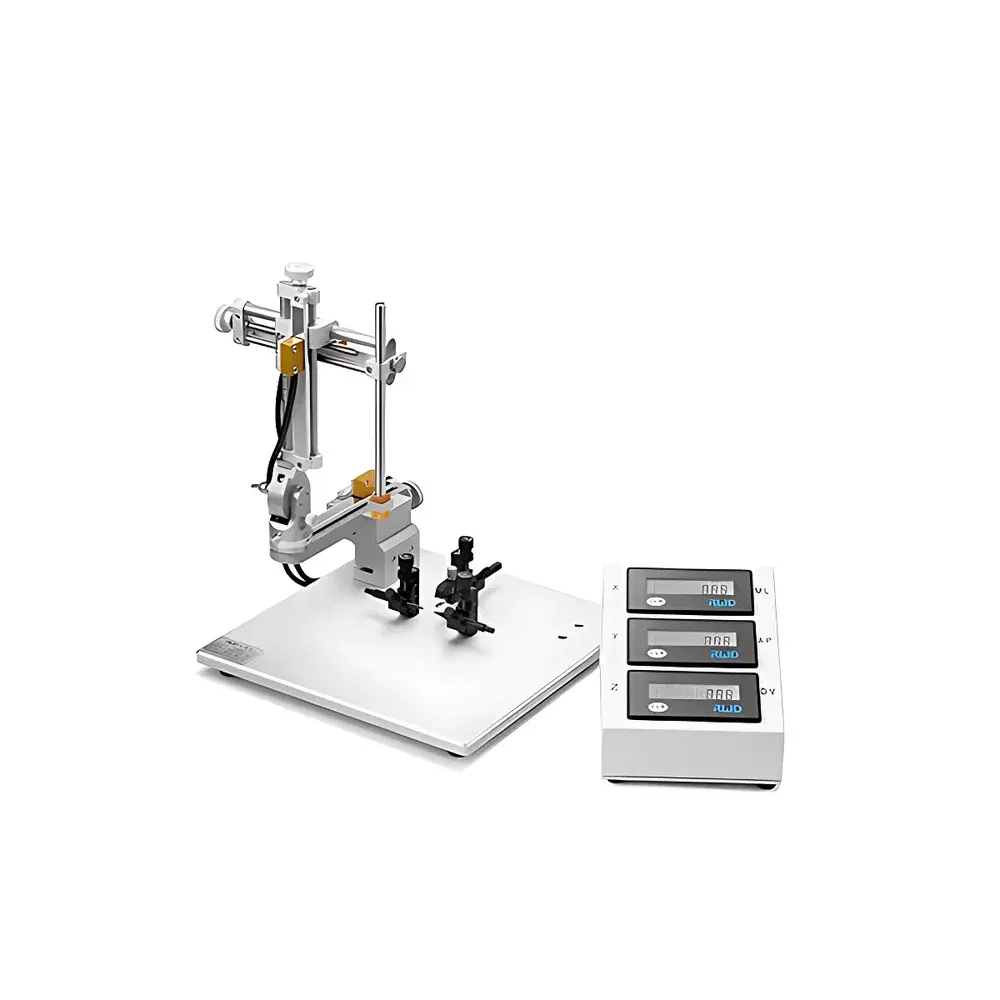
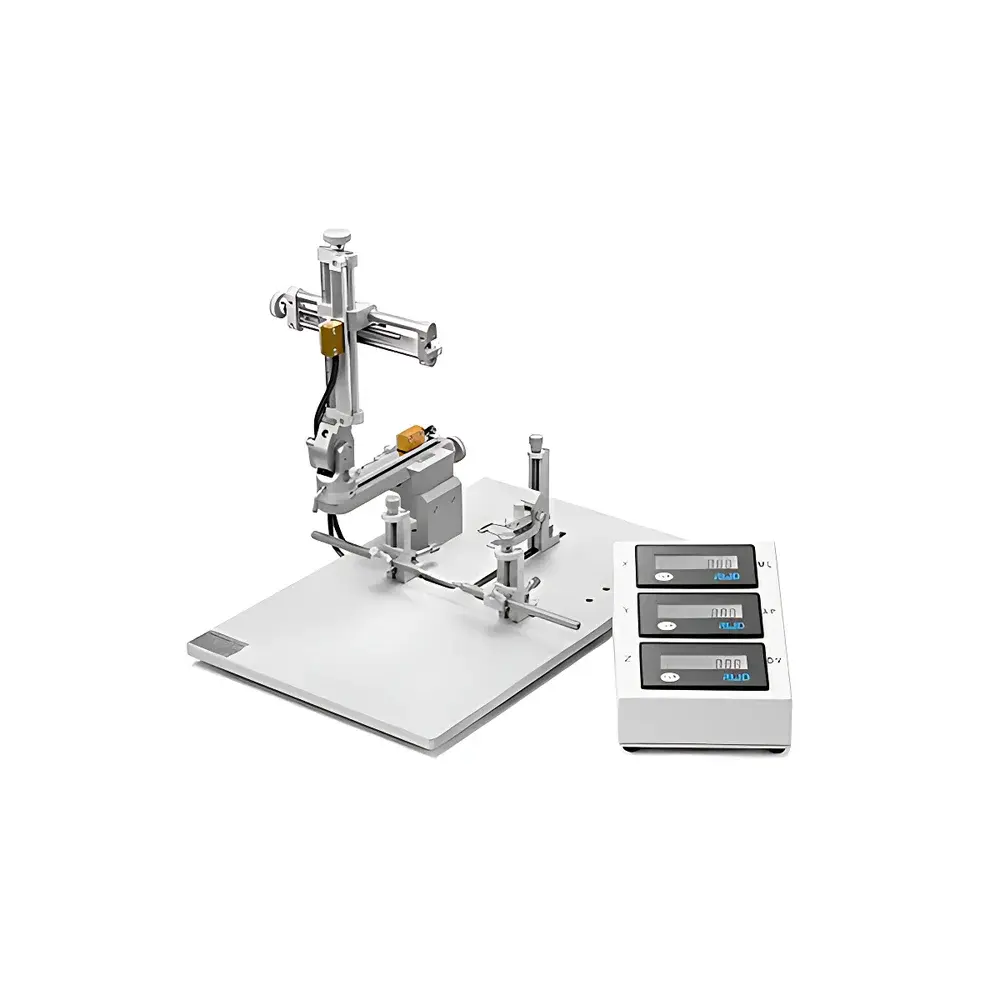
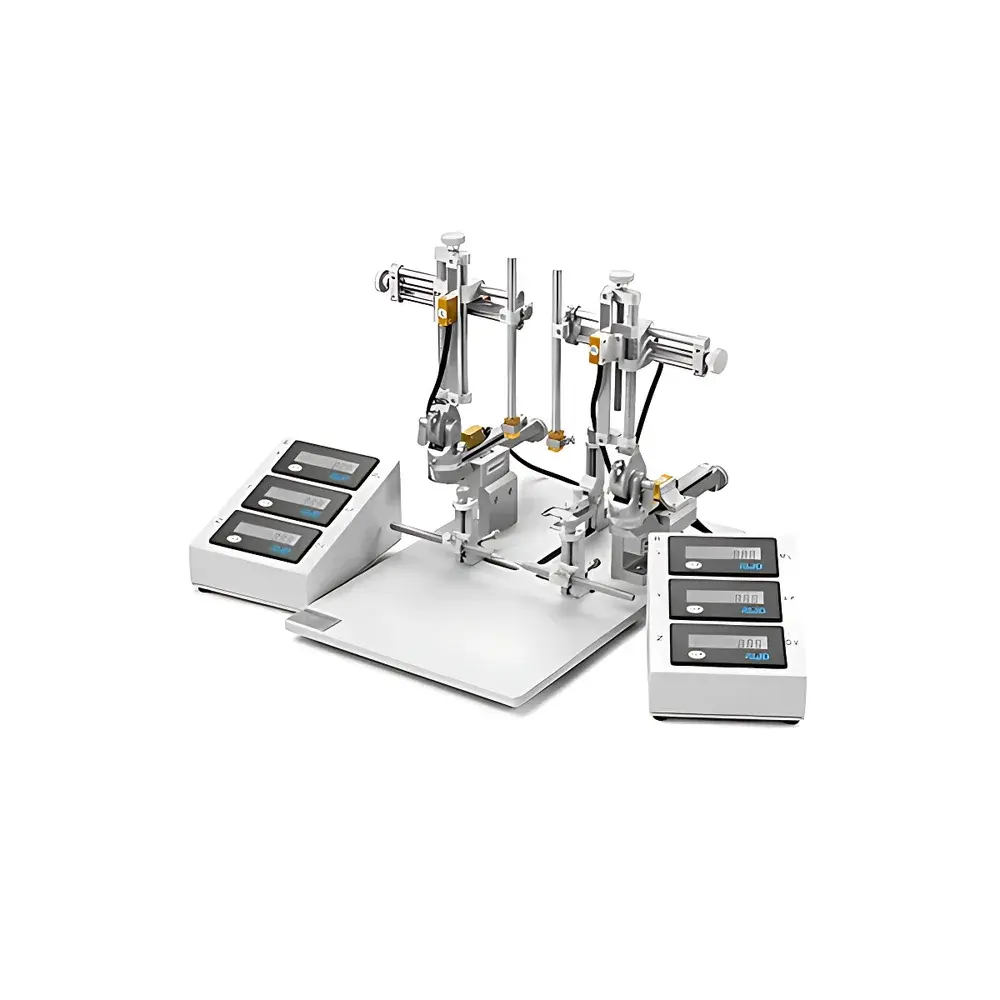
RWD 68511 Lightweight Digital Stereotaxic Instrument for Rats
| Brand | RWD |
|---|---|
| Origin | Shenzhen, China |
| Manufacturer Type | Original Equipment Manufacturer (OEM) |
| Product Category | Domestic |
| Model | 68511 |
| Pricing | Available Upon Request |
| Precision Options | 100 µm / 10 µm |
| Configuration | Lightweight, Single-Arm, Digital Readout, Rat-Specific |
| Structural Design | Open-Frame Architecture (No U-Shaped Frame) |
| Compatibility | Standard Rodent Ear Bars, Nose Clips, Microinjection Pumps, Manual/Electric Cranial Drills, Inhalational Anesthesia Systems (e.g., RWD Anesthesia Units) |
| Mounting Flexibility | Benchtop or Custom Rig Integration |
Overview
The RWD 68511 Lightweight Digital Stereotaxic Instrument is an engineered solution for precise intracranial targeting in rat neurosurgical procedures. Designed around the principles of stereotactic neuroanatomy—where brain coordinates are mapped relative to standardized bregma–lambda landmarks—the instrument employs a calibrated three-axis micromanipulator (anterior–posterior, medial–lateral, dorsal–ventral) to position surgical tools with deterministic spatial accuracy. Its open-frame architecture eliminates the obstructive U-shaped support structure common in legacy systems, significantly increasing unobstructed access to the animal’s head and facilitating ergonomic manipulation during craniotomy, electrode implantation, or cannula placement. The digital readout system provides real-time positional feedback at user-selectable resolutions of either 100 µm or 10 µm, enabling protocol-specific trade-offs between operational speed and sub-millimeter targeting fidelity. Built for compliance with GLP-aligned laboratory practices, the 68511 supports traceable setup documentation and repeatable coordinate registration across longitudinal studies.
Key Features
- Open-frame mechanical design maximizes working clearance above and around the rat’s skull—reducing hand fatigue and improving visibility during delicate dural exposure or fiber optic cannulation.
- Digital position display with dual-resolution capability (100 µm coarse adjustment / 10 µm fine adjustment) allows rapid initial positioning followed by high-fidelity final alignment without mechanical backlash.
- Rat-optimized base plate and ear bar mounting interface ensure stable cranial immobilization while accommodating natural anatomical variation across strains (e.g., Sprague-Dawley, Wistar, Long-Evans).
- Modular arm architecture supports seamless integration of third-party accessories—including syringe pumps (e.g., Harvard Apparatus PHD Ultra), microdrills (e.g., FHC M345), optogenetic fiber manipulators, and electrophysiology electrodes—via standardized 1/4″-20 threaded mounts.
- Benchtop-compatible footprint (320 × 240 × 310 mm) enables deployment in laminar flow hoods, anesthesia chambers, or dedicated stereotaxic workstations without spatial compromise.
Sample Compatibility & Compliance
The RWD 68511 is validated for use with adult rats (200–500 g body weight) under controlled physiological conditions (normothermia, normocapnia, stable anesthesia depth). It conforms to ISO 13485–aligned manufacturing controls and meets mechanical stability requirements outlined in ASTM F2947-14 (Standard Guide for Preclinical Neurological Device Testing). All metallic components are constructed from anodized aluminum and stainless steel to resist corrosion from repeated ethanol/isopropanol disinfection and inhalational anesthetic agents (isoflurane, sevoflurane). The device supports audit-ready workflows through compatibility with electronic lab notebooks (ELNs) and complies with foundational elements of FDA 21 CFR Part 11 when paired with validated data capture software.
Software & Data Management
While the 68511 operates as a standalone mechanical platform, its digital encoder outputs are compatible with optional RS-232 or USB-to-TTL interfaces for integration into custom LabVIEW, MATLAB, or Python-based acquisition environments. Positional data can be time-stamped and logged alongside physiological signals (e.g., EEG, LFP, temperature) to reconstruct procedural timelines for peer-reviewed publication or regulatory submission. Calibration certificates—including axis linearity verification (±2 µm over 25 mm travel) and zero-drift testing (<0.5 µm/h)—are provided with each unit and may be archived per institutional QA protocols.
Applications
- Intracerebral microinjection: Precise delivery of viral vectors (AAV, lentivirus), pharmacological agents, or fluorescent tracers into defined nuclei (e.g., hippocampus CA1, ventral tegmental area, basolateral amygdala) using motorized or manual syringe pumps.
- Optogenetic probe implantation: Accurate placement of ferrule-coupled optical fibers for light delivery, enabling cell-type-specific neuromodulation with minimal tissue displacement.
- Fiber photometry: Stable anchoring of GRIN lenses or multimode fibers for chronic calcium imaging (e.g., GCaMP6f/s) or neurotransmitter sensing (dLight, iGluSnFR).
- In vivo electrophysiology: Reproducible insertion of tungsten, platinum-iridium, or silicon probes into cortical layers or subcortical targets for single-unit or local field potential recording.
- Chronic cranial window surgery: Alignment of custom-designed metal or polymer headplates for two-photon microscopy or widefield imaging preparation.
FAQ
Is the RWD 68511 compatible with mouse models?
No—the 68511 is specifically engineered for rat-scale anatomy and skull dimensions. For murine applications, refer to the RWD 68513 (digital, single-arm, mouse) or 68516 (digital, dual-arm, mouse) configurations.
Does the digital readout require external power or battery replacement?
Yes—the integrated LCD display is powered via a regulated 5 V DC input; an AC adapter is included. Battery backup is not supported; continuous power is recommended during active procedures.
Can the 68511 be sterilized using autoclaving?
No—electronic components and precision gears are not autoclavable. Surface decontamination is performed using 70% ethanol, isopropyl alcohol, or approved enzymatic cleaners per IACUC guidelines.
What tolerance specifications apply to the X/Y/Z axes?
Mechanical repeatability is ±1.5 µm (3σ) over full travel range; linear scale resolution is selectable at 10 µm or 100 µm per step, with encoder interpolation ensuring sub-step positional confidence.
Is technical support available for international customers?
Yes—RWD provides remote application engineering assistance, calibration guidance, and documentation in English, with regional distributors supporting installation, validation, and preventive maintenance contracts.





