
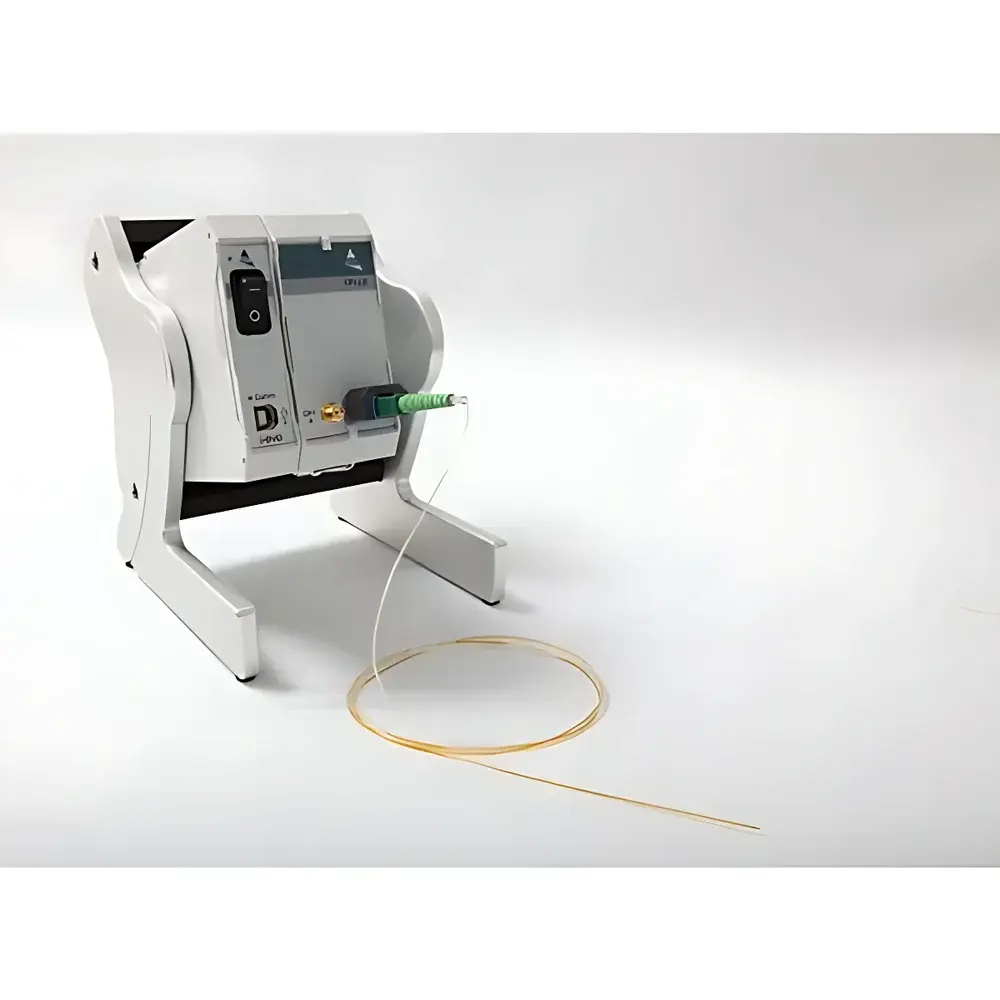
RWD FOP-LS-PT9-10 Invasive Pressure Transducer System for Small Animal Hemodynamics
| Brand | RWD |
|---|---|
| Origin | Shenzhen, China |
| Manufacturer Type | Direct Manufacturer |
| Country of Origin | China |
| Model | FOP-LS-PT9-10 |
| Pressure Range | ±300 mmHg |
| Accuracy | ±3 mmHg |
| Resolution | ±0.3 mmHg (dependent on filter settings) |
| Operating Temperature | 10–50 °C |
| Sampling Rate | Analog Output: 15,000 Hz |
| Digital Output | 5,000 Hz (configurable via Evolution software) |
| Data Output | USB 2.0 (digital, 16-bit) / 0–5 V analog |
| Catheter Size | 0.5 Fr (FOP-LS-PT9-11), 0.9 Fr (FOP-LS-PT9-10), 2 Fr (FOP-LS-2FR-10), 3 Fr (FOP-LS-3FR-10) |
| MRI Compatibility | Yes (RF- and EMI-immune) |
| Sensor Type | Non-electronic fiber-optic transducer |
| Reusability | Multiple-use catheter |
| Signal Conditioning | FPI-LS-10 single-channel optical signal conditioner |
| Data Acquisition | Compatible with iWorx IX-4041 4-channel system & LabScribe2 software |
| Optional Module | LS-30BP blood pressure analysis add-on |
Overview
The RWD FOP-LS-PT9-10 is a high-fidelity, fiber-optic-based invasive pressure monitoring system engineered for precise, real-time hemodynamic measurements in preclinical rodent and small animal models. Unlike conventional solid-state or piezoresistive transducers, this system employs extrinsic Fabry–Pérot interferometric (EFPI) sensing technology embedded within an all-dielectric, non-electronic catheter. This architecture eliminates electromagnetic interference (EMI), enables safe operation inside MRI bores (1.5T–7T), and ensures galvanic isolation—critical for longitudinal studies requiring repeated instrumentation in genetically modified mice or rats. The system delivers calibrated pressure data across a broad dynamic range (±300 mmHg), with traceable accuracy of ±3 mmHg and sub-millimeter resolution (±0.3 mmHg under standard low-pass filtering). Its clinical-grade metrology supports rigorous experimental protocols aligned with NIH, AAALAC, and ISO 10993 biocompatibility frameworks.
Key Features
- Fiber-optic EFPI sensor with zero electrical components in the catheter lumen—eliminates grounding artifacts, RF heating, and capacitive coupling during electrophysiology or MRI-integrated experiments.
- Ultra-miniaturized catheter profiles: 0.5 Fr (FOP-LS-PT9-11), 0.9 Fr (FOP-LS-PT9-10), 2 Fr, and 3 Fr variants enable targeted cannulation of femoral artery, left ventricle, bladder, intracranial space, intraocular chamber, and gastrointestinal tract.
- Front-face pressure sensing geometry—minimizes hydrostatic error and directional dependence compared to side-port configurations, improving reproducibility in pulsatile waveform acquisition.
- Reusable catheters validated for ≥5 sterilization cycles (ethylene oxide or low-temperature plasma); compatible with standard heparinized saline flush protocols.
- Modular signal conditioning architecture: FPI-LS-10 optical conditioner supports single-channel deployment; scalable via EVO-SD-2 (dual-channel) or EVO-SD-5 (five-channel) mounting frames for multi-site pressure mapping.
- Dual-mode output: 16-bit digital USB 2.0 stream (5 kHz max) synchronized with 0–5 V analog output (15 kHz bandwidth) for integration into existing DAQ ecosystems including National Instruments, ADInstruments, and iWorx platforms.
Sample Compatibility & Compliance
The FOP-LS-PT9-10 system is validated for use in Sprague-Dawley and Wistar rats, C57BL/6 and BALB/c mice, New Zealand White rabbits, guinea pigs, cats, and dogs up to 10 kg. All catheters meet ISO 10993-1 biological safety requirements for short-term (<24 h) and extended-duration (>72 h) implantation. The optical fiber assembly complies with IEC 60601-1 third edition for medical electrical equipment safety and carries CE marking per Directive 2017/745 (MDR). MRI compatibility has been verified per ASTM F2503-22 for passive implant safety in static magnetic fields up to 7 Tesla and gradient slew rates ≤200 T/m/s.
Software & Data Management
The system natively interfaces with iWorx LabScribe2 v8.x (Windows 10/11), supporting time-synchronized acquisition from up to four pressure channels plus auxiliary analog inputs (ECG, respiration, temperature). Raw pressure waveforms are stored in binary .ixd format with embedded metadata (calibration date, catheter ID, operator ID, animal ID). The optional LS-30BP module provides automated systolic/diastolic/mean arterial pressure (MAP) computation, pulse pressure derivation, dP/dtmax/min estimation, and beat-to-beat variability metrics compliant with AHA/ACC hypertension research guidelines. Audit trails, electronic signatures, and export to CSV, MATLAB (.mat), and HDF5 formats satisfy FDA 21 CFR Part 11 and GLP/GMP documentation requirements.
Applications
- Cardiovascular pharmacology: acute drug response profiling (e.g., vasodilators, β-blockers) with beat-by-beat MAP and LV dP/dt kinetics.
- Neurovascular coupling studies: simultaneous intracranial pressure (ICP) and cortical perfusion pressure monitoring during ischemia-reperfusion models.
- Urodynamic assessment: cystometrography in diabetic nephropathy or spinal cord injury models using 0.9 Fr or 2 Fr catheters.
- Respiratory mechanics: intra-tracheal or pleural pressure recording during ventilator-induced lung injury (VILI) protocols.
- MRI-guided interventions: real-time arterial pressure feedback during functional MRI (fMRI) or diffusion tensor imaging (DTI) acquisitions in awake or anesthetized rodents.
- Longitudinal phenotyping: repeated femoral artery cannulation in transgenic lines without signal drift or sensor degradation over 14-day study windows.
FAQ
Is the FOP-LS-PT9-10 catheter suitable for chronic implantation beyond 72 hours?
Yes—when used with appropriate aseptic technique and externalized port fixation, the 0.5 Fr and 0.9 Fr catheters support up to 14 days of continuous monitoring in rats and mice, as documented in peer-reviewed publications (e.g., Am J Physiol Heart Circ Physiol, 2022).
Can the system be calibrated in-house?
Yes—RWD provides NIST-traceable calibration certificates and a two-point (0 mmHg/760 mmHg) manual calibration workflow via LabScribe2; annual recalibration is recommended.
Does the optical signal conditioner require external power or cooling?
No—the FPI-LS-10 operates on 12 V DC input and generates negligible heat; no active cooling or rack-mounting is required.
How is data synchronization achieved when combining pressure with ECG or laser Doppler flowmetry?
Hardware-level TTL trigger inputs on the IX-4041 DAQ ensure sub-millisecond alignment between pressure waveforms and auxiliary physiological signals.
Are replacement catheters supplied sterile?
All catheters ship non-sterile; end-users must perform terminal sterilization via ethylene oxide (EtO) or hydrogen peroxide plasma—validated protocols are included in the IFU.




