
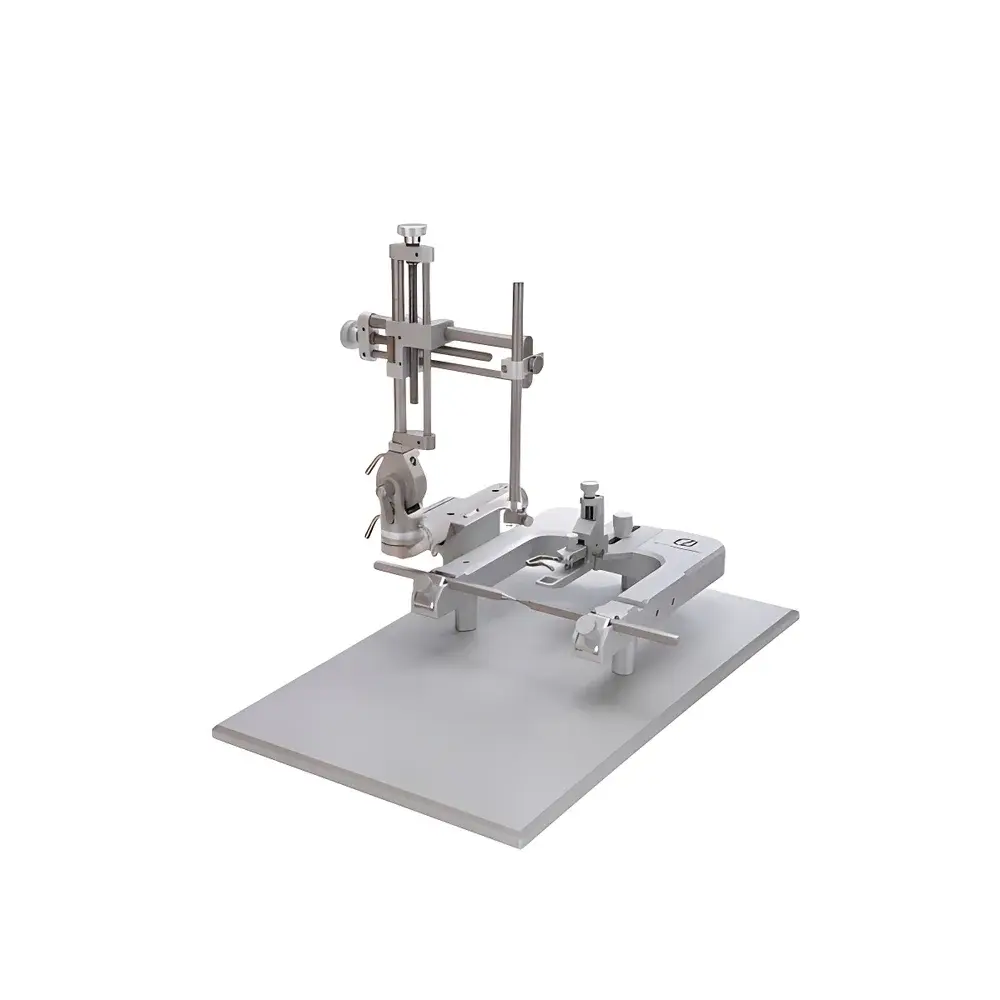
RWD Standard Stereotaxic Instrument
| Origin | Beijing, China |
|---|---|
| Manufacturer Type | Authorized Distributor |
| Origin Category | Domestic (PRC) |
| Model | RWD Standard Stereotaxic Instrument |
| Price Range | USD 7,000 – 14,000 |
| Frame Design | U-shaped rigid cast aluminum architecture |
| Motion Axes | X/Y/Z with 80 mm travel per axis |
| Positioning Resolution | 100 µm (micrometer-scale vernier scale) |
| Rotation Capability | 360° horizontal azimuthal rotation, 180° vertical elevation adjustment with mechanical locking |
| Scale Marking | Laser-etched dual-scale graduations (mm and 0.1 mm) |
| Drive Mechanism | Dual-lead precision brass-on-steel micrometer screws |
| Surface Treatment | Anodized aluminum frame and base plate for wear resistance and autoclave-compatible cleanability |
| Animal Adapter | Curved craniomandibular contour design for rat skull conformity |
| Ear Bar Fixation | Dual-side compression plate locking system |
| Compatibility | Integrated mounting interfaces for microinjection pumps (e.g., RWD KDS200 series), stereomicroscopes (Leica MZ10F, Olympus SZX16), and cranial drill systems (RWD 60000 series) |
Overview
The RWD Standard Stereotaxic Instrument is a mechanically precise, manually operated neurosurgical positioning platform engineered for reproducible intracranial targeting in rodent models. Based on the classical stereotaxic coordinate system—defined by bregma and lambda landmarks—the instrument employs a rigid U-shaped aluminum frame architecture to minimize mechanical drift during extended procedures. Its core functionality relies on orthogonal three-axis translation (X, Y, Z) combined with independent horizontal (azimuthal) and vertical (elevation) rotational degrees of freedom, enabling accurate placement of electrodes, cannulae, or injection needles relative to standardized brain atlases such as Paxinos & Watson. Designed for consistent use in academic neuroscience laboratories, preclinical pharmacology units, and contract research organizations (CROs), this instrument meets foundational requirements for GLP-aligned surgical workflows without electronic dependency.
Key Features
- Rigid U-shaped frame constructed from high-density anodized aluminum alloy, providing structural stability under repeated loading and minimizing thermal expansion-induced positional error.
- Three orthogonal micrometer-driven axes (X/Y/Z), each offering 80 mm linear travel with 100 µm resolution via dual-scale laser-etched vernier calibrations—ensuring traceable manual positioning without digital interpolation.
- Full 360° azimuthal rotation about the vertical axis and ±90° elevation tilt (180° total range), both equipped with knurled locking levers for immediate position fixation during craniotomy or probe insertion.
- Dual-lead brass-on-steel micrometer screws deliver smooth, backlash-free motion and enhanced torque transmission across all translational axes.
- Rat-specific adapter featuring anatomically contoured craniomandibular support surfaces, optimized to reduce pressure necrosis and improve head immobilization fidelity during prolonged stereotaxic sessions.
- Compression-plate ear bar clamping mechanism enables rapid, symmetrical fixation without tool-assisted tightening—critical for maintaining interaural alignment consistency across subjects.
- Modular mounting interface standardizes integration with third-party peripherals including motorized microinjectors, stereo zoom imaging systems, and high-speed cranial drilling units.
Sample Compatibility & Compliance
The RWD Standard Stereotaxic Instrument is validated for use with Sprague-Dawley and Wistar rats (200–500 g body weight) using the included 18° angled ear bars and adjustable bite bar assembly. Adapter interchangeability supports future expansion to mouse (via optional mouse adapter kit) and guinea pig configurations. All metallic components comply with ISO 13485–aligned surface finish specifications and withstand repeated cleaning with 70% ethanol, isopropyl alcohol, or low-concentration sodium hypochlorite solutions. The instrument’s mechanical design conforms to IEC 61000-6-2 electromagnetic immunity standards (as a non-electronic device) and satisfies foundational safety criteria outlined in ISO 14155:2020 for non-invasive animal research apparatus.
Software & Data Management
As a fully manual, non-digital positioning system, the RWD Standard Stereotaxic Instrument does not incorporate embedded firmware, onboard memory, or network connectivity. Consequently, it requires no software installation, driver configuration, or cybersecurity validation. All positional data—including coordinate entries, angular settings, and depth measurements—are recorded externally in laboratory notebooks or electronic lab notebooks (ELNs) compliant with 21 CFR Part 11 audit trail requirements. When paired with compatible microinjection pumps or imaging systems that do possess digital interfaces, the stereotaxic frame functions as a passive mechanical reference platform—ensuring full traceability of spatial parameters within integrated experimental metadata workflows.
Applications
- Precise intracerebral injection of viral vectors (AAV, lentivirus), neurotoxins (6-OHDA, ibotenic acid), or pharmacological agents into discrete nuclei including hippocampus, striatum, ventral tegmental area, and prefrontal cortex.
- Chronic electrode implantation for in vivo electrophysiology (single-unit recording, LFP, EEG) requiring sub-millimeter target accuracy and long-term mechanical stability.
- Stereotactic lesioning studies employing thermocoagulation or electrolytic ablation protocols.
- Cranioplasty and cortical window preparation for two-photon microscopy or intrinsic signal optical imaging.
- Training platform for graduate students and technicians in fundamental neurosurgical technique development prior to transitioning to motorized or image-guided systems.
FAQ
Is this instrument compatible with MRI or CT-guided procedures?
No—it is a purely mechanical, non-imaging-integrated platform. For image-guided stereotaxy, users must pair it with external navigation software and fiducial-based registration workflows.
Can the instrument be sterilized in an autoclave?
The aluminum frame and base plate are autoclavable at 121°C for 20 minutes; however, polymer components (e.g., rubber grips, plastic adapters) must be removed prior to sterilization.
What is the maximum recommended animal weight capacity?
The standard rat adapter supports animals up to 500 g; exceeding this mass may compromise head stabilization integrity and increase risk of lateral slippage during manipulation.
Does RWD provide calibration certification or metrological documentation?
Yes—each unit ships with a factory-verified mechanical calibration report referencing NIST-traceable gauge blocks and optical comparator verification at three axial endpoints.
Are replacement parts available for long-term maintenance?
All critical components—including micrometer screws, ear bars, adapters, and locking levers—are stocked and supplied with serial-number-matched replacement kits under RWD’s 24-month limited warranty.




