
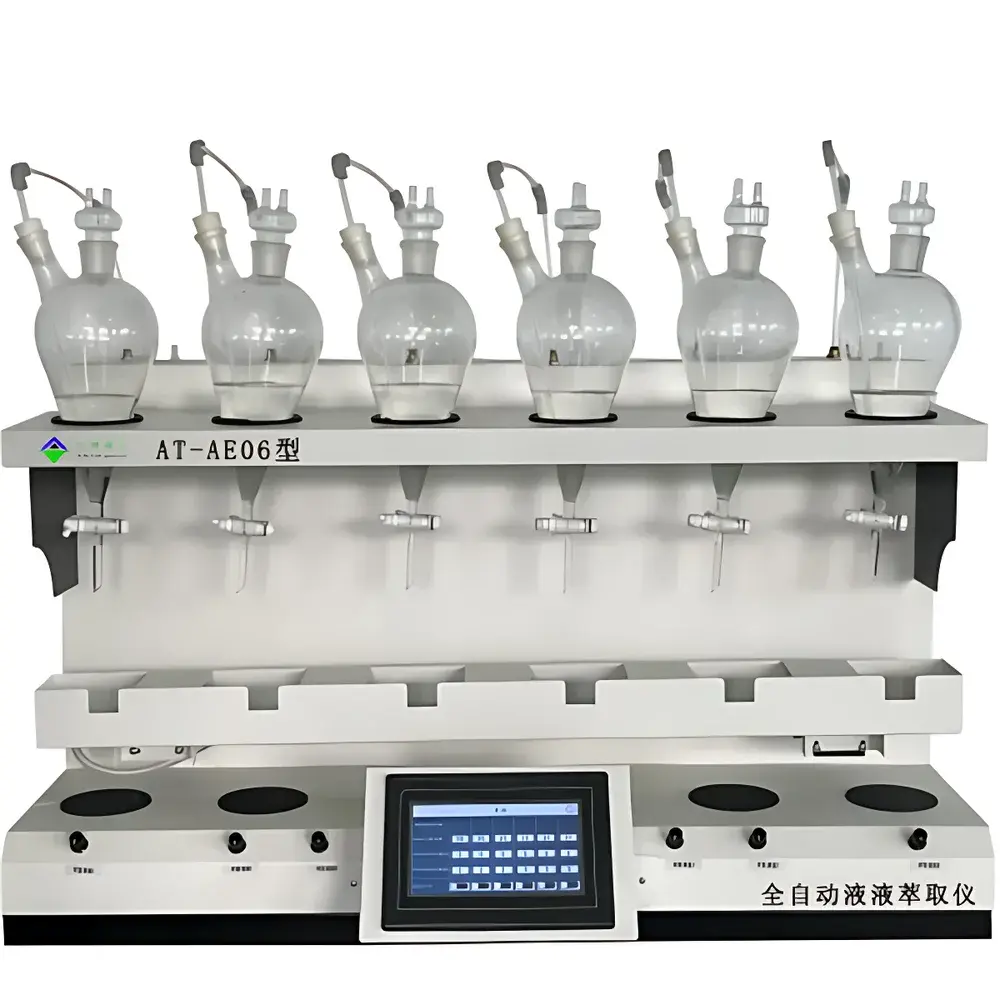
Safe AT-AE06 Automatic Liquid-Liquid Extractor
| Brand | Safe |
|---|---|
| Origin | Beijing, China |
| Manufacturer Type | OEM Manufacturer |
| Country of Origin | China |
| Model | AT-AE06 |
| Price Range | USD 1,400 – 4,200 |
| Extraction Efficiency | 0–100% |
| Extraction Time | 0–999 s |
| Oscillation Method | Sealed, Clean Air Internal Circulation Agitation |
| Simultaneous Extraction Positions | 6 |
Overview
The Safe AT-AE06 Automatic Liquid-Liquid Extractor is an engineered solution for standardized, high-reproducibility liquid-liquid extraction (LLE) in environmental and regulatory compliance laboratories. It operates on a sealed, clean-air internal circulation agitation principle—eliminating open-air exposure while ensuring consistent phase dispersion and interfacial mass transfer between immiscible solvents. Unlike traditional manual or semi-automated shakers, the AT-AE06 integrates bidirectional gas-liquid mixing dynamics to enhance emulsion formation and partitioning kinetics—critical for trace analyte recovery in aqueous matrices. Designed specifically for pre-treatment workflows in water quality analysis, it supports method-defined extraction protocols required by major Chinese environmental standards (e.g., HJ and GB series), and its architecture aligns with internationally recognized principles of Good Laboratory Practice (GLP) for sample preparation traceability.
Key Features
- 6-position independent extraction station with fully programmable operation per channel—enabling parallel processing of heterogeneous sample sets without cross-contamination.
- 7-inch capacitive touchscreen interface supporting intuitive parameter entry: extraction time (0–999 s), rest interval, cycle count, and agitation intensity—all adjustable per vial.
- Sealed pneumatic agitation system using PTFE-coated solenoid valves and corrosion-resistant air pathways; eliminates solvent vapor leakage and operator exposure.
- Integrated clean-air recirculation module with built-in activated carbon filtration—maintains >99.5% hydrocarbon and volatile organic compound (VOC) removal from exhaust streams.
- Automated end-to-end workflow: auto-addition of extractant, timed oscillation, pressure-relief venting, phase separation via gravity settling, upper/lower layer collection, waste discharge, and internal rinse cycles using deionized water or solvent.
- Modular bottle compatibility: accepts standard borosilicate glass extraction vessels (250 mL, 500 mL, and 1000 mL) with secure clamping and leak-proof sealing.
- Retractable waste tray with integrated vacuum-assisted filtration—enables hands-free effluent handling and reduces manual intervention during batch runs.
- Optional remote monitoring via mobile application with SMS alerting for cycle completion, error conditions (e.g., pressure anomaly, lid open), and maintenance reminders.
Sample Compatibility & Compliance
The AT-AE06 is validated for use in accredited environmental testing laboratories performing analyses per national standard methods including GB 7494–87 (anionic surfactants), HJ 503–2009 (phenols), GB/T 16488–1996 and HJ 637–2018 (petroleum hydrocarbons by IR spectroscopy), and HJ 970–2018 (petroleum hydrocarbons by UV spectroscopy). Its closed-system design meets ISO/IEC 17025:2017 requirements for minimizing external contamination and improving inter-laboratory reproducibility. All fluid-contact materials—including PTFE valve bodies, silicone gaskets, and stainless-steel chassis—are chemically inert to common LLE solvents (e.g., chloroform, n-hexane, dichloromethane) and certified non-leaching per USP Class VI biocompatibility guidelines.
Software & Data Management
The embedded control firmware logs all operational parameters—including timestamped start/stop events, agitation profiles, pressure readings, and cycle completion status—in a tamper-evident binary log file. Exportable CSV reports support integration into LIMS environments. While not inherently 21 CFR Part 11 compliant out-of-the-box, the system supports optional audit-trail add-ons with user authentication, electronic signatures, and data integrity validation—enabling alignment with GLP/GMP documentation requirements for regulated environmental testing.
Applications
- Pre-concentration of trace organic pollutants (e.g., PAHs, PCBs, phenolic compounds) from surface water, wastewater, and drinking water prior to GC-MS or HPLC analysis.
- Routine extraction of petroleum hydrocarbons for regulatory reporting under China’s Ministry of Ecology and Environment (MEE) directives.
- High-throughput preparation of calibration standards and QC samples requiring precise solvent-to-aqueous-phase ratios.
- Method development studies evaluating extraction efficiency across varying pH, ionic strength, and solvent selection—leveraging independent parameter control per position.
- Support for EPA Method 3510C (separatory funnel extraction) equivalents where automation, repeatability, and reduced analyst variability are prioritized.
FAQ
What types of extraction solvents are compatible with the AT-AE06?
Chloroform, n-hexane, dichloromethane, ethyl acetate, and diethyl ether are routinely used; all fluidic components are rated for compatibility with these reagents per ASTM D543-20 standards.
Does the system require external compressed air or vacuum sources?
No—the AT-AE06 includes an integrated oil-free diaphragm pump and recirculating air manifold; only standard AC power (220 V, 50 Hz) is required.
Can extraction parameters be saved as reusable methods?
Yes—up to 50 user-defined method templates can be stored locally and recalled via touchscreen or remote interface.
Is the device suitable for volatile or low-boiling-point analytes?
Yes—its sealed agitation chamber and controlled venting sequence minimize analyte loss; recommended for compounds with boiling points above 40 °C.
What maintenance intervals are recommended for routine operation?
PTFE valves and seals should be inspected every 500 cycles; activated carbon filters require replacement every 6 months under continuous use; full system calibration verification is advised annually.



