
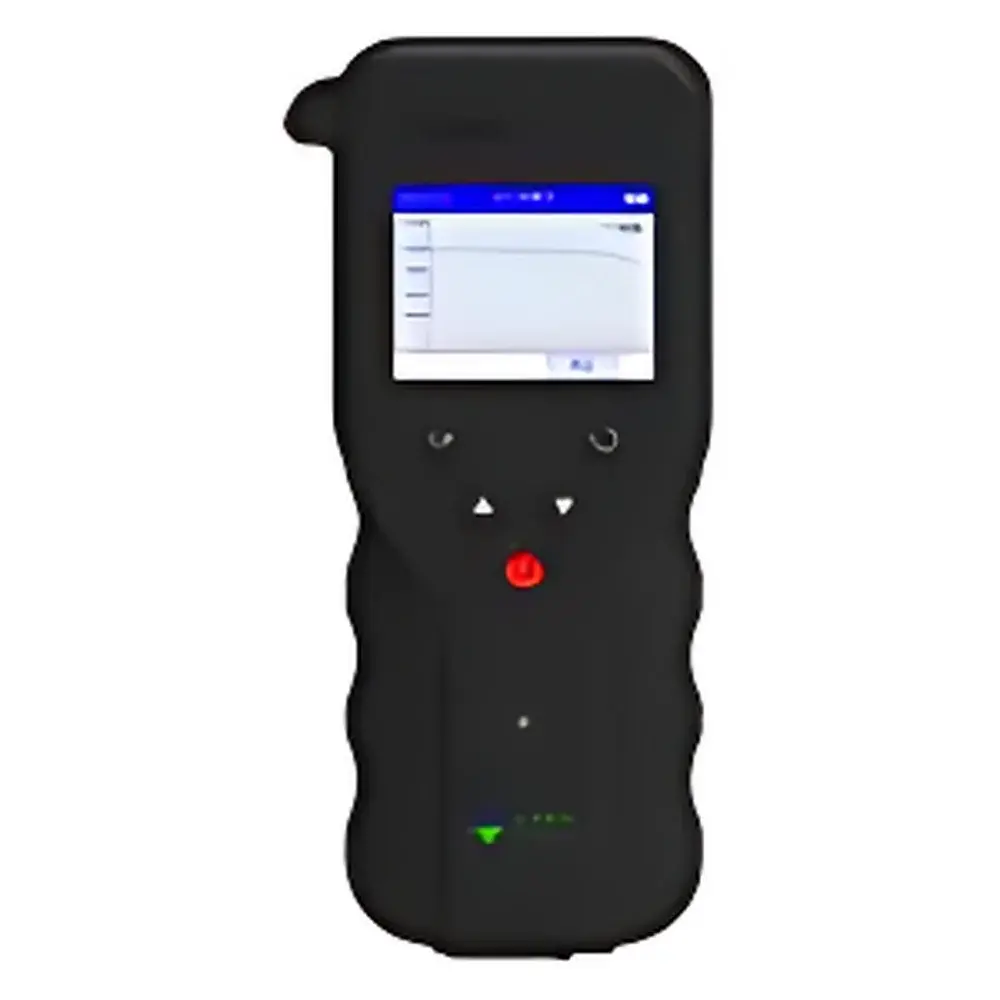
Safe AT-DX100 Handheld Water Toxicity Analyzer Using Bioluminescent Bacteria
| Brand | Safe |
|---|---|
| Origin | Beijing, China |
| Manufacturer Type | Direct Manufacturer |
| Country of Origin | China |
| Model | AT-DX100 |
| Instrument Type | Portable |
| Biological Agent | *Aliivibrio fischeri* (formerly *Vibrio fischeri*) bioluminescent bacteria |
| Operating Temperature Range | 0–70 °C |
| Reagent Storage & Usage Temperature | 0–55 °C |
| Coefficient of Variation (CV) | ≤5% |
| Batch Capacity | 1–10 samples per run |
| Detection Time | ≤5 minutes |
Overview
The Safe AT-DX100 Handheld Water Toxicity Analyzer is a field-deployable, bioluminescence-based instrument engineered for rapid, on-site assessment of acute aquatic toxicity in water samples. It implements the standardized luminescent bacterial inhibition assay—principally utilizing freeze-dried or lyophilized cultures of *Aliivibrio fischeri*, a marine Gram-negative bacterium that emits stable blue-green light (peak emission 450–490 nm) during normal respiratory metabolism. Upon exposure to toxicants—including heavy metals (e.g., Cu²⁺, Hg²⁺, Cd²⁺), organophosphates, carbamates, chlorinated hydrocarbons, quaternary ammonium compounds, and industrial surfactants—the electron transport chain is disrupted, resulting in quantifiable reduction of bioluminescence intensity. The degree of inhibition correlates linearly with toxicant concentration within defined dynamic ranges, enabling semi-quantitative toxicity classification (e.g., non-toxic, low, medium, high toxicity). This biological endpoint complements conventional physicochemical analysis by reflecting integrated bioavailability and synergistic/antagonistic effects of complex pollutant mixtures—making it especially valuable for emergency response, source tracking, and treatment efficacy verification.
Key Features
- Integrated dual-optical-path detection system: Simultaneous measurement of sample and control luminescence enables real-time kinetic profiling of inhibition onset, peak response, and recovery—supporting mechanistic interpretation beyond endpoint-only assays.
- Extended field operation: Built-in rechargeable lithium-ion battery supports >20 hours of standby time and ≥8 hours of continuous testing under ambient conditions (25 °C).
- Ergonomic handheld design: Compact footprint (≤180 × 85 × 45 mm), weight <450 g, IP65-rated enclosure for dust/water resistance during outdoor deployment.
- Intuitive localized interface: High-contrast monochrome LCD with Chinese-language menu navigation; no external PC required for basic operation or result export.
- Pre-qualified bioreagent system: Factory-calibrated lyophilized *A. fischeri* vials with documented viability (>90% luminescence retention after 12 months at 4 °C); lot-specific performance certificates provided.
- Onboard data handling: Internal memory stores ≥500 test records with timestamp, sample ID, inhibition %, and kinetic curve metadata; USB-C port for CSV export.
Sample Compatibility & Compliance
The AT-DX100 accepts raw, filtered (0.45 µm), or centrifuged aqueous matrices including surface water, groundwater, wastewater influent/effluent, drinking water, leachate, and industrial process streams. Turbidity up to 100 NTU and residual chlorine ≤0.5 mg/L are tolerated without pretreatment. Method validation aligns with ISO 11348-3:2018 (*Water quality — Determination of the inhibitory effect of water samples on the light emission of *Vibrio fischeri* (luminescent bacteria test) — Part 3: Method using freeze-dried bacteria*) and GB/T 15441–1995 (*Water Quality — Acute Toxicity Test Using Luminescent Bacteria*). Instrument design supports GLP-aligned workflows: user-accessible audit trail (operator ID, calibration log, reagent lot tracking), password-protected settings, and manual override logging. While not FDA 21 CFR Part 11-certified out-of-box, data export formats comply with laboratory LIMS ingestion requirements.
Software & Data Management
No proprietary desktop software is required for routine use. However, optional SafeTox Connect desktop application (Windows/macOS) enables advanced visualization: overlay of multiple kinetic curves, inhibition rate constant (kobs) calculation via exponential decay fitting, and batch statistical reporting (mean ± SD, CV%, confidence intervals). All exported CSV files include ISO-compliant metadata headers (ISO/IEC 17025 traceability fields), facilitating integration into ELN systems or regulatory submissions. Firmware updates are delivered via signed binary packages with SHA-256 checksum verification.
Applications
- Emergency response screening: Rapid triage of contamination events (e.g., chemical spills, pipeline breaches) by municipal environmental bureaus, MEE-affiliated monitoring stations, and provincial CDCs.
- Drinking water safety assurance: On-site verification of disinfection byproduct formation potential and post-treatment residual toxicity at intake, filtration, and distribution points.
- Wastewater treatment optimization: Real-time monitoring of influent toxicity spikes affecting biological reactor stability; effluent compliance checks prior to discharge.
- Landfill and remediation site management: Leachate toxicity profiling across containment zones and temporal monitoring of plume migration.
- Academic and training use: Undergraduate environmental toxicology labs, method validation studies, and inter-laboratory comparison exercises.
FAQ
What biological indicator organism does the AT-DX100 use?
It employs cryopreserved *Aliivibrio fischeri* (ATCC 49387 or equivalent strain), validated for consistent light output and sensitivity to priority pollutants per ISO 11348-3.
Can the instrument quantify specific contaminants like lead or atrazine?
No—it measures integrated acute toxicity, not compound-specific concentrations. Positive results require follow-up with targeted chemical analysis (e.g., ICP-MS, GC-MS) for identification and quantification.
Is sample filtration mandatory before testing?
Filtration through a 0.45 µm membrane is recommended for turbid or particulate-rich samples to prevent optical interference and bacterial entrapment—but not strictly required for clear waters.
How is instrument calibration verified?
Daily procedural blanks (dilution water) and positive controls (e.g., 1.0 mg/L ZnSO₄ solution) are measured to confirm baseline luminescence stability and inhibition response reproducibility; calibration certificates accompany each reagent lot.
Does the device support multi-language firmware beyond Chinese?
English-language firmware is available upon request for international distribution; other languages (Spanish, Portuguese, Arabic) may be commissioned with minimum order volume.
Related Products







