
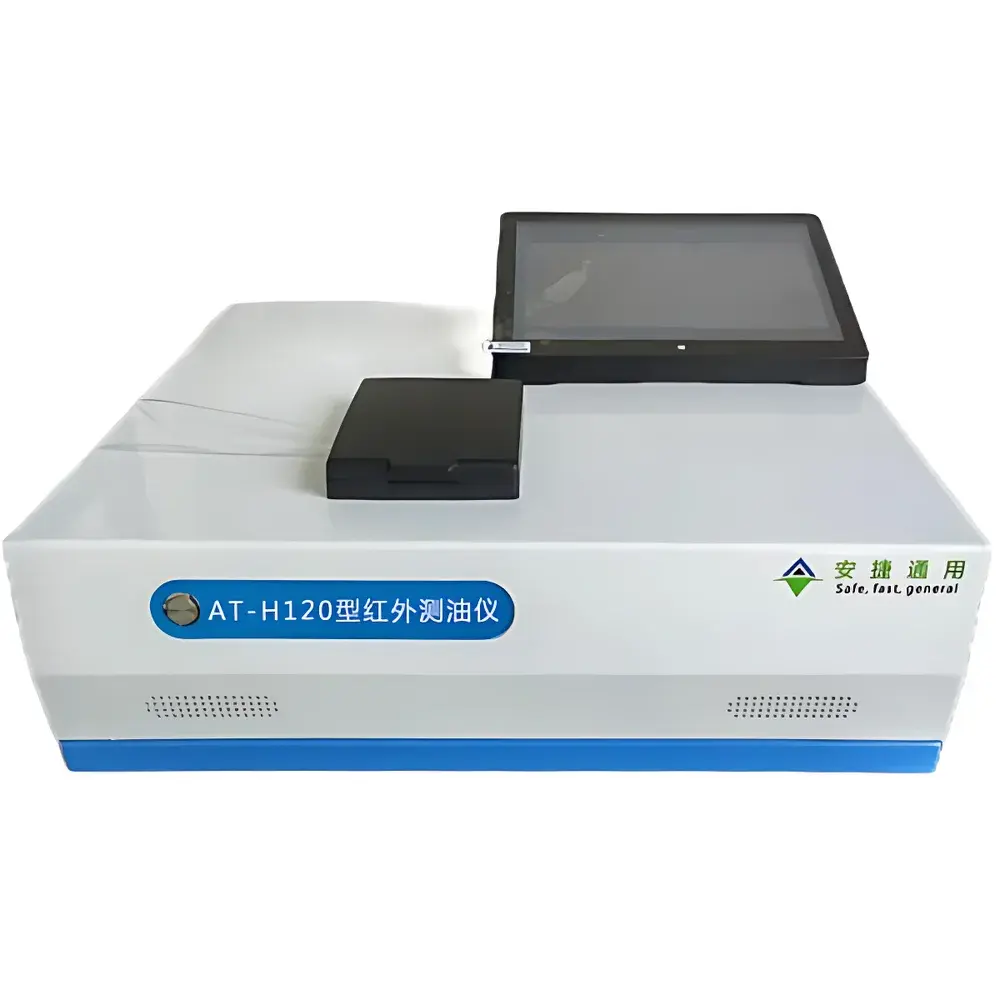
Safe AT-H120 Infrared Oil Content Analyzer for Water, Soil & Exhaust Gas Analysis
| Brand | Safe |
|---|---|
| Origin | Beijing, China |
| Manufacturer Type | Direct Manufacturer |
| Instrument Type | Laboratory Benchtop Analyzer |
| Principle | Infrared Spectrophotometry (Fourier-transform-free, Dispersive NIR with Fixed-Wavelength Detection at 2930, 2960, and 3030 cm⁻¹) |
| Measurement Range | 0.002–64,000 mg/L |
| Detection Limit | < 0.04 mg/L |
| Accuracy | ±2% (relative error, certified reference materials) |
| Resolution | 0.002 mg/L |
| Analysis Cycle Time | 30 seconds per sample (including extraction solvent introduction, cell filling, and spectral acquisition) |
Overview
The Safe AT-H120 Infrared Oil Content Analyzer is a dedicated benchtop instrument engineered for quantitative determination of total oil, petroleum hydrocarbons, and animal/vegetable oils in environmental matrices—specifically water, soil, and fixed-source exhaust gas (fume and mist). It operates on the principle of non-dispersive infrared (NDIR) spectrophotometry at three fixed wavenumbers: 2930 cm⁻¹ (aliphatic CH₂ stretch), 2960 cm⁻¹ (aliphatic CH₃ stretch), and 3030 cm⁻¹ (aromatic C–H stretch). These spectral bands enable selective quantification via the dual-absorbance correction algorithm defined in HJ 637–2018, permitting independent calculation of total oil, petroleum hydrocarbons (after silica-magnesium adsorption), and biogenic oil content (as the difference). The system is fully compliant with Chinese national environmental standards—including HJ 637–2018 (water), HJ 1051–2019 (soil), and HJ 1077–2019 (exhaust)—and meets metrological requirements under JJG 950–2012. Its optical architecture integrates a stable switch-mode infrared source, thermally monitored detection chamber, and sealed flow path to minimize drift and moisture interference during solvent-based analysis.
Key Features
- Optically isolated design: Independent optical and electronic modules reduce electromagnetic and thermal crosstalk, enhancing long-term baseline stability.
- Real-time zero-point auto-correction: Eliminates manual zeroing and full-scale calibration; compensates for solvent background drift during sequential analysis.
- Dual quantification modes: Users may select either pre-loaded calibration curves or user-defined correction coefficient input (per HJ 637–2018 equations) for traceability and method flexibility.
- Integrated 14-inch industrial-grade touchscreen PC: Embedded Linux OS with local data storage (≥10,000 records), USB export, and optional network connectivity for LIMS integration.
- Modular mechanical platform: Designed for seamless upgrade to 12-position automated sampling systems with continuous-loop solvent handling and phase separation modules.
- Thermally stabilized measurement cell: Maintains consistent optical path conditions across ambient temperatures from 10–35°C, critical for reproducible absorbance readings in chlorinated solvent environments.
Sample Compatibility & Compliance
The AT-H120 supports analysis of aqueous samples (pH ≤2, extracted with tetrachloroethylene), soil leachates (per HJ 1051–2019 solid-phase extraction protocol), and condensed fume/mist condensates (per HJ 1077–2019 impinger collection). All procedures adhere strictly to the spectral subtraction methodology outlined in HJ 637–2018. The instrument’s hardware and firmware are validated against JJG 950–2012 metrological verification criteria, including linearity, repeatability (RSD ≤1.8% at 10 mg/L), and limit-of-detection performance. While not FDA 21 CFR Part 11–certified out-of-the-box, its audit trail functionality (timestamped results, operator ID, method version, and raw absorbance logs) supports GLP-compliant laboratory workflows when deployed with documented SOPs and access-controlled user accounts.
Software & Data Management
The embedded software provides full method configuration, calibration management (up to 10 multi-point curves), and real-time spectral preview. Each analysis generates a structured report containing A2930, A2960, A3030, calculated concentrations (total oil, petroleum hydrocarbons, and animal/vegetable oil), and uncertainty estimates based on calibration residuals. Data files conform to CSV and XML formats for third-party statistical analysis or regulatory submission. Audit logs record all parameter changes, calibration events, and result exports with immutable timestamps. Optional remote diagnostics and firmware updates are supported via secure HTTPS channel.
Applications
- Wastewater treatment plants: Routine monitoring of effluent oil content prior to discharge (compliant with GB 8978–1996 Class I/II limits).
- Environmental monitoring stations: Field-deployable lab analysis of surface water, groundwater, and sediment pore water for petroleum contamination screening.
- Industrial stack testing: Quantification of油烟 (cooking fume) and oil mist emissions from metalworking, food processing, and chemical manufacturing facilities.
- Soil remediation projects: Pre- and post-treatment assessment of petroleum hydrocarbon load in excavated soils (TPH analysis per HJ 1051–2019).
- Research laboratories: Method development for alternative solvents (e.g., cyclohexane substitution studies) and inter-laboratory comparison programs.
FAQ
Does the AT-H120 require external extraction equipment?
Yes—the instrument measures only the infrared absorbance of prepared extracts. Sample extraction (e.g., liquid–liquid extraction with tetrachloroethylene) and post-extraction steps (dehydration, silica-magnesium purification) must be performed manually or using compatible auxiliary systems.
Is the instrument compatible with non-tetrachloroethylene solvents?
It can accommodate alternative IR-transparent solvents (e.g., cyclohexane, FC-40) provided their spectral interference at 2930/2960/3030 cm⁻¹ is characterized and correction coefficients are revalidated per HJ 637–2018 Annex B.
Can raw spectral data be exported for independent processing?
Yes—absorbance values at all three wavenumbers, along with baseline-corrected transmittance profiles, are stored in each result file and accessible via USB or network export.
What maintenance is required for long-term optical stability?
Annual verification of source intensity and detector responsivity is recommended; optical windows should be cleaned quarterly with spectroscopic-grade methanol to prevent residue buildup from solvent vapor condensation.
Is method validation documentation provided?
A comprehensive validation package—including accuracy, precision, LOD/LOQ, linearity, and robustness test reports aligned with ISO/IEC 17025 principles—is available upon request for laboratory accreditation purposes.
Related Products







