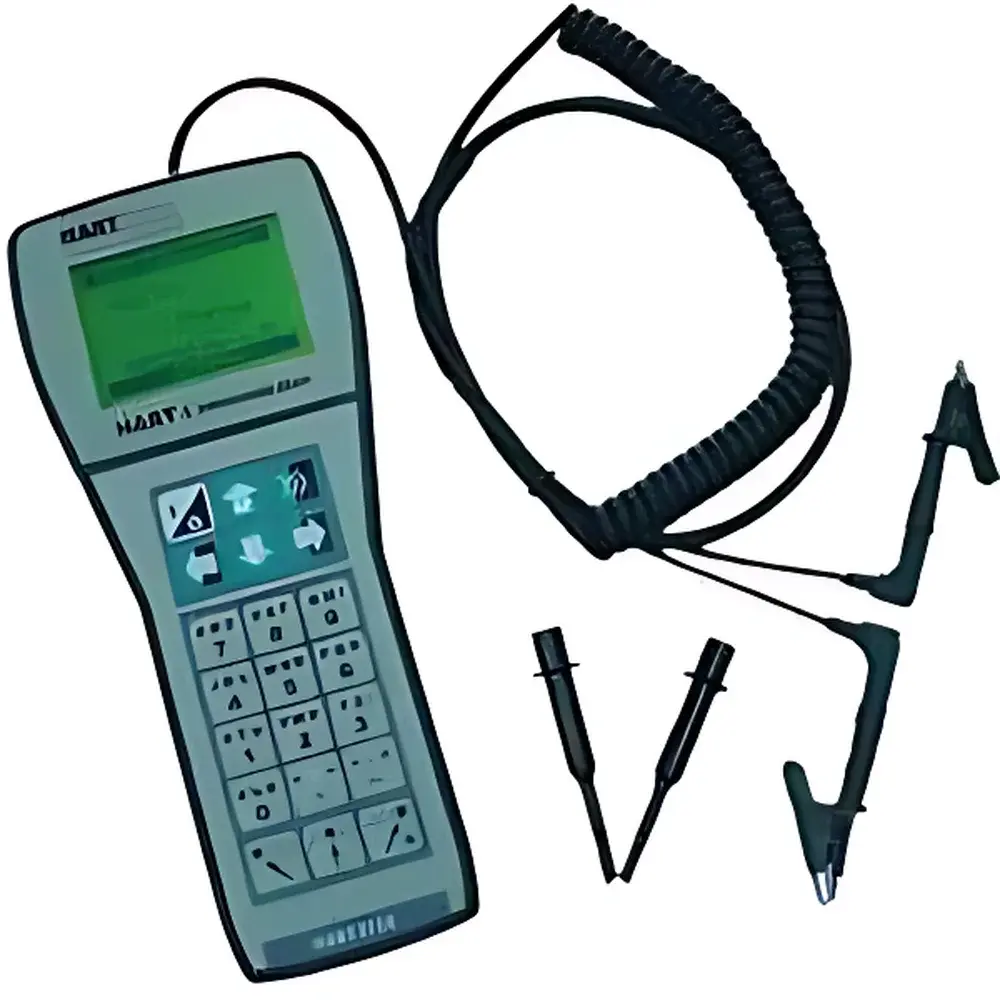
Safe HART375 Handheld Communicator
| Brand | Safe |
|---|---|
| Origin | Beijing, China |
| Manufacturer Type | Manufacturer |
| Regional Classification | Domestic (China) |
| Model | HART375 |
| Instrument Type | HART Protocol Field Communicator |
| Calibration Target | HART-enabled Pressure Transmitters, Temperature Transmitters, Flow Meters |
| Design | Integrated Handheld Unit |
| Application Environment | Industrial Plant Floors, Control Rooms, Field Maintenance Zones |
| Communication Modes | Point-to-Point, Multi-Drop (4–20 mA Loop), HART Primary Master Emulation |
| Supported Devices | All HART Revision 5–7 compliant field instruments |
| Power Source | Internal Rechargeable Li-ion Battery (Typical Runtime: >12 h continuous operation) |
| Loop Interface | Built-in 250 Ω precision resistor, loop-powered operation |
| Display | 3.5" TFT LCD (320 × 240 pixels), sunlight-readable with adjustable backlight |
| Environmental Rating | IP65 (Dust-tight, water-jet resistant) |
| Operating Temperature | –10 °C to +50 °C |
| Compliance | IEC 61000-4-2 (ESD), IEC 61000-4-3 (Radiated Immunity), ATEX/IECEx Zone 2 / Class I Div 2 (Optional Certified Variant Available) |
Overview
The Safe HART375 Handheld Communicator is an industrial-grade, integrated field service tool engineered for reliable configuration, diagnostics, and maintenance of HART® Protocol–compliant instrumentation. Based on the HART Communication Foundation’s physical layer specifications (Bell 202 FSK modulation over 4–20 mA analog current loops), the HART375 operates as a primary master device—enabling bidirectional digital communication without disrupting the analog signal integrity. It is designed specifically for use in process automation environments where pressure transmitters, temperature sensors, flow meters, and other smart field devices require commissioning, parameter re-ranging, firmware verification, or real-time health assessment. Its robust architecture supports all HART revisions from 5 through 7, ensuring backward compatibility with legacy installations while maintaining full interoperability with modern multi-variable and wireless HART devices.
Key Features
- Integrated 250 Ω precision shunt resistor enabling seamless loop connection—no external components required for standard 4–20 mA HART communication.
- Full HART primary master functionality, supporting both point-to-point and multi-drop (up to 15 devices) topologies per loop.
- Sunlight-readable 3.5-inch TFT display with configurable brightness and contrast—optimized for visibility in harsh plant lighting conditions.
- Built-in diagnostic suite including loop current measurement (0.000–24.000 mA, ±0.015% of reading), voltage monitoring (0–30 V DC), and device status reporting (e.g., “Out of Spec”, “Sensor Fault”, “Configuration Changed”).
- On-device parameter editing: set zero/span, adjust damping, configure linear/square-root output, assign device tags, and modify process variables units.
- Rechargeable lithium-ion battery with intelligent power management—supports >12 hours of continuous operation and includes low-battery warning and graceful shutdown.
- IP65-rated enclosure with reinforced polycarbonate housing, meeting mechanical shock and vibration requirements per IEC 60068-2-6 and IEC 60068-2-27.
Sample Compatibility & Compliance
The HART375 communicates exclusively with devices conforming to the HART Communication Protocol specification (HCF-certified). It has been validated against major manufacturer families—including Emerson Rosemount, Endress+Hauser, Yokogawa, Siemens Desigo, and ABB—across pressure, temperature, level, and flow categories. The device complies with electromagnetic compatibility standards IEC 61000-4-2 (ESD immunity up to ±8 kV contact), IEC 61000-4-3 (radiated RF immunity at 10 V/m, 80 MHz–2 GHz), and IEC 61000-4-4 (electrical fast transient/burst immunity). Optional explosion-proof variants are available with ATEX II 3G Ex nA IIC T4 Gc and IECEx nA IIC T4 Gc certifications for safe deployment in Zone 2 hazardous areas. Software configuration files adhere to ISA-84.00.01 (IEC 61511) documentation traceability requirements.
Software & Data Management
The HART375 includes embedded firmware supporting offline configuration storage (up to 100 device profiles), change-log history with timestamped entries, and exportable ASCII-based diagnostic reports via micro-USB interface. While it does not require PC connectivity for core operations, optional SafeLink™ Desktop Utility (Windows-compatible) enables bulk profile migration, firmware updates, and audit-ready PDF report generation. All configuration changes are logged locally with operator ID fields (manually entered), supporting GLP/GMP-aligned recordkeeping. Data export conforms to NIST-traceable metadata conventions, including UTC timestamps, loop current values at time of read, and HART variable identifiers per HART Universal Command Set.
Applications
- Field calibration verification of pressure transmitters prior to and after hydrostatic testing or sensor replacement.
- Routine loop integrity checks—including mA output verification, sensor zero drift detection, and diagnostics flag review—during preventive maintenance cycles.
- Commissioning support for new HART-enabled devices, including tag assignment, range setting, and unit conversion (e.g., psi → bar, °C → °F).
- Troubleshooting intermittent faults in distributed control systems by isolating device-specific error codes (e.g., “Overrange”, “RTD Open”, “Transmitter Memory Error”).
- Supporting ISO/IEC 17025-accredited calibration laboratories in documenting HART-specific configuration steps within calibration certificates.
- Integration into plant-wide asset management strategies aligned with ISA-95 and ISA-101 human-machine interface standards.
FAQ
Does the HART375 support WirelessHART devices?
No—the HART375 is designed exclusively for wired 4–20 mA HART communication. WirelessHART requires gateway-level infrastructure and is outside its operational scope.
Can it perform automatic calibration adjustment using external pressure standards?
No—it is a communication and configuration tool, not a calibrator. It reads and writes parameters but does not generate or measure pressure, temperature, or flow stimuli.
Is firmware upgrade capability built-in?
Yes—firmware updates are performed via micro-USB using SafeLink™ Desktop Utility; version history and checksum validation ensure update integrity.
What safety certifications apply to standard and hazardous-area models?
Standard units meet CE, RoHS, and FCC Part 15 compliance. Explosion-proof variants carry ATEX and IECEx certification for Zone 2 / Class I Div 2 environments.
How is user accountability maintained during configuration changes?
Each configuration action is timestamped and optionally tagged with an operator ID; logs are retained onboard until manually cleared or exported.