
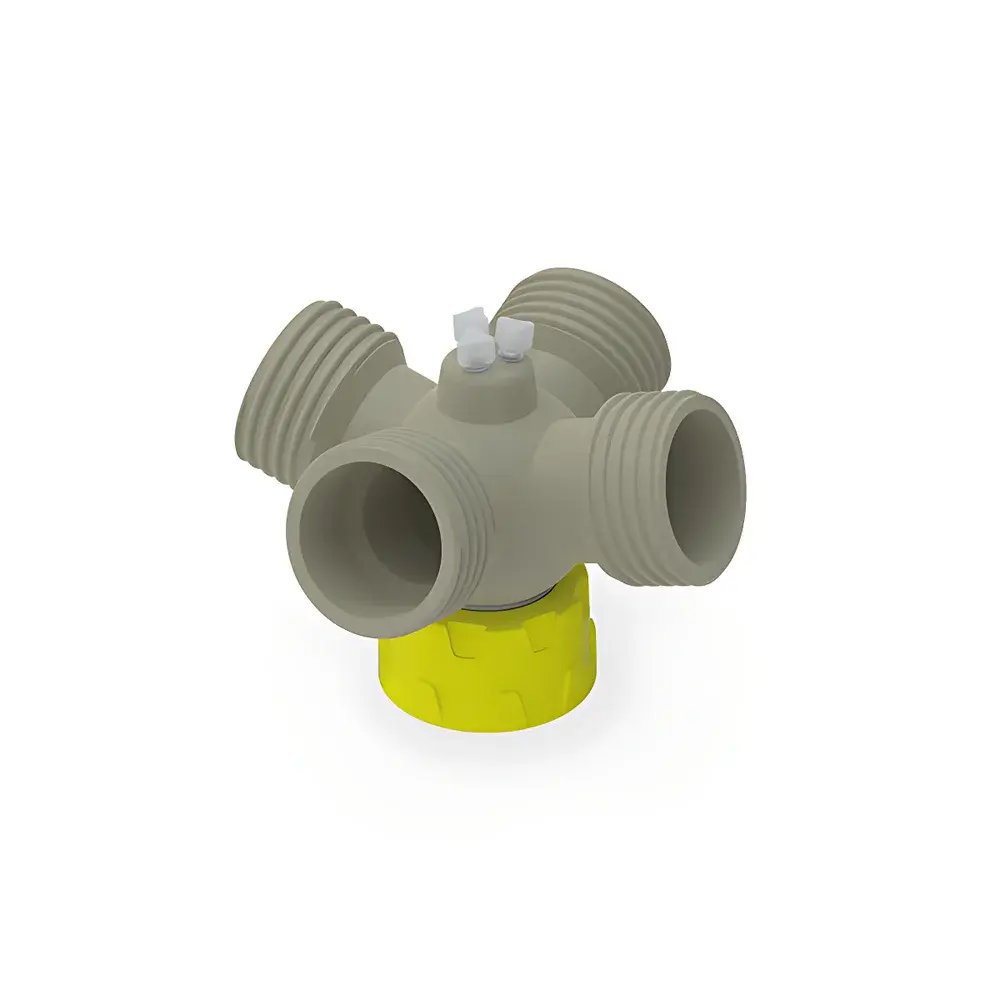
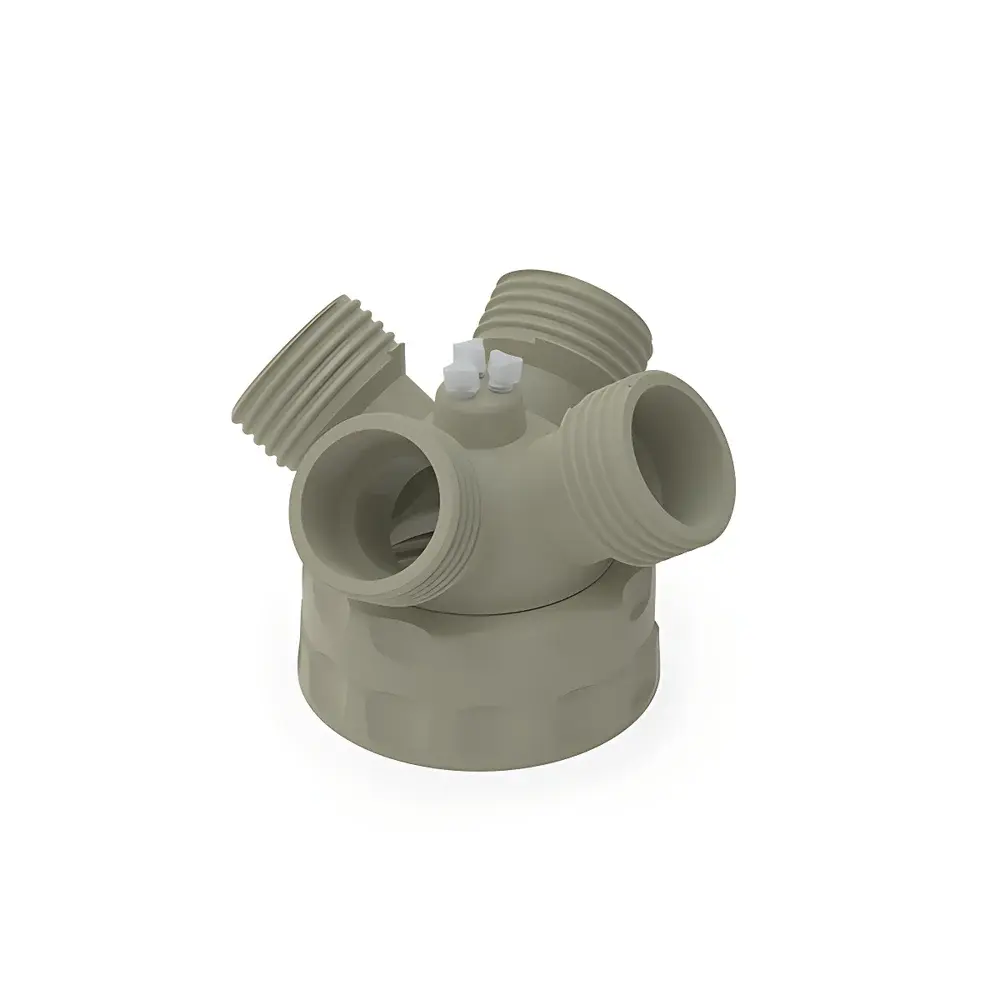
B.safe HPLC Solvent Dispensing Cap
| Brand | b.safe |
|---|---|
| Origin | Germany |
| Model | HPLC Solvent Dispensing Cap (GL45 & GLS80) |
| Material | Polypropylene (PP) for cap body and GLS80 seal |
| Temperature Range | 0 °C to +110 °C |
| Chemical Resistance | Excellent (rated ++) |
| Air Vent Max OD | 14 mm (recommended for GL45) |
| Central Port Configuration | 3× fine-tube threaded connections (M6 × 0.75) |
| Side Ports | 4× lateral barbed fittings (GL45 version) |
| Color | Opaque white |
| Compliance | Designed for ISO/IEC 17025-compliant HPLC solvent handling environments |
Overview
The B.safe HPLC Solvent Dispensing Cap is an engineered precision component designed to replace standard solvent bottle closures in high-performance liquid chromatography (HPLC) and ultra-high-performance liquid chromatography (UHPLC) laboratories. It functions as a sterile, contamination-controlled interface between solvent reservoirs and autosampler or pump inlet lines, eliminating manual pipetting, open-bottle transfer, and associated risks of vapor exposure, particulate ingress, and solvent degradation. The cap operates on a closed-system principle: integrated air venting with sub-14 mm diameter compatibility ensures passive headspace pressure equalization without solvent vapor release, while maintaining inert gas integrity when used with nitrogen or argon purging. Its mechanical architecture—featuring a freely rotating inner core and precisely dimensioned neck geometry—enables unobstructed installation of both solvent delivery tubing and air vent assemblies directly onto standard GL45 (24–400 thread) or GLS80 (32–400 thread) solvent bottles. This design supports full traceability and reproducibility in method-critical solvent dispensing workflows.
Key Features
- Two standardized platform variants: GL45 (for 1–4 L bottles) and GLS80 (for 4–20 L bottles), each with mechanically optimized sealing interfaces and rotational freedom for ergonomic tube routing
- Chemically inert construction: PP body (GLS80) and PPS sealing ring (GL45) ensure compatibility with acetonitrile, methanol, tetrahydrofuran, chloroform, and other aggressive HPLC-grade solvents
- Integrated three-port central manifold with M6 × 0.75 fine-thread connections—designed for direct attachment of reverse-flush lines to HPLC pump pistons or injector needle seats
- Four lateral barbed ports (GL45 version) allow simultaneous connection of primary solvent lines, purge lines, and auxiliary monitoring sensors without adapter stacking
- Thermal stability up to +110 °C enables use in heated solvent cabinets or warm-room storage conditions without deformation or seal failure
- No gasket replacement required: the self-aligning, compression-molded seal maintains consistent torque retention across ≥500 installation/removal cycles
Sample Compatibility & Compliance
The B.safe dispensing cap is validated for use with all common HPLC mobile phase solvents meeting ASTM D4790 and USP specifications. Its closed-loop architecture conforms to Good Laboratory Practice (GLP) and current Good Manufacturing Practice (cGMP) requirements for solvent handling integrity. When deployed in systems subject to FDA 21 CFR Part 11 compliance, the cap supports audit-ready workflows by eliminating unlogged manual transfers—thereby reducing deviation risk during method validation and routine QC analysis. The PP and PPS materials comply with EU Regulation (EC) No. 1935/2004 for food-contact materials and ISO 10993-5 cytotoxicity testing. No leachables have been detected under ICH Q5C stress conditions (60 °C, 72 h in 90% acetonitrile/water).
Software & Data Management
While the B.safe cap is a passive hardware component, its integration into automated HPLC platforms—including Waters Empower, Thermo Chromeleon, and Agilent OpenLab CDS—enables full metadata linkage. When paired with solvent-level sensors (e.g., capacitive or ultrasonic level transducers mounted externally on the bottle), cap installation status and usage duration can be logged via system event timestamps. Audit trails generated in compliant CDS environments reflect cap deployment as a defined instrument configuration step, satisfying ALCOA+ data integrity principles (Attributable, Legible, Contemporaneous, Original, Accurate, Complete, Consistent, Enduring, Available). No firmware or driver installation is required.
Applications
- Reverse-flushing of HPLC pump check valves and piston seals using dedicated solvent streams routed through the central 3-port manifold
- Simultaneous dual-solvent delivery for gradient elution systems with independent degassing line integration
- Inert-gas-purged solvent storage for oxygen-sensitive applications (e.g., LC-MS mobile phases containing ammonium formate)
- Multi-vial solvent pooling setups where GLS80 caps enable consolidated 10–20 L reservoirs with minimized headspace-to-volume ratio
- Automated QC labs performing ASTM D4176 (determination of water in petroleum distillates) requiring repeatable, low-particulate solvent addition
FAQ
Can the B.safe cap be autoclaved?
Yes—both PP and PPS components withstand standard laboratory autoclaving cycles (121 °C, 20 min, saturated steam), though repeated cycles may reduce seal longevity beyond 50 cycles.
Is the cap compatible with solvent bottles from non-German manufacturers?
Yes—GL45 and GLS80 thread standards are globally harmonized per DIN ISO 2852; compatibility has been verified with bottles from Fisher Scientific, VWR, Thermo Scientific, and DWK Life Sciences.
How is leak integrity verified during installation?
A visual torque indicator line on the cap skirt aligns with a reference mark on the bottle neck at manufacturer-specified tightening torque (1.8 ± 0.2 N·m); no additional pressure testing is required for standard HPLC operating pressures (<400 bar).
Does the cap support integration with solvent management systems that monitor conductivity or UV absorbance?
Yes—the lateral ports accommodate inline flow cells and sensor housings with standard 1/16″ or 1/8″ Swagelok fittings; electrical feedthroughs must be added externally per system vendor specifications.



