
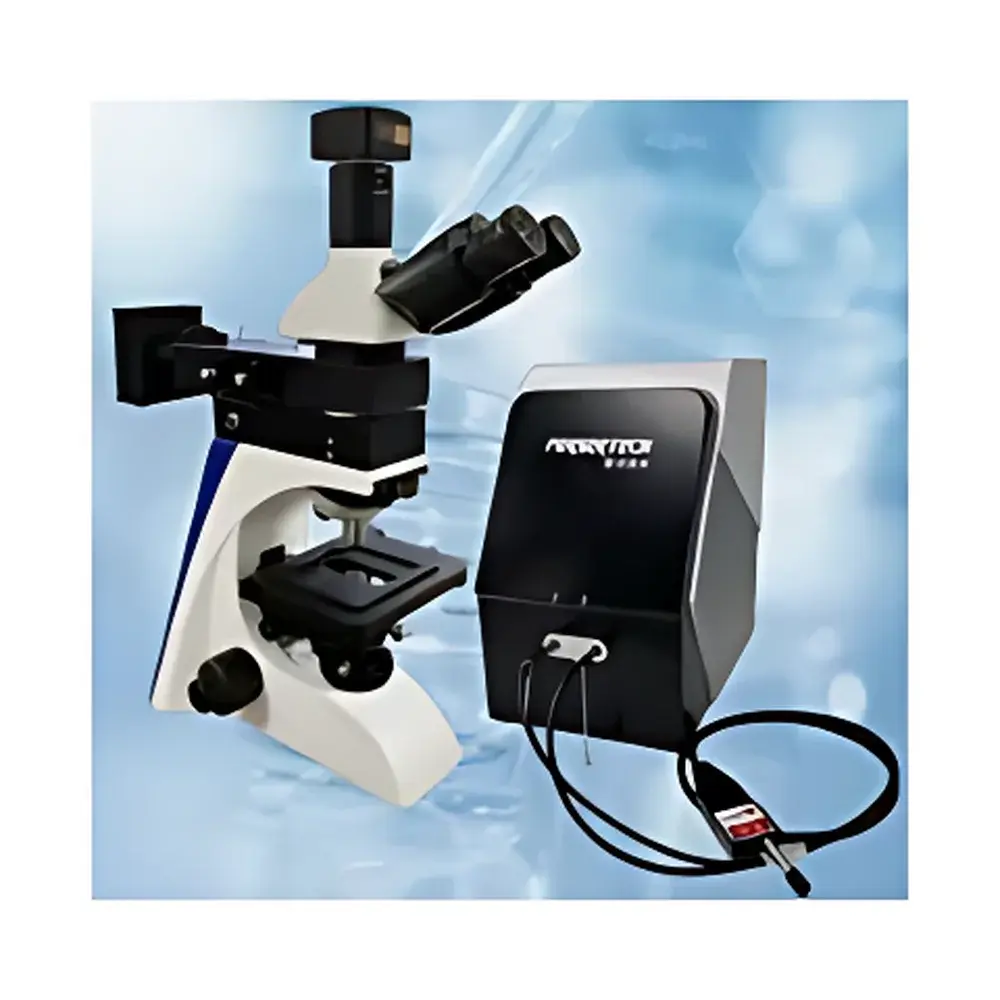
Safe AT-RS300 Series Research-Grade Confocal Raman Spectrometer
| Brand | Safe |
|---|---|
| Origin | Beijing, China |
| Manufacturer Type | Direct Manufacturer |
| Instrument Type | Confocal Micro-Raman Spectrometer |
| Excitation Wavelength | 785 nm |
| Spectral Range | 200–3350 cm⁻¹ |
| Spectral Resolution | 4.5–10 cm⁻¹ (best ≤4.5 cm⁻¹ at 912 cm⁻¹) |
| Spatial Resolution | 1 µm (lateral), 1 µm (axial) |
| Minimum Wavenumber | 200 cm⁻¹ |
| Spectral Reproducibility | ≤ ±0.15 cm⁻¹ |
Overview
The Safe AT-RS300 Series is a research-grade confocal micro-Raman spectrometer engineered for high-fidelity vibrational spectroscopic analysis across diverse scientific domains. Based on confocal optical architecture and 785 nm diode laser excitation, the system minimizes fluorescence interference while maximizing signal-to-noise ratio—particularly critical for organic compounds, biological tissues, pharmaceuticals, and pigment-containing cultural heritage materials. Its spectral coverage from 200 to 3350 cm⁻¹ enables comprehensive fingerprinting of molecular bonds, including C–H, O–H, C=O, C=C, and aromatic ring modes. The instrument employs a thermoelectrically cooled back-illuminated CCD detector and precision grating monochromator, delivering stable wavenumber calibration and long-term measurement repeatability (≤ ±0.15 cm⁻¹). Designed for both benchtop laboratory use and field-deployable configurations, the AT-RS300 supports modular integration with motorized XYZ stages, microscope objectives (10×–100×), and fiber-optic probes—enabling non-contact, spatially resolved Raman mapping without sample destruction.
Key Features
- 785 nm excitation laser optimized for low-fluorescence Raman acquisition in complex matrices (e.g., biological tissue, dyed textiles, pharmaceutical tablets)
- Confocal optical design with adjustable pinhole aperture ensures axial sectioning capability and depth-resolved spectral acquisition
- Spectral resolution tunable between 4.5 cm⁻¹ (at 912 cm⁻¹) and 10 cm⁻¹, validated per ISO 17830:2015 guidelines for Raman instrument performance verification
- Sub-micron spatial resolution (1 µm lateral and axial) achieved via diffraction-limited focusing and high-NA objective coupling
- Fiber-optic probe interface (SMA 905) allows remote sampling in confined or hazardous environments—compatible with custom probe geometries (e.g., immersion, angled, or SERS-compatible tips)
- Modular microscope integration supports brightfield/DIC imaging co-registered with Raman spectra for morphological–chemical correlation
- Open API and SDK support for Python, MATLAB, and LabVIEW enable full OEM integration, automated assay development, and third-party control systems
Sample Compatibility & Compliance
The AT-RS300 accommodates solid, liquid, gel, and powder samples—including fragile archaeological artifacts, unstained histological sections, polymer films, crystalline APIs, and SERS-active substrates. Its non-destructive, label-free operation complies with ASTM E1840-22 (Standard Guide for Raman Microspectroscopy) and aligns with analytical validation requirements under ICH Q2(R2) for qualitative identification in pharmaceutical QC. When configured with GLP-compliant software modules, the system supports 21 CFR Part 11–enabled audit trails, electronic signatures, and data integrity controls. All optical components meet RoHS and CE directives; laser safety classification conforms to IEC 60825-1:2014 (Class 3B).
Software & Data Management
The bundled RamanSuite Pro software provides real-time spectral acquisition, multivariate curve resolution (MCR), principal component analysis (PCA), and cluster-based mapping visualization. Raw spectra are stored in standardized JCAMP-DX format with embedded metadata (laser power, integration time, grating position, calibration reference). Batch processing workflows support automated baseline correction (Asymmetric Least Squares), cosmic ray removal, and peak deconvolution using Voigt profiles. For regulated environments, optional GxP Mode enforces user role management, electronic lab notebook (ELN) synchronization, and raw-data archiving compliant with ALCOA+ principles. Export options include CSV, ASCII, and HDF5 for interoperability with chemometric platforms such as Unscrambler X or Python’s scikit-learn.
Applications
- Forensic trace evidence analysis: Identification of illicit drugs, explosives residues, ink dyes, and gunshot residue particles via spectral library matching against NIST RM 8014 and INTERPOL Raman Database
- Cultural heritage science: In situ pigment identification on frescoes, manuscripts, and lacquerware without sampling—validated in collaboration with the Palace Museum (Beijing) and Shanghai Museum conservation labs
- Pharmaceutical quality control: Polymorph screening, blend uniformity assessment, and counterfeit drug detection per USP and Ph. Eur. 2.2.48
- Materials science: Strain mapping in 2D materials (graphene, MoS₂), carbon nanotube chirality assignment, and semiconductor defect characterization
- Biomedical oncology research: Label-free discrimination of cancerous vs. normal tissue margins during ex vivo biopsy analysis using supervised machine learning models trained on spectral libraries
FAQ
Is the AT-RS300 compatible with surface-enhanced Raman spectroscopy (SERS)?
Yes—the system supports SERS via interchangeable fiber probes with integrated nanostructured substrates and optional 532 nm laser module upgrade for resonance enhancement in specific chromophore systems.
Can spectral calibration be verified traceably?
Yes—built-in neon/argon lamp alignment routine enables NIST-traceable wavenumber calibration; certificate of calibration is provided with each instrument shipment.
Does the system support automated mapping over irregular surfaces?
Yes—when equipped with a motorized Z-stage and autofocus algorithm, the AT-RS300 maintains focus across topographically variable samples (e.g., corroded metal, painted canvas, or tissue sections) during raster scanning.
What level of technical support is offered for SDK-based customization?
Safe provides documented C++/Python APIs, example scripts, and dedicated engineering consultation for integration into OEM instruments or automated production lines—subject to NDA and development agreement.
Are maintenance intervals and service contracts available internationally?
Yes—Safe maintains authorized service centers in Germany, USA, and Singapore; preventive maintenance plans include annual wavelength accuracy verification, detector quantum efficiency profiling, and optical alignment certification.
Related Products





