
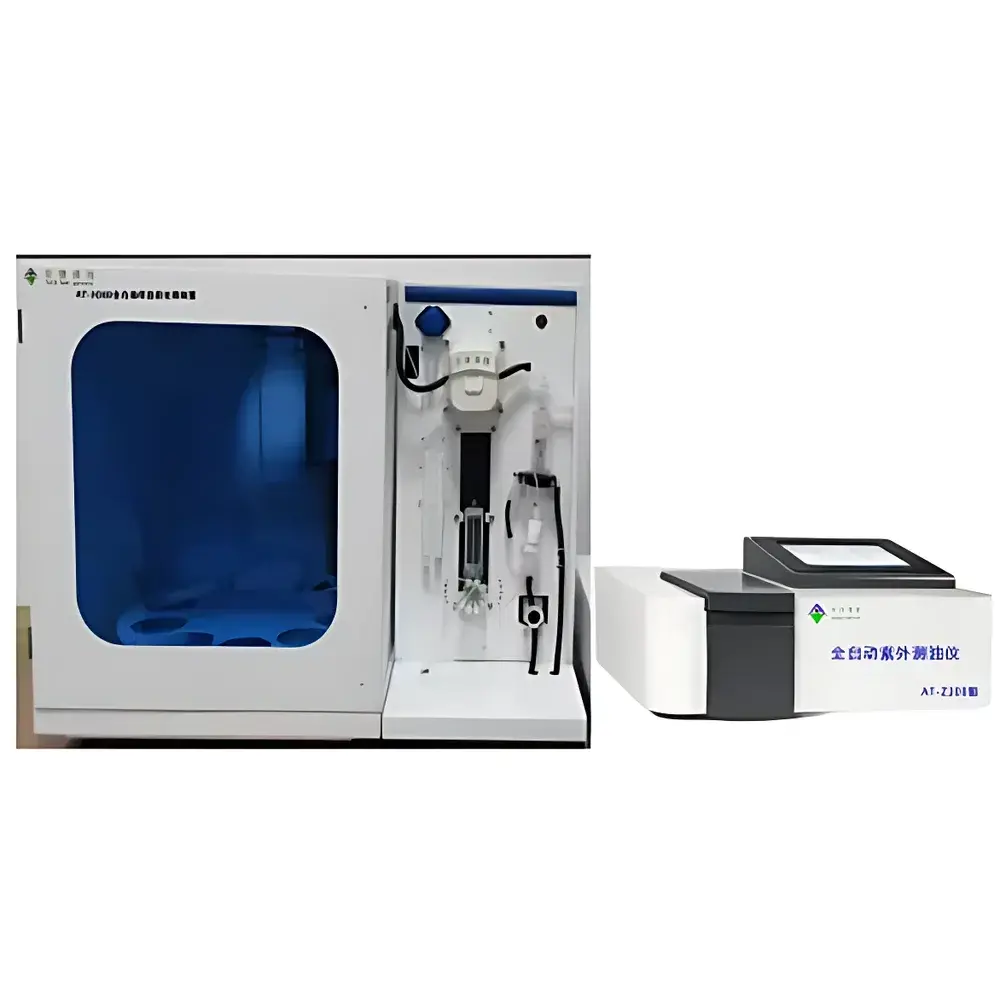
Safe AT-Z300 Fully Automated UV Oil-in-Water Analyzer
| Brand | Safe |
|---|---|
| Origin | Beijing, China |
| Manufacturer Type | Manufacturer |
| Product Category | Domestic |
| Model | AT-Z300 |
| Instrument Type | Laboratory-Based |
| Measurement Principle | Ultraviolet Spectrophotometry (UV-Vis) |
| Measurement Range | 0.002–64,000 mg/L |
| Limit of Detection (LOD) | < 0.01 mg/L |
| Accuracy | ±0.2 mg/L |
| Resolution | < 0.004 mg/L |
| Analysis Time per Sample | 7–12 minutes |
Overview
The Safe AT-Z300 Fully Automated UV Oil-in-Water Analyzer is an integrated laboratory instrument engineered for precise, standardized quantification of petroleum hydrocarbons in aqueous matrices using ultraviolet spectrophotometry at 225 nm. It operates in full compliance with the People’s Republic of China Environmental Protection Standard HJ 970–2018, “Determination of Petroleum Hydrocarbons in Water—Ultraviolet Spectrophotometric Method (Trial)”, and implements a fully automated, closed-loop workflow from sample introduction to final concentration reporting. The system employs n-hexane as the extraction solvent, followed by water removal and polar compound removal via magnesium silicate adsorption—ensuring selective measurement of petroleum hydrocarbons while excluding interference from plant and animal oils. Its dual-beam optical architecture minimizes baseline drift and enables robust long-term stability during sequential multi-sample analysis. Designed for regulatory-grade environmental laboratories, the AT-Z300 delivers trace-level sensitivity, high reproducibility, and audit-ready data integrity across diverse water types—including surface water, groundwater, and seawater.
Key Features
- Fully automated sample handling: Processes 1–12 water samples unattended, with real-time volume recognition directly from sampling bottles (10–800 mL range), eliminating manual transfer and associated hydrocarbon loss.
- Dual-symmetric orbital agitation: Ensures uniform, efficient liquid–liquid extraction without emulsion formation or phase separation delay.
- Integrated adsorption column monitoring: Tracks magnesium silicate consumption in real time and triggers low-reagent alerts to maintain consistent polarity removal performance.
- Closed-system waste management: Includes on-board activated carbon-based exhaust treatment and segregated waste liquid/waste water collection—compatible with fume hood integration via dedicated ventilation interface.
- Intelligent dilution logic: Automatically detects out-of-range concentrations and performs programmable serial dilution to extend effective dynamic range without operator intervention.
- Optical system: Dual-beam UV-Vis spectrophotometer with automatic wavelength setting (225 nm), dark-current calibration, and blank correction; large-color LCD display with intuitive graphical user interface.
Sample Compatibility & Compliance
The AT-Z300 is validated for use with freshwater, brackish water, and saline matrices up to 35 g/L total dissolved solids. All operational protocols align with HJ 970–2018 requirements for reagent purity, extraction efficiency verification, and method blank control. While not certified to ISO/IEC 17025 by default, the instrument supports GLP-compliant workflows through built-in audit trails, electronic signature capability, and timestamped raw data logging. Optional software modules enable 21 CFR Part 11 compliance for regulated environments requiring electronic records and signature validation. System performance meets or exceeds the precision criteria specified in ASTM D7066–04 (Standard Test Method for Determination of Total Petroleum Hydrocarbons in Water by UV Fluorescence) for comparative benchmarking.
Software & Data Management
The proprietary SafeAnalytix™ software provides comprehensive instrument control, spectral acquisition, quantitative analysis, and report generation. It supports multiple analysis modes—including photometric measurement, fixed-wavelength quantitation, standard curve construction (linear, quadratic, or cubic regression), kinetic scanning, and full-spectrum wavelength sweep (190–1100 nm). All raw absorbance data, calibration parameters, and processing metadata are stored in encrypted binary format with SHA-256 checksums. Audit logs record every user action—including method edits, calibration events, and result overrides—with immutable timestamps and operator ID tagging. Export options include CSV, PDF, and XML formats compatible with LIMS integration via ODBC or RESTful API.
Applications
The AT-Z300 serves as a primary analytical platform for environmental monitoring agencies, municipal water utilities, industrial effluent testing labs, and third-party environmental service providers. Typical use cases include routine surveillance of petroleum hydrocarbon contamination in riverine and lacustrine systems; compliance testing of discharge permits under national wastewater regulations; forensic assessment of oil spill impact zones; and QA/QC of remediation efforts in contaminated aquifers. Its high throughput and minimal hands-on time also make it suitable for contract laboratories performing batch analyses for multiple clients under tight turnaround schedules.
FAQ
What extraction solvent does the AT-Z300 require?
n-Hexane, meeting HJ 970–2018 purity specifications (UV transmittance ≥ 90% at 225 nm in 1 cm quartz cell).
Can the instrument analyze seawater without matrix interference?
Yes—the system includes salinity-tolerant fluidics and incorporates method-specific blank correction routines to compensate for chloride-induced absorbance shifts.
Is method validation documentation available?
Yes—Safe provides a complete validation package including LOD/LOQ determination, linearity assessment (R² ≥ 0.999 over full range), repeatability (RSD ≤ 3.2%), and inter-laboratory comparison data.
How is cross-contamination prevented between samples?
Through disposable sample path components, automated solvent rinsing cycles between runs, and physically isolated adsorption columns with non-recirculating flow paths.
Does the system support remote monitoring or networked operation?
Yes—Ethernet connectivity enables remote diagnostics, firmware updates, and secure web-based status viewing via HTTPS-enabled dashboard.
Related Products







