
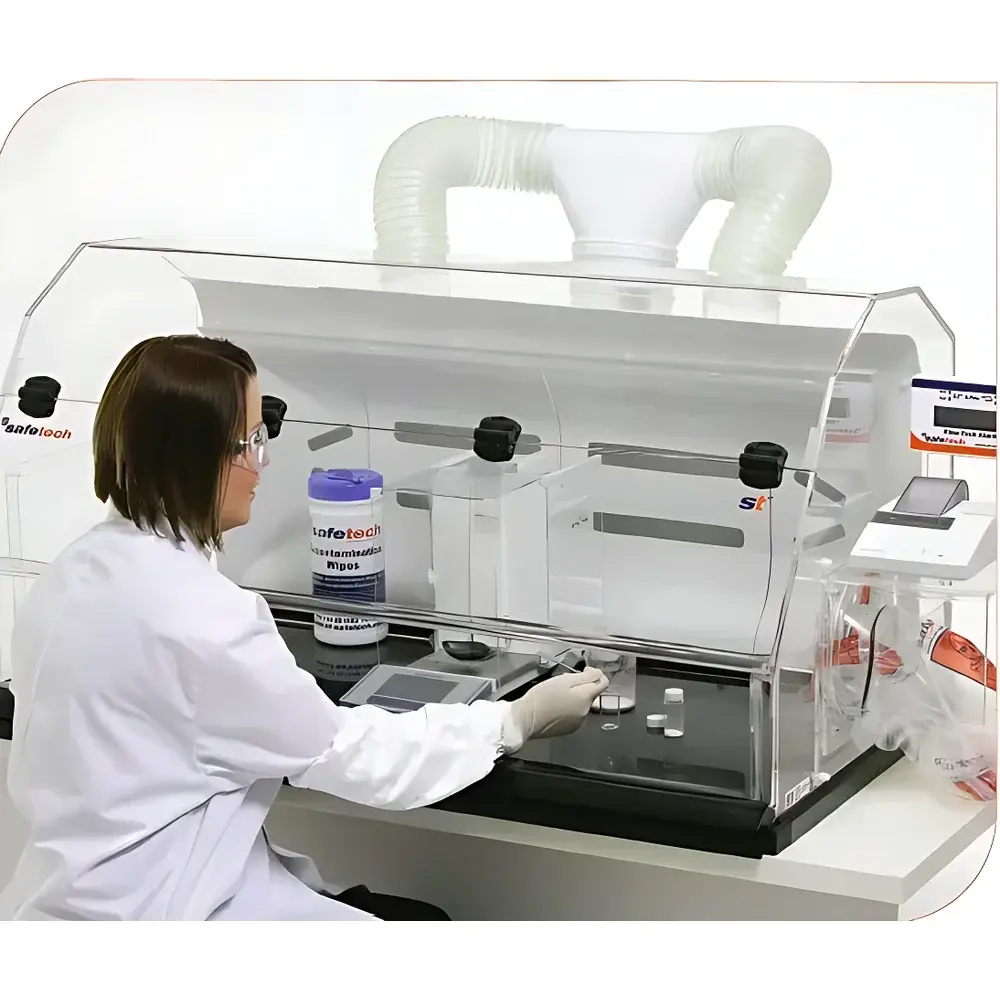
SAFETECH ST1 Weighing Enclosure
| Brand | a1 |
|---|---|
| Origin | Germany |
| Model | ST1 |
| Construction | Full-steel fume hood |
| Configuration | Single-face operator access |
| Dimensions (ST1-1200) | 1200 mm W × 600 mm H × 750 mm D |
| Internal Working Depth | 640 mm |
| Airflow Control | Dual-sensor FlowTech alarm with data logging |
| Filtration Options | H13/H14 HEPA (bag-out), activated carbon for solvent capture |
| Compliance | EN 14175, ASHRAE 110, EN 1822 |
| Base Material Options | Phenolic resin, granite, or stainless steel |
| Enclosure Material | Cast acrylic (chemical-resistant) |
| Containment Validation | SafeBridge Consultants surrogate powder testing |
Overview
The SAFETECH ST1 Weighing Enclosure is an engineered containment solution developed by a1 (Germany) for high-integrity gravimetric operations involving potent active pharmaceutical ingredients (APIs), cytotoxic compounds, and other low-dose hazardous substances. Unlike conventional fume hoods or generic balance enclosures, the ST1 operates on a validated unidirectional airflow principle—optimized via patented directional baffle technology—to establish a turbulence-free, laminar-weighting environment. Its design conforms to the performance criteria of EN 14175 (laboratory fume hood testing) and ASHRAE 110 (face velocity and tracer gas containment assessment), with independent third-party validation conducted by SafeBridge Consultants using standardized surrogate powders. The enclosure integrates structural containment, aerodynamic control, and filtration redundancy to meet occupational exposure limit (OEL) targets down to <1 ng/m³ for highly potent compounds—making it suitable for use in GLP-compliant analytical laboratories, QC/QA suites, and early-phase API handling environments.
Key Features
- Patented directional airflow baffle system ensures consistent inward face velocity and minimizes eddy formation within the weighing chamber.
- Increased internal depth (640 mm) accommodates modern high-precision analytical balances—including models with extended pan supports or integrated draft shields.
- Dual-sensor FlowTech alarm continuously monitors inflow and exhaust air velocities; triggers visual/audible alerts upon deviation beyond ±10% of setpoint.
- Data logging module records real-time airflow metrics (m³/h) with timestamped entries, supporting audit readiness under FDA 21 CFR Part 11 and EU Annex 11 requirements.
- Safe-change HEPA filtration architecture enables filter replacement without exposure risk—utilizing H13 or H14 grade filters tested per EN 1822, with optional double-H14 configurations for enhanced particulate retention.
- Modular solvent filtration option integrates activated charcoal beds for volatile organic compound (VOC) abatement, compatible with common solvents used in reference standard preparation.
- Chemical-resistant cast acrylic enclosure walls provide superior resistance to cleaning agents (e.g., ethanol, isopropanol, hydrogen peroxide) and incidental acid/base splashes.
- Recessed phenolic resin, granite, or stainless steel base contains spills and facilitates decontamination; base geometry prevents lateral fluid migration during wipe-down procedures.
Sample Compatibility & Compliance
The ST1 is validated for use with solid-phase APIs, lyophilized powders, reference standards, and intermediate blends where operator protection during manual dispensing, taring, and transfer is critical. It complies with ISO 14644-1 Class 5 (ISO Class 5) cleanroom-compatible airflow behavior when operated with appropriate filtration and room pressure differentials. All units undergo factory pre-commissioning per EN 14175 Section 7 (type testing), including face velocity mapping, smoke visualization, and tracer gas (SF₆) containment efficiency measurement. Documentation packages include test certificates traceable to DAkkS-accredited calibration standards. The enclosure supports GMP-aligned workflows through configurable alarm thresholds, electronic log integrity, and compatibility with laboratory information management systems (LIMS) via Modbus RTU or analog 4–20 mA output.
Software & Data Management
The integrated FlowTech controller provides local HMI operation with password-protected configuration access. Airflow data—including average face velocity, minimum/maximum readings over user-defined intervals (1 min to 24 h), and alarm event history—is stored onboard for ≥30 days. Export is supported via USB-C interface in CSV format for integration into electronic lab notebooks (ELN) or quality management systems (QMS). Optional firmware upgrades enable remote monitoring via Ethernet/IP with TLS 1.2 encryption, satisfying cybersecurity requirements outlined in IEC 62443-3-3 for laboratory infrastructure devices. Audit trails comply with ALCOA+ principles (Attributable, Legible, Contemporaneous, Original, Accurate, Complete, Consistent, Enduring, Available).
Applications
- Weighing of oncology APIs and hormone-active compounds in development labs.
- Preparation of certified reference materials (CRMs) requiring OEL adherence.
- QC release testing of sterile drug products where cross-contamination prevention is mandated.
- Handling of nanomaterials and ultrafine powders with high inhalation toxicity profiles.
- Stability-indicating assay sample preparation under controlled environmental conditions.
- Regulatory submission support—data generated meets expectations of EMA CHMP, USP , and ICH Q5C guidelines for containment justification.
FAQ
Does the ST1 require external ducting?
No—ST1 units are available in both ducted (direct connection to central exhaust) and recirculating (fan-filter unit with HEPA + carbon) configurations. Recirculating mode achieves ≥99.995% particle removal (H14) and ≥90% VOC reduction at 100 ppm inlet concentration.
Can the ST1 be integrated into a facility’s BMS?
Yes—standard analog outputs (4–20 mA) and optional Modbus TCP/Ethernet interfaces allow seamless integration with building management systems for centralized airflow and alarm monitoring.
What maintenance intervals are recommended for HEPA filters?
Filter service life depends on usage intensity and challenge load; typical replacement intervals range from 12–24 months. The FlowTech system logs cumulative airflow resistance and recommends replacement when ΔP exceeds 250 Pa across the filter bank.
Is the ST1 compliant with USP requirements for hazardous drug handling?
Yes—the ST1 meets all engineering control provisions of USP , including containment verification, alarm functionality, and documentation of performance qualification (PQ) per section 5.2.2.
Are installation and commissioning services available?
a1-certified field engineers perform IQ/OQ protocols aligned with ISO/IEC 17025 and GAMP 5, including airflow mapping, containment validation, and alarm response verification. Commissioning reports are delivered in English with digital signatures.



