
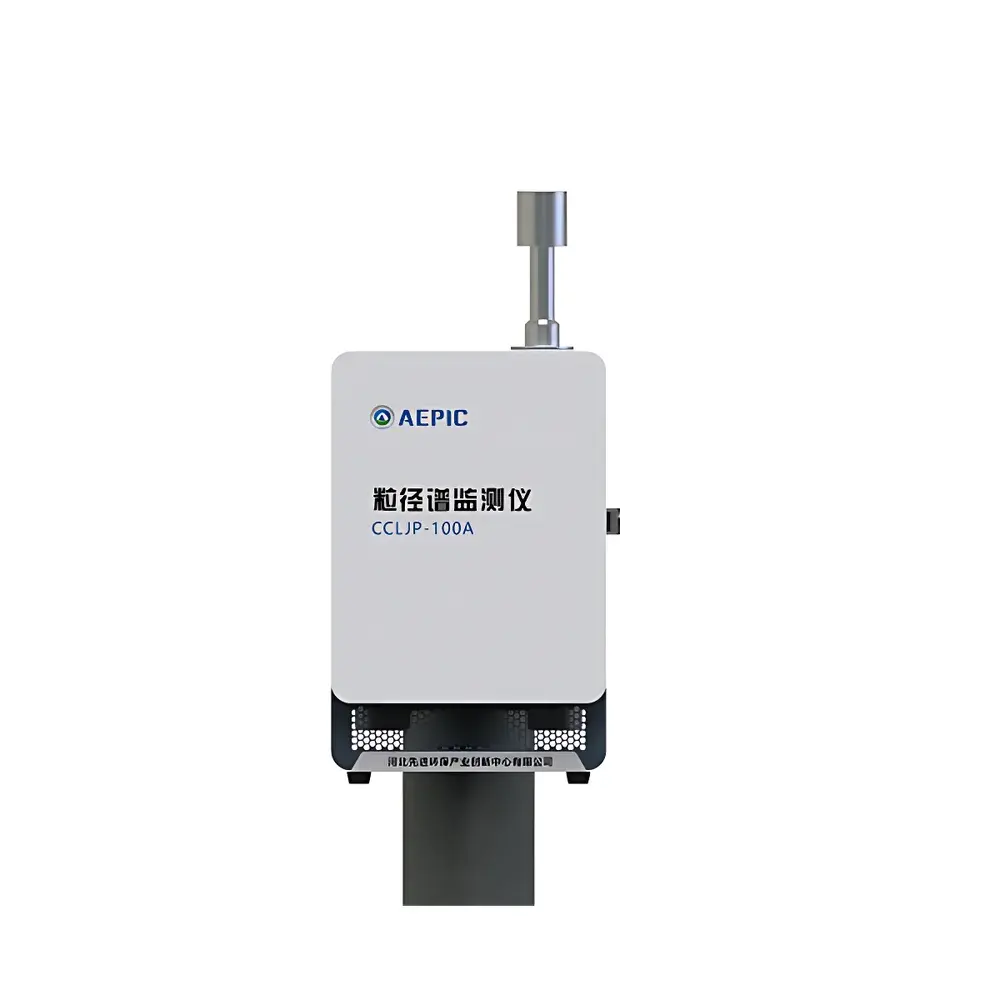
SAIL HERO CCLJP-100A Optical Particle Size Spectrometer
| Brand | SAIL HERO |
|---|---|
| Origin | Hebei, China |
| Manufacturer Type | OEM/ODM Manufacturer |
| Country of Origin | China |
| Model | CCLJP-100A |
| Pricing | Available Upon Request |
| Measurement Principle | Optical Light Scattering (90° Detection) |
| Sampling Flow Rate | 1 L/min |
| Particle Size Range | 0.18–20 µm |
| Particle Counting Range | 0–20,000 particles/cm³ |
| Number of Size Channels | 64 |
Overview
The SAIL HERO CCLJP-100A Optical Particle Size Spectrometer is a fixed-site, compact ambient aerosol monitoring instrument engineered for continuous, high-fidelity measurement of airborne particulate matter size distribution in real time. It operates on the principle of single-particle optical light scattering: individual particles traverse a precisely defined sensing volume uniformly illuminated by a broad-spectrum LED source. As each particle passes through this zone, it generates a discrete Mie-scattered light pulse detected at a 90° angle relative to the incident beam. The amplitude of the pulse correlates directly with particle diameter, while pulse count yields number concentration. With 64 logarithmically spaced size bins spanning 0.18–20 µm, the CCLJP-100A delivers granular resolution across ultrafine, fine, and coarse fractions—enabling robust source apportionment, PM₂.₅/PM₁₀ mass estimation (via calibration), and dynamic process monitoring in both urban and industrial environments.
Key Features
- Optical sensing architecture with integrated 90° scatter detection geometry for high signal-to-noise ratio and minimal angular dependence;
- Dynamic heating system coupled with real-time temperature and relative humidity compensation algorithms—validated for stable operation up to 100% RH without condensation-induced bias;
- Self-calibrating airflow control and internal reference diagnostics ensuring long-term drift < ±2% per year under typical field conditions;
- Onboard 3.5-inch TFT display with intuitive menu navigation for local parameter configuration, real-time histogram visualization, and status diagnostics;
- Embedded dual-mode connectivity: LTE-M/NB-IoT via SIM card slot and IEEE 802.11 b/g/n Wi-Fi for flexible deployment in remote or infrastructure-limited locations;
- Data output latency ≤ 1 second—supporting sub-minute temporal resolution for rapid event detection and transient plume tracking;
- Ruggedized enclosure rated IP54 for outdoor wall- or pole-mount installation with optional solar power integration.
Sample Compatibility & Compliance
The CCLJP-100A is designed for ambient air sampling without pre-separation or dilution. It accommodates polydisperse aerosols including combustion soot, traffic emissions, mineral dust, sea salt, and secondary organic aerosols. Its optical design avoids electrostatic charging artifacts common in CPC-based systems and eliminates reliance on volatile particle evaporation. The instrument complies with ISO 27827:2019 (ambient aerosol instrumentation—performance requirements and test methods) and supports traceable calibration against NIST-traceable PSL standards. Data integrity protocols align with GLP principles, including timestamped audit logs, firmware version tracking, and sensor health flags embedded in all data packets—facilitating regulatory reporting under EU Directive 2008/50/EC and China’s HJ 653–2013 standard for ambient air quality monitoring.
Software & Data Management
Raw pulse data are processed onboard using adaptive thresholding and deconvolution algorithms to resolve overlapping pulses at high concentrations (>5,000 particles/cm³). Output includes full 64-channel size distribution matrices, integrated counts per bin, and derived metrics (e.g., total number concentration, geometric mean diameter, standard deviation). Data export follows standardized JSON and CSV formats compliant with AQMesh, OpenAQ, and national air quality information platforms. Cloud synchronization occurs via MyAtmosphere—a secure, TLS 1.2–encrypted platform supporting role-based access control, automated QA/QC flagging, and API-driven integration with forecasting engines (e.g., WRF-Chem, CAMx). All firmware updates and configuration changes are digitally signed and logged with SHA-256 hashes for full traceability.
Applications
- High-density urban air quality networks requiring spatially resolved PM characterization;
- Industrial fence-line monitoring for fugitive dust and process emission verification;
- Indoor air quality assessment in schools, hospitals, and transit hubs;
- Research-grade field campaigns studying new particle formation, hygroscopic growth, or aerosol-cloud interactions;
- Calibration reference for low-cost sensor networks—providing ground-truth size-resolved validation;
- Compliance monitoring for construction sites, landfill operations, and mining facilities under local environmental permits.
FAQ
Does the CCLJP-100A require periodic optical cleaning or lamp replacement?
No—the LED light source has a rated lifetime exceeding 50,000 hours, and the optical path is sealed and pressure-differential protected against particulate ingress. Routine maintenance is limited to inlet filter replacement every 3–6 months depending on site conditions.
Can it be used for occupational exposure assessment?
It is not certified for personal exposure monitoring per ISO 7708 or EN 481. Its 1 L/min flow rate and fixed-site orientation meet ambient monitoring requirements but do not satisfy breathing-zone sampling criteria.
How is humidity interference mitigated during fog or rain events?
The dynamic heating system maintains the sample line and sensing volume at a controlled temperature differential above ambient dew point, preventing condensation. Simultaneously, multi-parameter regression models correct residual scattering cross-section shifts using co-located RH and T measurements.
Is raw pulse data accessible for custom algorithm development?
Yes—firmware v3.2+ supports optional binary packet streaming over TCP/IP, enabling direct ingestion into MATLAB, Python (NumPy/Pandas), or LabVIEW environments for advanced spectral analysis or machine learning applications.
Related Products







