
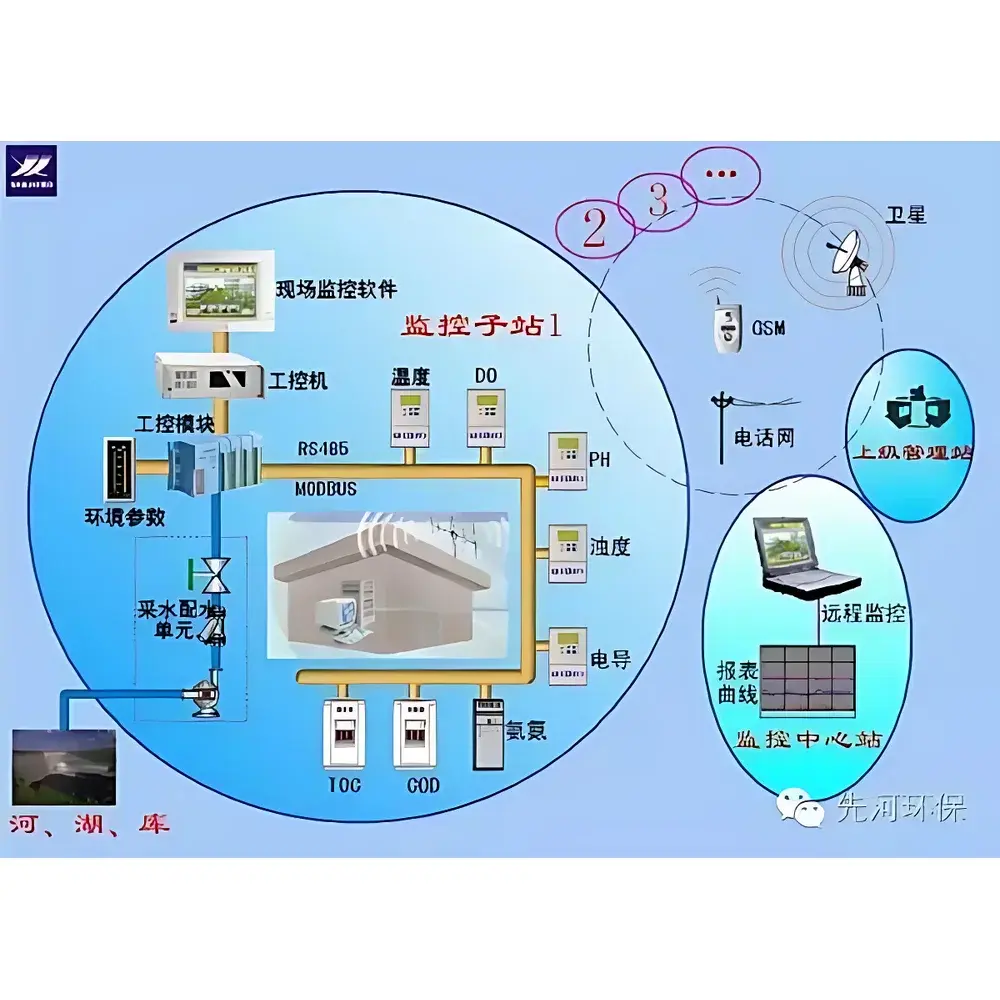
SAIL HERO Fixed-Station Surface Water Quality Online Monitoring System
| Brand | SAIL HERO |
|---|---|
| Origin | Hebei, China |
| Manufacturer Type | Original Equipment Manufacturer (OEM) |
| Country of Origin | China |
| Model | Fixed-Station Surface Water Quality Online Monitoring System |
| Price Range | USD 42,000 – 70,000 |
Overview
The SAIL HERO Fixed-Station Surface Water Quality Online Monitoring System is an integrated, rack-mounted environmental monitoring platform engineered for continuous, unattended operation in permanent surface water monitoring stations. It operates on the principle of multi-parameter sensor fusion combined with discrete automated wet-chemistry analysis, enabling real-time quantification of physical, chemical, biological, and optical water quality indicators. Designed specifically for long-term deployment in lakes, reservoirs, rivers, estuaries, and coastal zones, the system conforms to the operational requirements of national surface water monitoring networks—supporting both routine surveillance and early-warning functions for pollution incidents. Its architecture integrates hydraulic control, analytical chemistry automation, environmental conditioning, and secure telemetry, delivering high reproducibility under variable ambient conditions including wide temperature ranges (−20 °C to +50 °C), high turbidity (>1000 NTU), and suspended solids concentrations typical of sediment-laden northern Chinese rivers or algal-bloom-prone southern reservoirs.
Key Features
- Modular subsystem design: Independent but interoperable units—including intelligent sampling & distribution, conditioned sample preparation, multi-channel analyzer racks, embedded PLC-based station controller, and climate-stabilized enclosure—facilitate maintenance, calibration, and technology upgrades without full-system downtime.
- Adaptive sampling logic: Equipped with programmable isokinetic intake, anti-clogging filtration, and auto-flushing protocols optimized for high-sediment environments; supports time-proportional, flow-proportional, and event-triggered sampling per ISO 5667-10 and HJ/T 91–2002 guidelines.
- Redundant data integrity: Dual-path communication (4G LTE + wired Ethernet) with local SD-card buffering (≥30 days of raw sensor and analytical data); all timestamps are synchronized via NTP or GPS-derived UTC.
- Self-diagnostic capability: Real-time health monitoring of pumps, valves, reagent levels, optical path cleanliness, and electrode drift; automatic fault logging with severity classification (warning, error, critical).
- Low operational footprint: Average power consumption 180 days.
Sample Compatibility & Compliance
The system accommodates raw surface water samples across a broad physicochemical spectrum: freshwater to brackish (conductivity up to 50 mS/cm), turbidity up to 2000 NTU, and suspended solids ≤ 500 mg/L. All wet-chemistry modules comply with standardized methods referenced in China’s HJ series standards (e.g., HJ 505–2009 for CODCr, HJ 535–2009 for NH3-N, HJ 636–2012 for TN), while sensor-based measurements align with ISO 7888 (pH), ISO 5814 (DO), and ISO 7027 (turbidity). The platform supports audit-ready operation under GLP principles, with electronic logbooks, user access controls, and configurable audit trails meeting basic requirements for regulatory reporting frameworks.
Software & Data Management
The embedded station controller runs a Linux-based real-time OS with deterministic I/O scheduling. Data acquisition and control logic are implemented via IEC 61131-3 compliant ladder logic. Remote configuration, diagnostics, and firmware updates are performed through a TLS 1.2–secured web interface compatible with desktop and tablet browsers. Export formats include CSV, XML (WaterML 2.0 compliant), and MQTT payloads for integration into SCADA, GIS, or national environmental data platforms such as China’s National Surface Water Monitoring Information System (NSWMIS). All measurement records retain original sensor resolution, method identification, calibration history, and QC flagging (e.g., “calibrated”, “out-of-range”, “maintenance-required”).
Applications
- Long-term trend analysis of eutrophication drivers (TN, TP, chlorophyll-a, CDOM) in reservoirs and lakes.
- Early detection of industrial discharge events via simultaneous spikes in heavy metals (Cd, Pb, Cr(VI)), VOCs, and bio-toxicity endpoints.
- Regulatory compliance monitoring at national control sections defined under China’s “River Chief System” and Ministry of Ecology and Environment (MEE) monitoring network specifications.
- Support for hydrodynamic–water quality coupled modeling by providing high-frequency boundary condition inputs (e.g., DO saturation deficit, nutrient loading rates).
- Operational validation of constructed wetlands or in-river remediation structures through pre- and post-intervention multi-parameter profiling.
FAQ
Does the system support remote calibration and verification?
Yes—remote zero/span checks can be initiated via the web interface; certified reference materials (CRMs) are introduced automatically during scheduled maintenance windows, with results logged and traceable to NIM (National Institute of Metrology, China)–certified standards.
Can it operate in freezing winter conditions?
The enclosure includes thermostatically controlled heating and insulation rated for sustained operation down to −25 °C; intake pipes feature self-regulating heat tracing per IEC 60079-30-1.
Is the software compatible with third-party data platforms outside China?
Yes—the system exports data in open, documented formats (CSV, WaterML 2.0, MQTT) and supports custom API hooks for integration with international platforms including HydroServer, CKAN, or EPA’s WQX.
What cybersecurity measures are implemented?
Role-based authentication (RBAC), encrypted communications (TLS/SSL), disabled default credentials, and periodic security patching aligned with IEC 62443-3-3 Level 1 requirements.
How is biofouling managed on optical sensors?
Integrated ultrasonic cleaning cycles (programmable frequency/duration) and wiper mechanisms are deployed prior to each measurement; antifouling coatings (TiO₂-based) are applied to all submerged optical windows.
Related Products







