
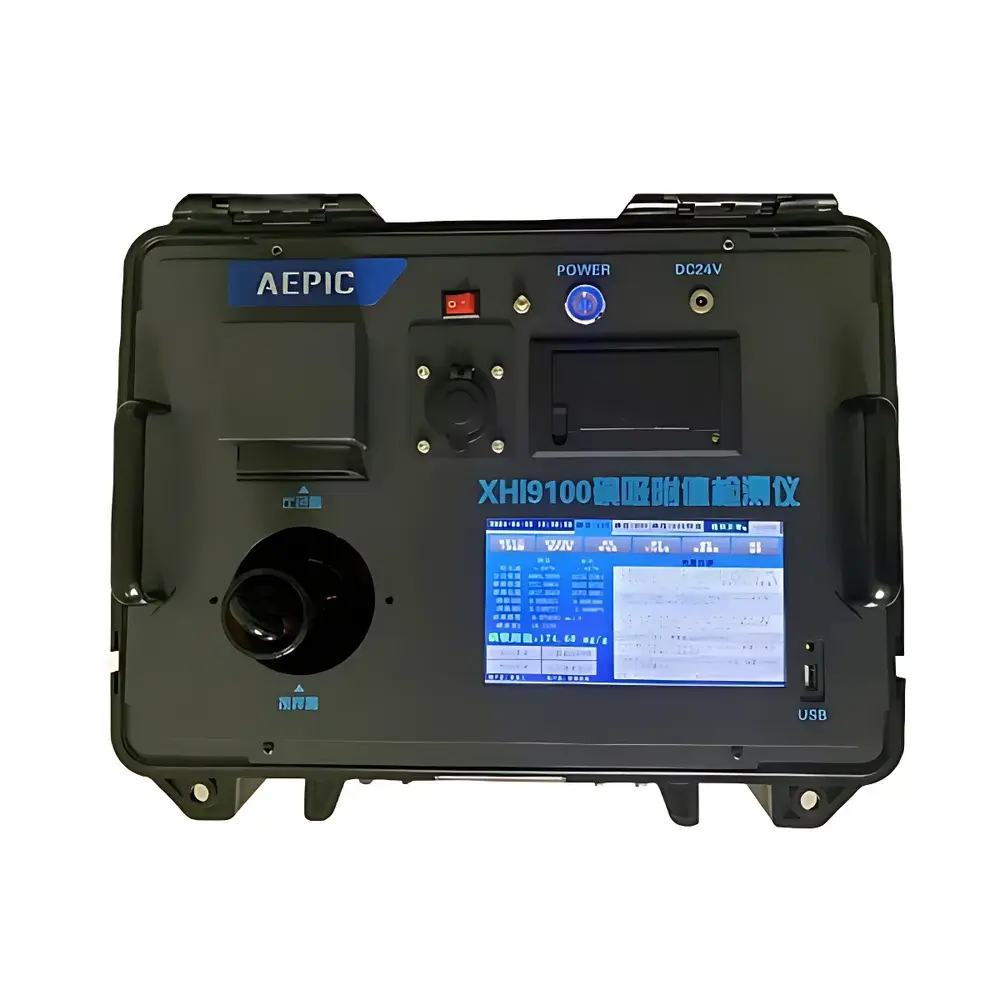
SAIL HERO XHBXI9100 Portable Iodine Number Analyzer
| Brand | SAIL HERO |
|---|---|
| Origin | Hebei, China |
| Manufacturer Type | Manufacturer |
| Country of Origin | China |
| Model | XHBXI9100 |
| Pricing | Upon Request |
Overview
The SAIL HERO XHBXI9100 Portable Iodine Number Analyzer is a field-deployable, benchtop-class instrument engineered for the rapid, quantitative determination of iodine adsorption capacity (iodine number) in activated carbon samples. It operates on the principle of UV-Vis spectrophotometry at 520 nm—measuring residual iodine concentration in the filtrate after standardized adsorption equilibrium per ASTM D4607 and ISO 7833. Unlike classical titrimetric methods, this system eliminates endpoint judgment variability, reagent standardization drift, and operator-dependent dilution errors. The analyzer delivers traceable, reproducible iodine number values (mg I₂/g C) directly from raw or granular activated carbon—without requiring laboratory infrastructure, distilled water supply, or chemical waste handling. Its design targets compliance with routine quality control workflows under GLP-aligned environments and supports audit-ready documentation for regulatory oversight.
Key Features
- UV-Vis dual-beam optical path architecture: Compensates for turbidity interference from suspended carbon fines in filtrate, ensuring measurement integrity without centrifugation or membrane filtration pre-treatment.
- Fully automated assay protocol: Integrates programmable magnetic stirring, precision sample weighing (0.001 g resolution), timed adsorption reaction (30 min ± 10 s), vacuum-assisted filtration, and photometric quantification—all controlled via embedded touchscreen interface.
- Onboard data processing engine: Applies NIST-traceable calibration curves (iodine standards: 0–100 mg/L) and calculates iodine number using the formula: IN = [(C₀ − C₁) × V × 1000] / m, where C₀ and C₁ are initial and residual iodine concentrations (mg/L), V is filtrate volume (L), and m is dry carbon mass (g).
- Integrated peripheral suite: Includes rechargeable Li-ion battery (≥8 h operation), 12 V DC/220 V AC inverter, portable micro-mill for particle size reduction (<150 µm), analytical balance (0.1 mg readability), thermal printer (direct report output), and GPS module for geotagged result logging.
- Ruggedized portable form factor: Dimensions 320 × 240 × 180 mm; total weight <6.2 kg. IP54-rated enclosure withstands dust ingress and incidental moisture during field deployment.
Sample Compatibility & Compliance
The XHBXI9100 accommodates powdered, granular, and pelletized activated carbons—including coal-, wood-, coconut shell-, and lignite-based variants—with nominal particle sizes ranging from 75 µm to 2.0 mm. Sample preparation adheres to ASTM D3860 (standardization of carbon particle size distribution) and ASTM D4607 (iodine number test method). Instrument validation includes linearity (R² ≥ 0.999 over 0–100 mg I₂/g range), repeatability (RSD ≤ 2.1% at 800 mg I₂/g), and intermediate precision across operators and days. Data export formats (CSV, PDF) support integration into LIMS and comply with FDA 21 CFR Part 11 requirements for electronic records and signatures when paired with user authentication and audit trail activation.
Software & Data Management
Embedded firmware v3.2 provides intuitive workflow navigation, real-time absorbance monitoring, and automatic outlier detection based on Beer-Lambert law deviation thresholds. All measurements generate timestamped metadata: GPS coordinates (WGS84), operator ID, sample ID, ambient temperature/humidity, and instrument serial number. Data sync occurs via Wi-Fi or USB to cloud-hosted platforms (e.g., SAIL HERO Cloud Portal) with TLS 1.2 encryption. Audit trails record every parameter change, result modification, or calibration event—enabling full traceability for ISO/IEC 17025 accreditation audits or EPA Region 4 QA/QC reporting.
Applications
- Regulatory field verification: Environmental protection bureaus performing spot-checks on spent carbon from municipal water treatment plants or VOC abatement systems.
- Supplier qualification: Industrial end-users (e.g., pharmaceutical, food-grade carbon purchasers) conducting incoming inspection per USP or EP 2.2.17 specifications.
- Process optimization: Activated carbon manufacturers correlating iodine number with BET surface area and pore size distribution for batch release decisions.
- Emergency response: Rapid assessment of carbon exhaustion in respirator cartridges or hazmat filtration units during incident deployment.
FAQ
What regulatory standards does the XHBXI9100 comply with?
It implements ASTM D4607-22 and ISO 7833:2021 methodologies, with software features aligned with FDA 21 CFR Part 11 and ISO/IEC 17025:2017 data integrity requirements.
Can the instrument measure iodine number for non-standard carbon matrices (e.g., biochar or metal-impregnated carbons)?
Yes—provided the sample exhibits measurable iodine adsorption within the linear dynamic range and does not interfere optically at 520 nm; method validation per ASTM D7265 is recommended for novel matrices.
Is external calibration required before each use?
No. The instrument performs daily self-calibration using integrated reference filters and validates photometric accuracy prior to each assay sequence.
How is data security ensured during wireless transmission?
All Wi-Fi transmissions utilize WPA3-Enterprise encryption and certificate-based mutual authentication with the destination server.
What maintenance intervals are specified for field operation?
Optical path cleaning every 50 assays; battery health check every 6 months; annual factory recalibration recommended for metrological traceability.







