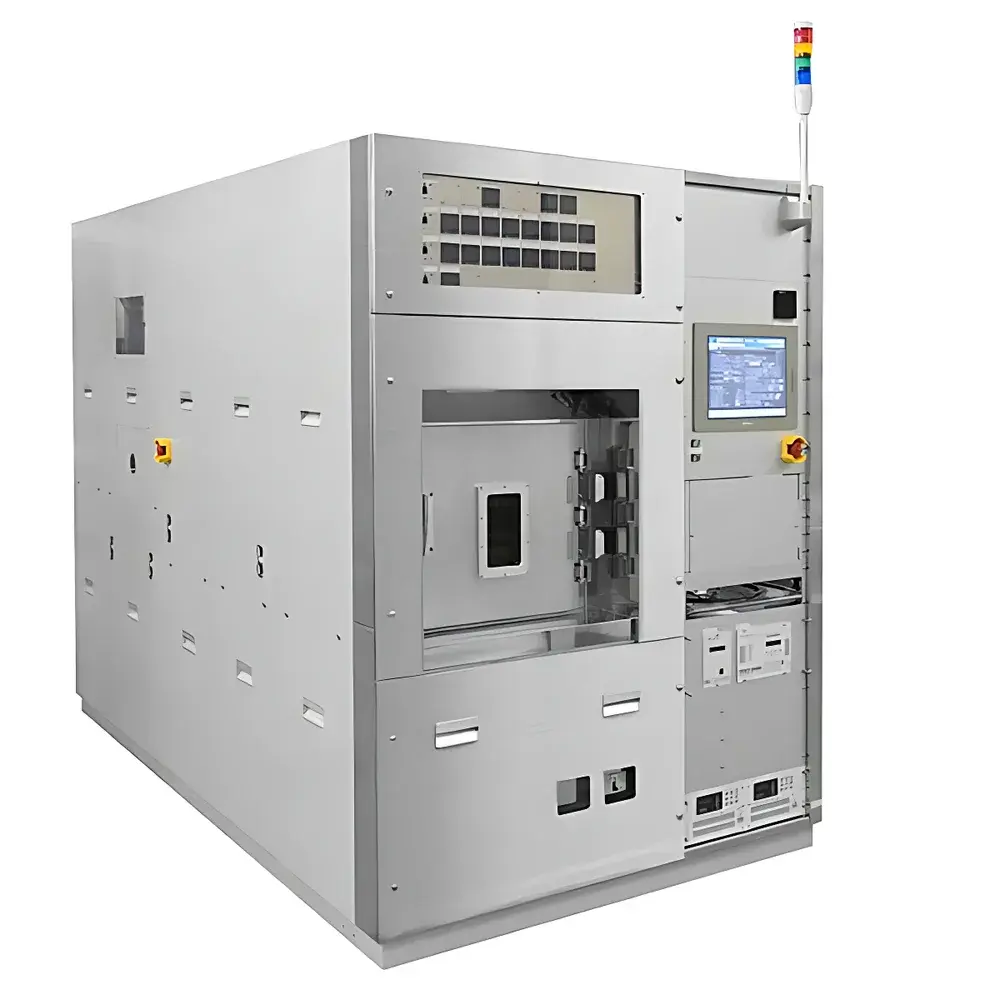
SAMCO RIE-350iPC Inductively Coupled Plasma (ICP) Etching System
| Brand | SAMCO |
|---|---|
| Origin | Japan |
| Model | RIE-350iPC |
| Maximum Wafer Diameter | Ø350 mm |
| ICP Source Technology | HSTC™ (Hyper Symmetrical Tornado Coil) |
| Vacuum Pumping | Turbo Molecular Pump (TMP) with Symmetrical Exhaust Design |
| Gas Delivery | Optimized Multi-Channel Manifold |
| Endpoint Detection | Optional Optical Interferometric Monitoring System |
| Application Scope | GaN, GaAs, InP, SiC, SiN, SiO₂, Dielectrics, Metals, PSS Fabrication |
Overview
The SAMCO RIE-350iPC is a cassette-loaded, high-precision inductively coupled plasma (ICP) etching system engineered for advanced semiconductor fabrication processes. Unlike capacitively coupled plasma (CCP) tools, the RIE-350iPC employs a dedicated RF-powered ICP source to generate high-density, low-pressure plasma—enabling independent control of ion energy and ion flux. This decoupling is critical for achieving anisotropic profiles, high selectivity, and minimal substrate damage in compound semiconductor and wide-bandgap material processing. Designed for batch handling of up to twelve 3-inch wafers, eight 4-inch wafers, or one full 12-inch (Ø300 mm) or 350 mm carrier, the system supports scalable throughput without compromising process reproducibility. Its architecture integrates fundamental plasma physics principles—including electron cyclotron resonance conditions, sheath-controlled ion acceleration, and radical-dominated surface reactions—to deliver repeatable etch rates and profile fidelity across diverse material systems including GaN power devices, VCSELs, micro-LED arrays, RF BAW/Saw filters, and patterned sapphire substrates (PSS).
Key Features
- High-uniformity ICP source utilizing SAMCO’s proprietary HSTC™ (Hyper Symmetrical Tornado Coil) technology—engineered to produce radially symmetric plasma density distribution over Ø350 mm area, minimizing center-to-edge non-uniformity (<±2.5% across 300 mm wafers under standard SiO₂ etch conditions).
- Symmetrical dual-side turbo molecular pumping configuration with optimized conductance paths, ensuring rapid pressure stabilization (<5 sec to reach 1 mTorr from atmospheric), stable plasma ignition, and reduced particle generation.
- Modular, multi-zone gas manifold with individually regulated mass flow controllers (MFCs) for up to six process gases—enabling precise stoichiometric tuning of reactive species (e.g., Cl₂/BCl₃/Ar for GaN, SF₆/CHF₃ for SiO₂, CF₄/O₂ for photoresist stripping).
- Integrated RF bias subsystem (13.56 MHz) with real-time impedance matching and voltage/current monitoring—supporting controlled ion bombardment energy (typically 10–500 eV range) independent of plasma density.
- Optional in-situ endpoint detection via broadband optical interferometry or monochromatic emission spectroscopy—capable of resolving sub-nanometer thickness changes during multilayer stack etching (e.g., AlGaN/GaN heterostructures or Ti/Pt/Au metallization stacks).
Sample Compatibility & Compliance
The RIE-350iPC accommodates standard semiconductor wafer formats (Ø76.2 mm to Ø350 mm) on electrostatic chucks with helium backside cooling, supporting thermal management requirements for high-power etch chemistries. It is compatible with silicon, sapphire, SiC, GaN-on-silicon, GaN-on-sapphire, InP, GaAs, and quartz substrates. Process recipes are validated per industry-standard test structures defined in SEMI E10 (Specification for Definition and Measurement of Equipment Reliability, Maintainability, and Availability) and align with key reliability metrics required for AEC-Q200-compliant power electronics manufacturing. The system’s vacuum integrity, gas leak rate (<1×10⁻⁹ mbar·L/s He), and chamber cleanliness meet ISO Class 5 cleanroom integration requirements. While not certified as GMP or FDA 21 CFR Part 11 compliant out-of-the-box, its logging architecture supports audit-ready data export (CSV/TXT) and optional third-party validation packages for GLP/GMP environments.
Software & Data Management
Control is executed via SAMCO’s proprietary Windows-based GUI platform, featuring recipe-driven operation with hierarchical parameter locking, version-controlled script storage, and real-time plasma parameter logging (RF forward/reflected power, chamber pressure, coil/bias V/I waveforms, gas flows). All process logs—including timestamps, operator IDs, chamber conditions, and endpoint signals—are timestamped and stored locally with SHA-256 checksum verification. Data export conforms to SEMI E142 (Equipment Communication Standard) and supports OPC UA connectivity for integration into factory MES systems. Audit trails record all user actions (login/logout, recipe edits, manual overrides) with immutable timestamps—facilitating compliance with internal quality protocols and external assessments.
Applications
- High-aspect-ratio etching of GaN HEMTs for 5G RF front-end modules and fast-charging power converters.
- Patterning of PSS templates for high-efficiency blue micro-LED epitaxy, with sub-100 nm feature resolution and <0.5° sidewall angle control.
- Anisotropic SiO₂ hard mask removal prior to deep trench etching in MEMS inertial sensors.
- Low-damage dielectric etching (SiNₓ, SiO₂, Al₂O₃) in VCSEL cavity definition and distributed Bragg reflector (DBR) trimming.
- Multi-step metal etching sequences (Ti/Al/Ni/Au, Cr/Au) for RF interconnects and probe card fabrication.
FAQ
What wafer sizes does the RIE-350iPC support?
The system handles carriers up to Ø350 mm, with configurable cassettes for Ø76.2 mm (3″), Ø100 mm (4″), Ø150 mm (6″), Ø200 mm (8″), Ø300 mm (12″), and custom 350 mm carriers.
Is the HSTC™ coil compatible with chlorine-based chemistries for GaN etching?
Yes—the HSTC™ coil is constructed from ceramic-coated aluminum and operates at frequencies and power levels optimized for Cl₂/BCl₃/Ar plasmas, maintaining stable coupling efficiency and minimal erosion over >10,000 etch cycles.
Can endpoint detection be retrofitted to existing RIE-350iPC units?
Yes—optical interferometric and OES-based endpoint modules are field-installable with minimal downtime and require no chamber modification.
Does the system support automated recipe transfer between tools?
Recipe files are portable across RIE-350iPC platforms via encrypted USB import/export; cross-tool consistency is maintained through calibration traceability to NIST-traceable RF and pressure standards.
What maintenance intervals are recommended for the ICP source and vacuum system?
Plasma source inspection is recommended every 500 hours of operation; TMP oil replacement and bearing check every 3,000 hours; chamber cleaning and electrode refurbishment every 10,000 plasma-on minutes, per SAMCO Maintenance Protocol MP-RIE-350iPC Rev. 4.2.
Related Products