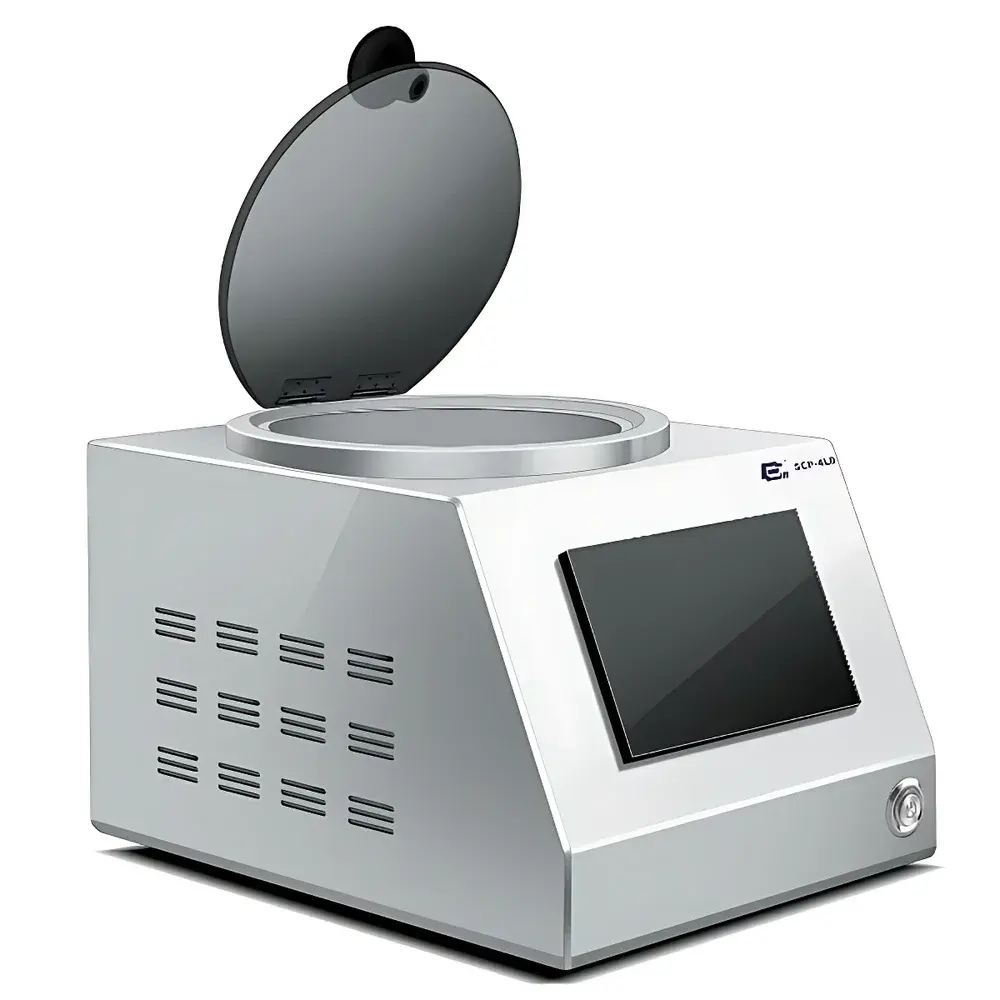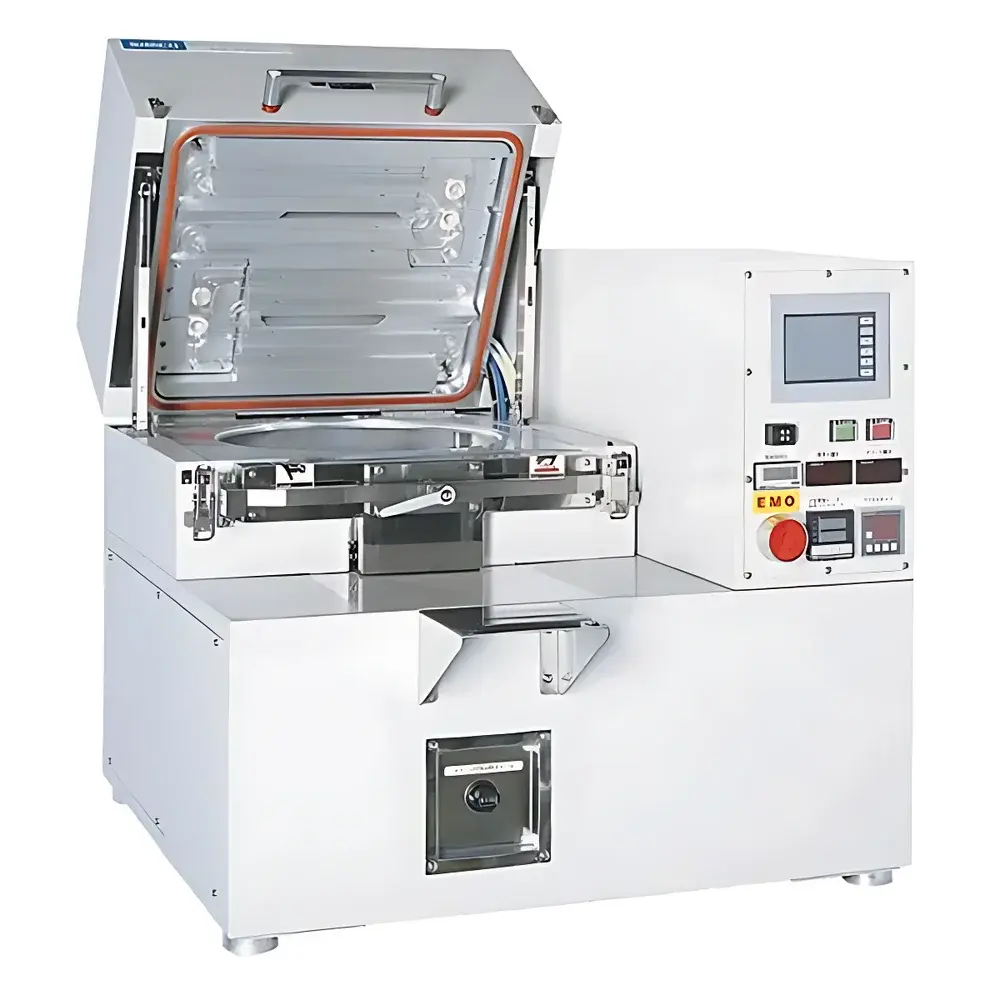
SAMCO UV-300H Benchtop UV-Ozone Cleaner
| Brand | SAMCO |
|---|---|
| Origin | Japan |
| Model | UV-300H |
| Maximum Sample Diameter | Ø800 mm (8-inch) |
| Operating Environment | Ambient Atmospheric Pressure |
| Heating Stage Temperature Range | Room Temperature to 150 °C |
| Safety Features | Interlocked Lid, Ozone Catalyst Scrubber, N₂ Purge Cycle, Thermal Fuse Protection, Emergency Stop |
| Compliance | Designed for ISO Class 5–7 Cleanroom Integration |
Overview
The SAMCO UV-300H is a benchtop ultraviolet-ozone (UV-O₃) surface cleaning system engineered for high-precision, dry, non-contact surface preparation in semiconductor fabrication, MEMS development, and advanced packaging workflows. It operates on the principle of photochemical oxidation: 185 nm and 254 nm UV radiation generated by low-pressure mercury lamps dissociates ambient oxygen (O₂) into atomic oxygen (O), which reacts with additional O₂ molecules to form ozone (O₃). Simultaneously, 254 nm photons directly cleave C–C, C–H, and C–O bonds in organic contaminants while ozone oxidizes residual hydrocarbons into volatile CO₂ and H₂O—both products are evacuated as gaseous effluent. The integrated heated stage (up to 150 °C) accelerates reaction kinetics without thermal stress or plasma-induced damage, making the UV-300H especially suitable for temperature-sensitive substrates such as GaN-on-Si, polymer-based interposers, and thin-film photovoltaic stacks.
Key Features
- Compact footprint (W600 × D700 × H500 mm) optimized for Class 5–7 cleanroom benchtop deployment without requiring dedicated exhaust ducting or vacuum infrastructure.
- Uniform UV irradiance distribution across Ø800 mm processing area, validated per IEC 62471 for UV hazard classification and equipped with real-time lamp intensity monitoring.
- Programmable heating stage with PID-controlled thermal regulation (RT to 150 °C ±2 °C), enabling process optimization for residue removal kinetics and surface energy modulation.
- Fail-safe mechanical lid interlock system that physically disables UV lamp power and ozone generation upon door opening—compliant with ISO 13857 safety distance requirements.
- Integrated catalytic ozone destruct unit (MnO₂-based) reducing outlet O₃ concentration to <0.05 ppm (per OSHA PEL and JIS B 9924), verified via onboard electrochemical sensor feedback loop.
- Automated N₂ purge cycle initiated pre- and post-process to displace ambient air, minimize recontamination, and suppress nitric oxide formation during UV exposure.
Sample Compatibility & Compliance
The UV-300H accommodates rigid and semi-rigid substrates including silicon wafers (up to 8-inch diameter), sapphire, quartz, fused silica, alumina ceramics, LTCC/HTCC substrates, polyimide and benzocyclobutene (BCB) coated leadframes, and compound semiconductor epiwafers (GaN, GaAs, InP, SiC). Its atmospheric operation eliminates risk of charging damage associated with RF plasma systems—critical for gate oxide integrity in CMOS and AlGaN/GaN HEMT processes. The system meets functional safety requirements per IEC 61000-6-2 (immunity) and IEC 61000-6-4 (emissions), and supports audit-ready documentation for GLP/GMP environments through optional RS-232/RS-485 logging interface. While not certified to FDA 21 CFR Part 11 out-of-the-box, its process parameter logging architecture is compatible with third-party electronic signature and audit trail software.
Software & Data Management
The UV-300H employs a microcontroller-based embedded control system with a 4.3-inch TFT-LCD touchscreen interface. All process parameters—including UV exposure time (0.1–999.9 min), stage temperature setpoint, N₂ purge duration, and lamp on/off sequencing—are stored in non-volatile memory with timestamped event logging (last 1,000 cycles). Optional Ethernet or USB-C data export enables integration into MES platforms (e.g., CIMLink, FactoryTalk) for SPC traceability. Process recipes can be duplicated, renamed, and protected by password-level access control (three-tier user roles: Operator, Engineer, Administrator). No proprietary drivers or cloud dependencies are required—data files conform to CSV/ASCII format for direct import into JMP, Minitab, or Python pandas workflows.
Applications
- Pre-bonding surface activation of silicon and glass wafers to enhance hydrophilicity and improve anodic bonding yield.
- Removal of spin-coated photoresist residues and post-etch organic polymers from GaN HEMT gate recesses without undercutting or surface pitting.
- Surface oxidation of SiC substrates to grow native 1–3 nm SiO₂ layers prior to ALD nucleation—demonstrated in IEEE Electron Device Letters (2022, Vol. 43, No. 5).
- Cleaning of polymer-molded QFN and fan-out wafer-level packages prior to underfill dispensing, achieving >95% void reduction in reliability-tested assemblies.
- UV curing of silane-based adhesion promoters on ceramic substrates used in high-power LED packaging.
- Restoration of contact angle uniformity on microfluidic PDMS chips after repeated handling or storage.
FAQ
What is the maximum allowable substrate thickness for the UV-300H?
The standard stage accommodates substrates up to 50 mm thick; custom-height spacers are available for thicker carriers or cassettes.
Can the UV-300H operate continuously for extended periods?
Yes—the lamp cooling system and thermal management architecture support uninterrupted operation up to 8 hours per cycle, with automatic lamp duty cycling to extend lifetime beyond 5,000 hours.
Is ozone exhaust routing mandatory?
While the built-in catalyst reduces outlet O₃ to safe levels, local industrial hygiene regulations may require connection to a central exhaust manifold; SAMCO provides compliant vent adapter kits (DN50 flange, ISO-KF compatible).
How is lamp aging compensated during long-term use?
The system includes manual UV intensity calibration mode using a NIST-traceable radiometer; intensity drift compensation is applied via firmware gain adjustment during recipe execution.
Does the UV-300H support remote monitoring via Ethernet?
Standard configuration includes RS-232; Ethernet (TCP/IP Modbus RTU) and digital I/O expansion modules are factory-installable options with OEM documentation provided.