
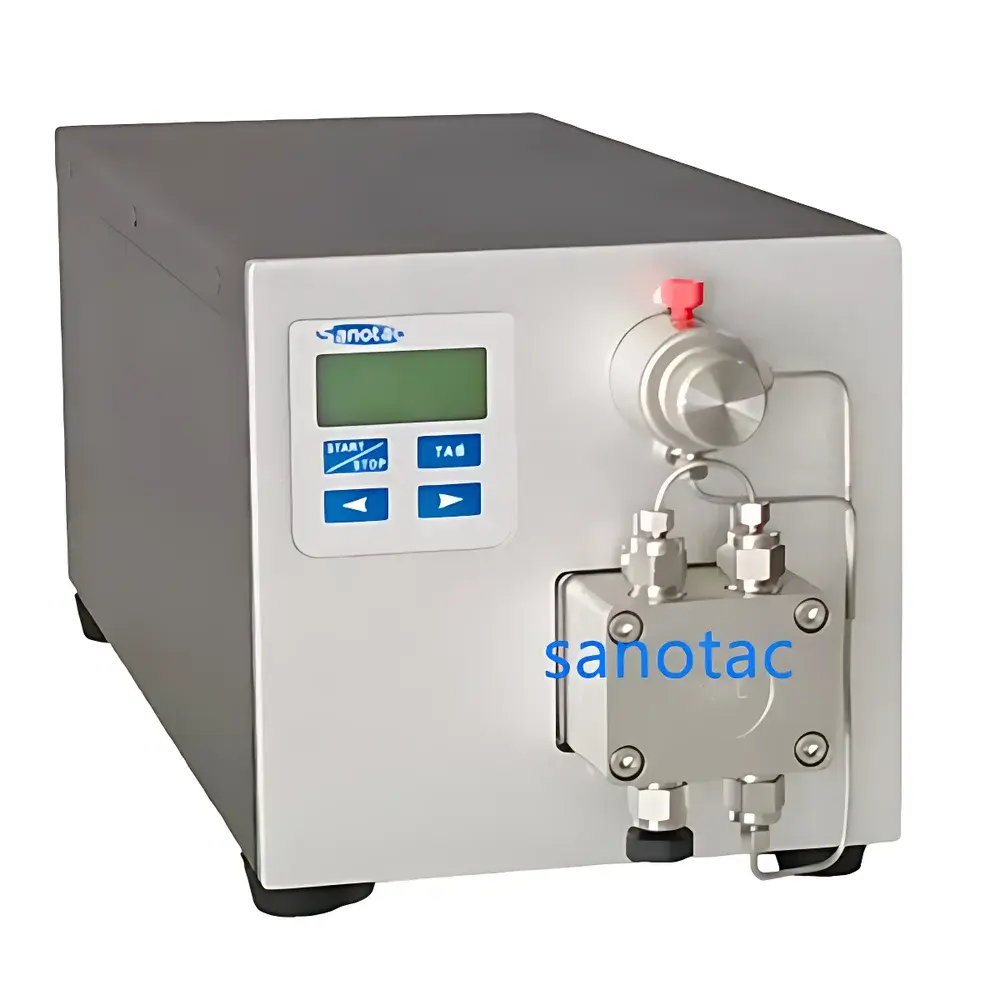
Sanotac AP0030 Analytical High-Pressure Syringe Pump
| Brand | Sanotac |
|---|---|
| Origin | Shanghai, China |
| Manufacturer Type | Direct Manufacturer |
| Model | AP0030 |
| Flow Rate | 0.001–2.000 mL/min |
| Increment | 0.001 mL/min |
| Flow Accuracy | ±0.1% |
| Flow Precision (RSD) | ≤0.1% |
| Maximum Pressure | 42 MPa |
| Pressure Ripple | ≤0.1 MPa |
| Pumping Mechanism | Dual-piston series configuration with floating piston design |
| Wetted Materials | 316L stainless steel, ruby, PTFE, ceramic |
| Tubing Connection | 1/16" standard fittings |
| Display | 256×64 dot matrix backlit LCD |
| Control Interface | Front-panel keypad + RS232/485/422, USB, Ethernet (Modbus RTU/ASCII, Profibus DP, Profinet), analog/digital I/O |
| Power Supply | 85–264 VAC, 50 Hz |
| Dimensions | 370 × 240 × 152 mm |
Overview
The Sanotac AP0030 Analytical High-Pressure Syringe Pump is an engineered precision fluid delivery system designed for low-flow, high-pressure applications in analytical instrumentation and process-critical laboratory environments. Based on dual-piston serial displacement architecture with floating piston compensation, the AP0030 delivers stable, pulse-minimized flow across its full operational range of 0.001–2.000 mL/min — a specification aligned with ISO 5725-2 accuracy requirements for volumetric metering devices. Its maximum pressure rating of 42 MPa (6090 psi) supports compatibility with sub-2-µm particle-packed columns, supercritical fluid chromatography (SFC), and high-viscosity solvent systems commonly encountered in preparative HPLC, microfluidic synthesis, and reaction monitoring setups. The pump’s core function relies on positive displacement via synchronized, electronically compensated cam-driven pistons — eliminating reliance on feedback-based pressure regulation while maintaining intrinsic flow linearity and long-term drift stability.
Key Features
- High-fidelity flow control: Factory-calibrated multi-point flow correction across the entire 0.001–2.000 mL/min range ensures traceable accuracy (±0.1%) and repeatability (RSD ≤0.1%), compliant with ASTM D3418 and USP method validation criteria.
- Active pulse suppression: Integrated cam-profile optimization combined with real-time electronic flow ripple compensation reduces pressure fluctuations to ≤0.1 MPa — critical for baseline stability in UV-Vis and mass spectrometric detection.
- Intelligent pressure management: Programmable pressure limit protection, zero-offset calibration, and ambient temperature compensation mitigate mechanical hysteresis and thermal expansion effects in extended-run protocols.
- Extended service life engineering: Automatic post-stroke plunger wash cycle minimizes particulate accumulation at seal interfaces, reducing wear on ruby/PTFE seals and extending mean time between maintenance (MTBM) by >40% versus conventional single-piston designs.
- Modular control architecture: Native support for RS232/485/422, USB 2.0, Ethernet (TCP/IP), and industrial fieldbus protocols (Modbus RTU/ASCII, Profibus DP, Profinet) enables seamless integration into SCADA, DCS, and PLC-controlled chemical reactors or automated QC workflows.
- Dual-mode operation: Supports both volumetric (mL/min) and gravimetric (g/min) delivery modes with real-time density compensation — essential for solvent mixtures and temperature-sensitive formulations in API synthesis and formulation development.
Sample Compatibility & Compliance
The AP0030 accommodates chemically aggressive solvents and suspensions through wetted-path construction using 316L stainless steel, sapphire check valves, PTFE sealing elements, and ceramic piston rods — validated per ASTM F2136 for corrosion resistance in halogenated and acidic media. All fluidic interfaces conform to ISO 8536-4 (syringe standards) and ASTM E2656 (HPLC pump qualification). The device meets CE marking requirements under the Machinery Directive 2006/42/EC and EMC Directive 2014/30/EU. Optional firmware modules provide 21 CFR Part 11-compliant audit trails, electronic signatures, and role-based access control — enabling deployment in GLP and GMP-regulated laboratories conducting method transfer, stability studies, or extractables/leachables testing.
Software & Data Management
The AP0030 operates with Sanotac’s PumpControl Suite v3.x — a Windows-based application supporting method creation, real-time visualization of flow/pressure transients, and synchronized data logging at up to 10 Hz resolution. All acquisition parameters (flow profile, pressure setpoint, dwell time, gradient slope) are stored in XML-based method files with SHA-256 checksum integrity verification. Export formats include CSV (for Excel/LabVIEW ingestion), PNG/JPEG (for regulatory documentation), and HDF5 (for MATLAB/Python post-processing). Remote operation is enabled via secure HTTPS REST API or OPC UA server — allowing centralized orchestration in multi-pump cluster configurations typical in parallel reaction screening or continuous manufacturing platforms.
Applications
- Analytical and preparative liquid chromatography requiring ultra-low dispersion and pressure robustness (e.g., UHPLC, SFC, SEC-MALS).
- Microreactor feed control in flow chemistry systems, including photochemical and electrochemical synthesis.
- Calibration fluid delivery for gas chromatograph vaporizers and ICP-MS nebulizers.
- Controlled infusion in dissolution testing apparatus per USP and .
- Gravimetric dosing in catalyst screening rigs and polymerization kinetics studies.
- Automated sample introduction in elemental analysis (ICP-OES, AAS) and hyphenated techniques (LC-ICP-MS).
FAQ
What is the minimum programmable flow rate and its resolution?
The AP0030 supports flow programming from 0.001 mL/min with 0.001 mL/min increment resolution — verified per ISO 5725-2 repeatability protocols.
Does the pump support gradient elution with multiple solvents?
Yes — when integrated with Sanotac’s optional high-pressure mixing module (AP-MIX-2CH), it enables binary gradient formation with independent flow control and dynamic composition adjustment.
Can the AP0030 be validated for GxP use?
Yes — with optional 21 CFR Part 11 firmware package, IQ/OQ documentation templates, and NIST-traceable flow calibration certificates available upon request.
What maintenance intervals are recommended for routine operation?
Plunger seals require replacement every 6,000 operating hours or 12 months (whichever occurs first); check valves should be inspected quarterly under continuous 24/7 operation.
Is remote firmware update supported?
Yes — over-the-air updates are delivered via encrypted HTTP(S) channel with cryptographic signature verification and rollback capability.



