
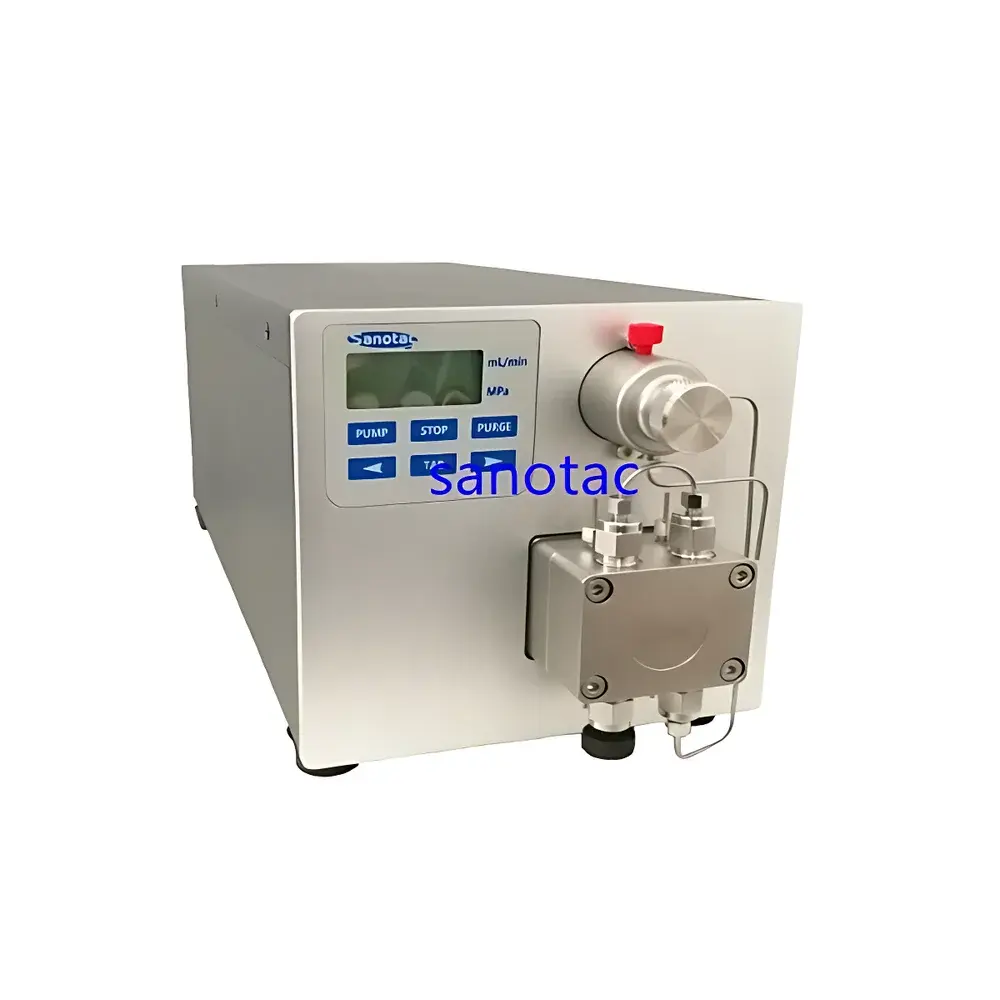
Sanotac FD-50 High-Pressure Constant Flow Pump for Aviation Kerosene Delivery in Engine Test Rigs
| Brand | Sanotac |
|---|---|
| Model | FD-50 |
| Flow Range | 0.01–50.00 mL/min |
| Flow Increment | 0.01 mL/min |
| Flow Accuracy | ±0.5% |
| Flow Precision (RSD) | ≤0.1% |
| Maximum Pressure | 30 MPa |
| Pressure Pulsation | ≤0.2 MPa |
| Pump Head Material | 316L Stainless Steel, Sapphire, PTFE, Ceramic |
| Fluid Path Connection | 1/16" Standard Fitting |
| Display | 256×64 Dot Matrix Backlit LCD |
| Control Interface | Front Panel Keypad + RS232/Ethernet Computer Remote Control (Open Protocol) |
| Power Supply | 85–264 VAC, 50 Hz |
| Dimensions | 370 × 240 × 152 mm |
Overview
The Sanotac FD-50 High-Pressure Constant Flow Pump is an engineered solution for precise, pulse-free delivery of aviation kerosene (Jet A-1, JP-8) and other hydrocarbon-based fuels in aerospace engine test rigs and propulsion system validation laboratories. Designed around dual parallel plunger architecture with floating plunger mechanics and cam-profile compensation, the FD-50 operates on positive displacement principles to deliver stable volumetric flow under sustained high backpressure—up to 30 MPa (4350 psi). Its core function is not merely fluid conveyance but metrological-grade flow control: critical for simulating real-world fuel injection dynamics, calibrating combustion chamber inlet conditions, and validating fuel system integrity under transient thermal and pressure loads. Unlike general-purpose peristaltic or diaphragm pumps, the FD-50 employs solvent compressibility compensation algorithms and multi-point flow calibration curves to maintain accuracy across its full dynamic range—from 0.01 mL/min (micro-dosing for sensor calibration) to 50.00 mL/min (full-scale rig operation)—without recalibration.
Key Features
- Dual parallel plunger design with floating plunger mechanism minimizes seal wear and extends service life under continuous high-pressure operation.
- Cam curve optimization combined with electronic flow pulsation suppression reduces pressure ripple to ≤0.2 MPa—essential for avoiding spurious transients in pressure-sensitive instrumentation and fuel metering subsystems.
- Multi-point flow calibration algorithm corrects for fluid compressibility, temperature-induced viscosity drift, and mechanical hysteresis across the entire 0.01–50.00 mL/min range.
- Chemically inert fluid path constructed from 316L stainless steel, sapphire check valves, PTFE seals, and ceramic components ensures long-term compatibility with aviation kerosene, synthetic jet fuels (e.g., FT-SPK), and additive-laden blends.
- Open-protocol RS232/Ethernet interface supports bidirectional communication with third-party test automation platforms (e.g., NI LabVIEW, MATLAB, Keysight PathWave), enabling synchronized pump control within larger engine test orchestration frameworks.
- Backlit 256×64 dot-matrix LCD display provides real-time monitoring of flow rate, pressure, gradient profile, error codes, and active program status—operable without external software.
Sample Compatibility & Compliance
The FD-50 is validated for use with aviation turbine fuels conforming to ASTM D1655 (Jet A, Jet A-1), DEF STAN 91-91 (JP-8), and MIL-DTL-83133E specifications. Its wetted materials meet ASTM G124 requirements for hydrocarbon compatibility and exhibit no measurable leaching or swelling after 1000-hour exposure testing per ISO 4624 adhesion protocols. The pump’s mechanical design complies with ISO 5801 for centrifugal fan/pump safety margins and incorporates overpressure protection per EN 13445-3 Annex C. While not intrinsically rated for Zone 1 hazardous areas, optional explosion-proof enclosures (ATEX II 2G Ex db IIB T4 Gb) are available upon request. All firmware versions support audit trail logging and user access control—aligning with GLP/GMP data integrity expectations per FDA 21 CFR Part 11 when integrated into regulated test environments.
Software & Data Management
The FD-50 supports both standalone operation and networked deployment. Its embedded controller stores up to ten user-defined programs—including flow ramps, step gradients, hold periods, and pressure-triggered pauses—with non-volatile memory retention. Remote control utilizes a documented ASCII command set (open protocol), enabling integration into custom Python, C#, or LabVIEW applications without proprietary drivers. Optional Sanotac PumpControl™ software (Windows/Linux/macOS) provides graphical gradient editor, real-time flow/pressure trending, CSV export with timestamped metadata, and automated compliance reporting (e.g., flow accuracy verification logs per ISO 5725-2). All data exports include instrument ID, firmware revision, calibration date, and operator ID—supporting traceability requirements in accredited testing laboratories.
Applications
- Fuel delivery simulation in gas turbine engine test cells (e.g., component-level combustor testing, fuel nozzle characterization).
- High-pressure fuel conditioning for alternative fuel certification (SAE AS6035, ASTM D7566 Annexes).
- Dynamic viscosity measurement systems requiring constant shear-rate fluid supply.
- Calibration of Coriolis mass flow meters and ultrasonic fuel flow sensors under realistic pressure and temperature profiles.
- Long-duration endurance testing of fuel filtration systems and electrostatic dissipater additives.
- Research into fuel thermal stability and coking behavior under controlled residence time and wall temperature conditions.
FAQ
What materials contact the fuel stream in the FD-50?
The primary wetted components are 316L stainless steel pump body and head, sapphire inlet/outlet check valves, PTFE piston seals, and ceramic valve seats—all selected for resistance to hydrocarbon swelling, oxidation, and trace sulfur compound attack.
Can the FD-50 operate continuously at 30 MPa?
Yes—rated for continuous duty at maximum pressure with appropriate cooling and ambient temperature ≤40°C; derating is recommended above 40°C per ISO 15552 Annex E guidelines.
Is flow accuracy verified per ISO 5725 or ASTM D3418?
Calibration certificates include traceable gravimetric verification per ISO 4185, with uncertainty budgets reported per ISO/IEC 17025:2017 Annex A.
Does the pump support gradient elution like HPLC systems?
While not designed for chromatographic separation, its programmable flow ramping and multi-step profiles enable controlled fuel composition transitions during combustion testing—functionally analogous to gradient programming.
How is maintenance performed on the plunger seals?
Seal replacement requires only standard hex tools and takes <15 minutes; spare kits include torque-specification charts and alignment jigs per manufacturer’s service manual Rev. 4.2.
Related Products



