
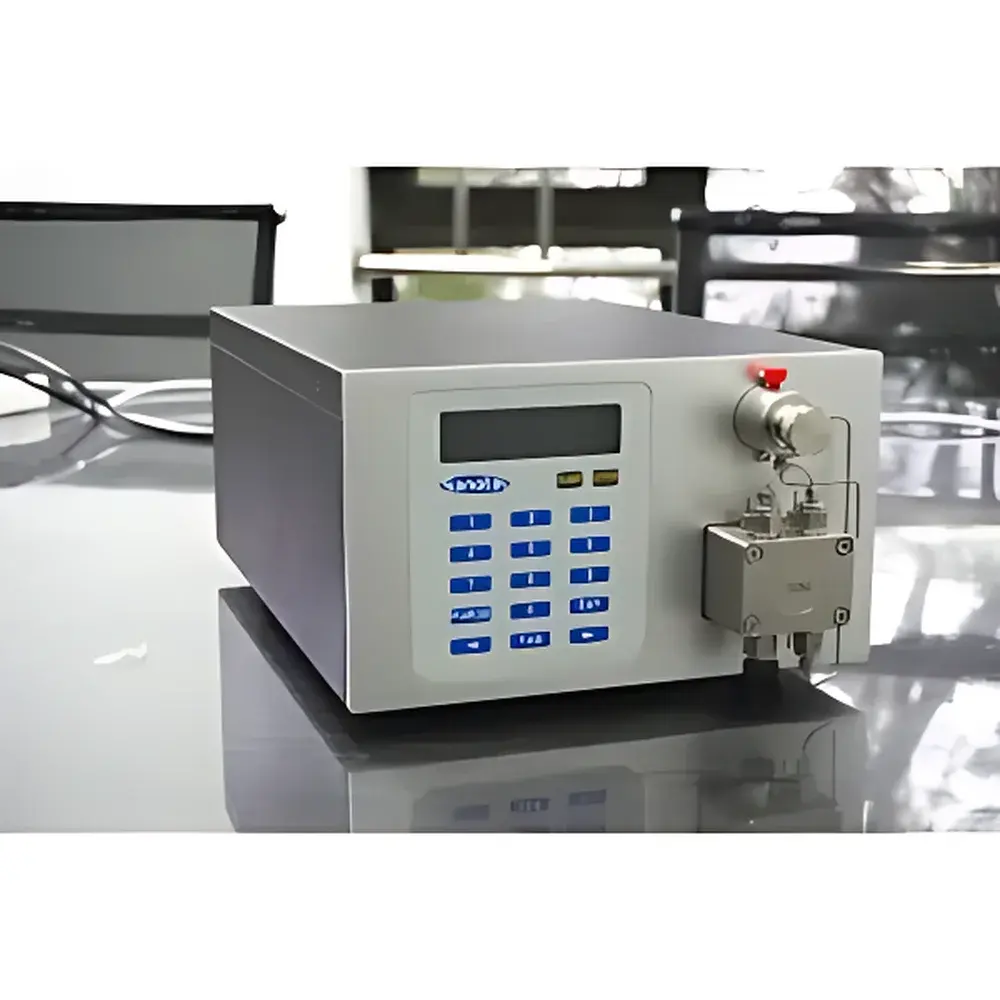
Sanotac MP Series High-Pressure Constant Flow Pump for Precise Delivery of Meltblown Polypropylene Additives
| Brand | Sanotac |
|---|---|
| Origin | Shanghai, China |
| Manufacturer Type | Direct Manufacturer |
| Region Classification | Domestic (China) |
| Model | MP |
| Price Range | USD 1,400 – 2,800 (FOB) |
| Flow Rate | 0.01–100.00 mL/min |
| Maximum Pressure | 20 MPa |
| Flow Accuracy | ±0.5% |
| Flow Precision (RSD) | ≤0.1% |
| Pressure Pulsation | ≤0.2 MPa |
| Wetted Materials | 316L Stainless Steel, Sapphire, PTFE, Ceramic |
| Communication | RS-232, USB (standard) |
| Display | 256×64-dot backlit LCD |
| Power Supply | 85–264 VAC, 50 Hz |
| Dimensions | 370 × 240 × 152 mm |
Overview
The Sanotac MP Series is a high-pressure, dual-piston parallel constant flow pump engineered for precision fluid delivery in demanding R&D and pilot-scale chemical synthesis environments. It operates on the principle of reciprocating positive displacement, where two independently actuated pistons—driven by a cam-follower mechanism with optimized motion profile—alternate suction and discharge phases in phase-shifted sequence. This architecture eliminates dead volume between strokes and ensures continuous, pulse-minimized flow under constant pressure conditions up to 20 MPa. The pump is specifically validated for metering thermally sensitive, low-viscosity organic peroxides—including di-tert-butyl peroxide (DTBP)—used as initiators in meltblown polypropylene (PP) fiber production, a critical process for high-efficiency filtration media in medical respirators. Its robust mechanical design, combined with real-time pressure and flow monitoring, supports GLP-compliant process development workflows in polymer chemistry, microreactor integration, and continuous pharmaceutical manufacturing.
Key Features
- Dual-piston parallel architecture with floating piston design and cam-profile compensation for <0.2 MPa pressure pulsation at full load
- High-accuracy flow control: ±0.5% absolute accuracy and ≤0.1% RSD across 0.01–100.00 mL/min range, enabled by solvent compressibility compensation and multi-point flow curve calibration
- Configurable pressure protection: programmable upper/lower limits with automatic shutdown and alarm logging
- Integrated column backwash function to prevent crystalline salt deposition on sapphire seals and stainless-steel plunger rods
- Real-time graphical display of synchronized pressure and flow rate curves on 256×64 backlit LCD
- Flexible unit selection: volumetric (mL/min) or gravimetric (g/min) flow output, supporting closed-loop control with external analytical balances via custom interface
- Comprehensive data logging: time-stamped pressure/flow trajectories exportable to Excel (.csv) with user-defined sampling intervals
- Multi-level communication support: RS-232 and USB standard; RS-485/RS-422 optional; protocol compatibility with Modbus RTU/ASCII and Sanotac’s native serial command set
- Scalable control architecture: single-pump operation or coordinated multi-pump gradient programming (up to 1:32 master-slave configuration)
- User-configurable parameter storage: retains pressure thresholds, flow programs, serial port settings, and calibration offsets across power cycles
Sample Compatibility & Compliance
The MP Series accommodates a broad spectrum of chemically aggressive and low-volatility fluids common in polymer synthesis, including organic peroxides, halogenated solvents, and aqueous salt solutions. Wetted components—316L stainless steel pump heads, sapphire check valves, PTFE seals, and ceramic plungers—are selected for resistance to oxidation, corrosion, and abrasion. The system meets mechanical safety requirements per ISO 12100 and conforms to electromagnetic compatibility standards EN 61326-1. While not certified for Class I Div 1 hazardous locations, its design supports integration into intrinsically safe systems when paired with appropriate barrier modules. For regulated environments, audit-trail-capable data logging satisfies core elements of FDA 21 CFR Part 11 (electronic records/signatures) when deployed with validated software layers and access-controlled user accounts.
Software & Data Management
The MP pump operates autonomously via front-panel interface but is fully controllable through PC-based host software (Windows/Linux/macOS compatible) supporting script-driven method sequencing, real-time dashboard visualization, and batch-wise export of operational metadata. All logged pressure and flow traces include UTC timestamps, device ID, and firmware version. Exported CSV files are structured for direct import into MATLAB, Python (pandas), or statistical process control (SPC) platforms. Firmware updates are performed via USB without external programmers. Remote diagnostics and parameter synchronization across distributed pump networks are supported using TCP/IP-over-serial bridges compliant with RFC 2217.
Applications
- Precision dosing of DTBP and other radical initiators in meltblown PP extrusion lines for consistent fiber diameter and filtration efficiency
- Continuous-flow synthesis in microreactors requiring stable reagent stoichiometry under elevated backpressure
- Automated catalyst injection in polymerization kinetics studies (e.g., Ziegler–Natta, metallocene systems)
- Calibration fluid delivery for viscometers, densitometers, and online NIR spectrometers
- Gradient elution in preparative HPLC and supercritical fluid chromatography (SFC) systems
- Controlled reagent addition in electrochemical flow cells and fuel cell test benches
- Environmental simulation chambers requiring trace-level additive infusion into gas-phase reaction streams
FAQ
What materials are in contact with the fluid path?
The wetted materials consist of 316L stainless steel (pump head, inlet/outlet manifolds), sapphire (check valve seats and balls), PTFE (seals and gaskets), and ceramic (plunger surface). These materials provide broad chemical compatibility while maintaining dimensional stability under sustained 20 MPa pressure.
Can the pump be integrated into an automated GMP manufacturing line?
Yes—the MP Series supports deterministic communication protocols (Modbus RTU, ASCII), time-synchronized data logging, and configurable alarm handling required for validation under Annex 11 and ISPE GAMP 5. Full qualification documentation (IQ/OQ templates) is available upon request.
Is flow calibration traceable to NIST standards?
While the pump itself does not include built-in NIST-traceable calibration, its multi-point flow correction algorithm accepts user-provided gravimetric or volumetric reference measurements. We recommend annual verification using certified flow meters traceable to national metrology institutes.
How is pulsation minimized at high pressure?
Pulsation suppression employs three concurrent strategies: (1) cam-profile optimization to linearize piston velocity, (2) electronic flow pulse cancellation via real-time feedback from internal pressure transducers, and (3) dual-piston phase offset ensuring overlapping discharge strokes.
Does the pump support gradient mixing with multiple solvents?
The MP Series is a single-channel constant flow device. Gradient capability requires external manifold integration or pairing with Sanotac’s multi-pump controller (model MPC-32), which enables synchronized, ratio-controlled delivery from up to four independent MP units.



