
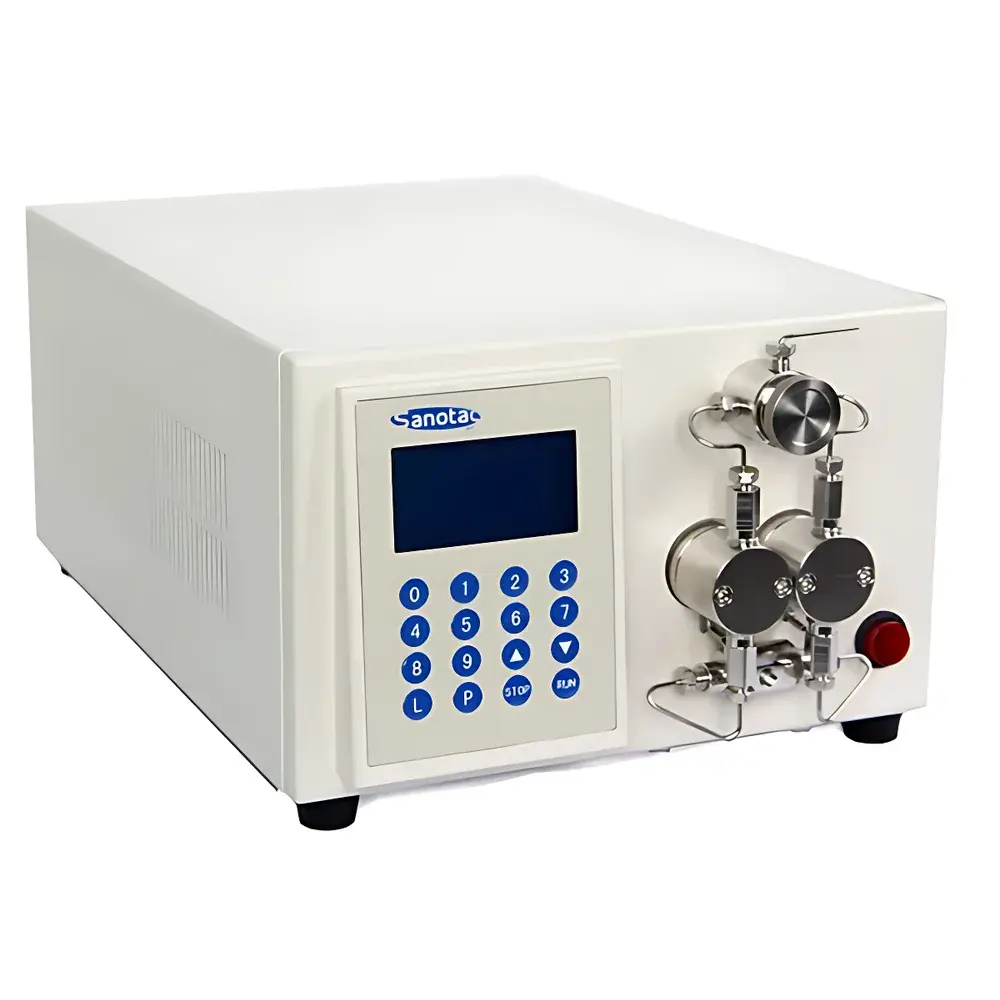
Sanotac MP0502 Medium-Pressure Chromatography Pump
| Brand | Sanotac |
|---|---|
| Origin | Shanghai, China |
| Manufacturer Type | Manufacturer |
| Product Category | Domestic |
| Model | MP0502 |
| Flow Rate | 0.1–50.0 mL/min |
| Maximum Pressure | 2 MPa |
| Flow Accuracy | ±1% |
| Flow Precision (RSD) | ≤1% |
| Pressure Pulsation | ≤0.1 MPa |
| Wetted Materials | 316L stainless steel, ruby, PTFE, zirconia ceramic |
| Control Interface | Front-panel keypad + RS232/USB computer remote control (open protocol) |
| Power Supply | 85–264 VAC, 50 Hz |
| Power Consumption | 75 W |
| Dimensions | 360 × 260 × 160 mm |
| Weight | 12 kg |
Overview
The Sanotac MP0502 Medium-Pressure Chromatography Pump is an engineered solution for laboratories requiring precise, stable, and scalable solvent delivery in preparative and analytical-scale column chromatography. Unlike low-pressure peristaltic or syringe-based systems, the MP0502 operates on a dual-piston parallel pumping architecture with active solvent compressibility compensation—enabling consistent volumetric flow across a wide pressure range (up to 2 MPa / 20 bar). This capability bridges the performance gap between conventional gravity-fed or low-pressure (<0.5 MPa) systems and high-end HPLC-grade pumps, making it ideal for medium-pressure flash chromatography, gradient purification of natural products, and method development for downstream analytical validation. Its design adheres to fundamental fluid mechanics principles of positive displacement pumping, with microprocessor-driven real-time flow correction via multi-point calibration curves—ensuring traceable, reproducible eluent delivery critical for method transfer and regulatory compliance.
Key Features
- High-accuracy flow delivery: Achieves ±1% flow accuracy and ≤1% RSD across the full 0.1–50.0 mL/min range, enabled by dual-servo-controlled parallel pistons and dynamic solvent compressibility modeling.
- Low-pressure pulsation: Incorporates cam-profile optimization and electronic pulse suppression algorithms to maintain pressure ripple ≤0.1 MPa—minimizing baseline noise in UV detection and improving fraction integrity.
- Modular wetted path: Standard 316L stainless steel pump head; optional PEEK head available for enhanced chemical compatibility with aggressive solvents (e.g., THF, DCM, TFA).
- Flexible gradient capability: Supports isocratic, linear, and step gradients via front-panel programming or external workstation control; open-protocol RS232/USB interface enables integration with third-party CDS platforms.
- Robust mechanical architecture: Features floating plunger design to reduce seal wear, imported Swiss check valves (ruby/sapphire seats), and hardened cam transmission—resulting in extended mean time between failures (MTBF > 15,000 hours).
- User-centric operation: Built-in memory for 10 customizable methods; intuitive LCD interface with real-time pressure/flow monitoring; password-protected parameter locking for GLP environments.
Sample Compatibility & Compliance
The MP0502 is compatible with standard glass chromatography columns (15–100 mm i.d.), stainless-steel medium-pressure columns (up to 25 mm i.d.), and packed cartridges using silica, C18, amino, cyano, and diol stationary phases. It supports mobile phases ranging from aqueous buffers (pH 2–10) to organic solvents including methanol, acetonitrile, ethyl acetate, and dichloromethane. The pump meets mechanical safety requirements per IEC 61010-1 and electromagnetic compatibility (EMC) standards per EN 61326-1. While not certified for GMP manufacturing, its audit-trail-capable firmware, programmable method locking, and deterministic flow behavior support alignment with FDA 21 CFR Part 11 (when deployed with compliant software), USP , and ISO/IEC 17025 method validation frameworks.
Software & Data Management
The MP0502 supports both standalone operation and computer-controlled sequencing via ASCII-based serial communication (RS232 or USB-to-serial). Its open command protocol allows seamless integration with open-source tools (e.g., Python-based LabVIEW alternatives) or commercial chromatography data systems (CDS) such as Chromeleon, Empower, or OpenLab. All flow/pressure setpoints, gradient profiles, and runtime logs are timestamped and exportable in CSV format. Firmware updates are performed via USB stick, with version rollback capability. No cloud connectivity or proprietary cloud accounts are required—ensuring full data sovereignty and IT security compliance in regulated academic and industrial labs.
Applications
- Purification of plant-derived alkaloids, flavonoids, terpenoids, and saponins using silica or reversed-phase media under 0.5–2 MPa backpressure.
- Preparative isolation of synthetic intermediates and APIs where crystallization-grade purity (>99%) is required prior to NMR or MS characterization.
- Method scouting for analytical HPLC: rapid screening of gradient slopes, dwell volume effects, and column loading capacity at sub-analytical flow rates.
- Stable isotope labeling workflows requiring consistent co-solvent delivery (e.g., D2O/acetonitrile mixtures) without phase separation or pulsation-induced band broadening.
- Multi-step orthogonal purification cascades—e.g., ion exchange followed by size exclusion—using pump-switching protocols within a single run sequence.
FAQ
What is the maximum recommended operating pressure for the MP0502 model?
The MP0502 is rated for continuous operation up to 2 MPa (20 bar); short-term excursions to 2.2 MPa are permissible but not advised for routine use.
Can the pump be used with corrosive solvents like trifluoroacetic acid (TFA) or hydrochloric acid?
Yes—with the optional PEEK pump head and chemically resistant seals; avoid prolonged exposure to >10% TFA in water or concentrated mineral acids without verifying seal compatibility.
Is gradient delay volume characterized and compensatable?
Delay volume is hardware-defined (~1.2 mL for standard configuration) and can be empirically measured; gradient timing offsets are programmable in all supported CDS platforms.
Does the pump support automatic leak detection or pressure override shutdown?
Yes—integrated pressure sensor triggers immediate flow halt and audible alarm if pressure exceeds user-defined threshold (adjustable from 0.5–2.0 MPa).
How is flow calibration performed, and is it traceable to national standards?
Calibration uses gravimetric measurement against NIST-traceable analytical balances; factory calibration certificates include uncertainty budgets per ISO/IEC 17025 guidelines.



