
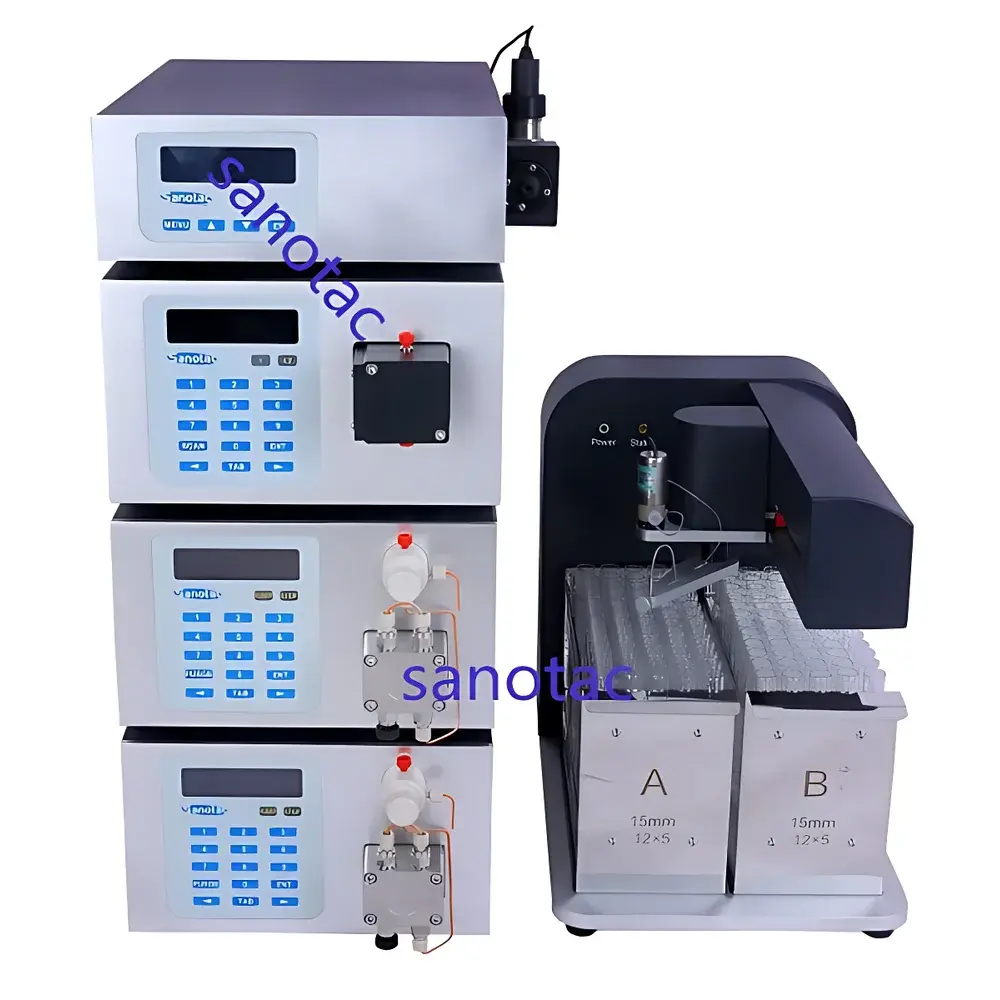
Sanotac Pilot Series Preparative Liquid Chromatography System with FDA 21 CFR Part 11–Compliant Software
| Brand | Sanotac |
|---|---|
| Origin | Shanghai, China |
| Manufacturer Type | OEM Manufacturer |
| Regional Classification | Domestic (China) |
| Model | Pilot |
| Application Level | Laboratory-Scale |
| Instrument Type | High-Pressure Preparative LC |
| Flow Rate Range | 0.01–100.00 mL/min |
| Flow Accuracy | ±1% |
| Flow Precision (RSD) | ≤0.5% |
| Maximum Pressure | 20 MPa |
| Wavelength Range | 190–800 nm |
| Wavelength Accuracy | ±1 nm |
| Wavelength Repeatability | 0.2 nm |
| Baseline Noise | ±0.75×10⁻⁵ AU (254 nm, TC = 1 s) |
| Data Acquisition Rate | 10 Hz |
Overview
The Sanotac Pilot Series Preparative Liquid Chromatography System is a modular, high-pressure preparative HPLC platform engineered for laboratory-scale purification of bioactive compounds, natural product isolates, synthetic intermediates, and therapeutic biomolecules. It operates on the principle of reversed-phase, normal-phase, or ion-exchange liquid chromatography—depending on column chemistry and mobile phase selection—and delivers precise, reproducible separation under programmable gradient conditions. Designed for scalability from analytical method transfer to gram-scale isolation, the system integrates a dual-piston high-pressure pump, dual-wavelength UV-Vis detector, and intelligent fraction collector—all coordinated via the Sanochrom™ control software. Its architecture supports both stainless-steel and medium-pressure glass columns, enabling flexible deployment across small-molecule purification, herbal extract fractionation, peptide refinement, and early-stage biopurification workflows.
Key Features
- Microprocessor-controlled dual-piston parallel pump with real-time chamber pressure feedback, compensating for solvent compressibility and refilling dynamics across the full flow range (0.01–100.00 mL/min).
- Cam-curve flow pulsation compensation and multi-point volumetric calibration ensure flow accuracy of ±1% and repeatability (RSD) ≤0.5%, critical for method robustness and inter-lab transferability.
- Floating plunger design extends seal lifetime under sustained high-pressure operation up to 20 MPa.
- Dual-wavelength UV-Vis detection (190–800 nm) with simultaneous dual-channel monitoring, wavelength programming, stop-flow scanning, and automatic D2/tungsten lamp switching—optimized for sensitivity (baseline noise: ±0.75×10⁻⁵ AU at 254 nm, 1 s time constant) and linearity.
- Intelligent fraction collector featuring hybrid linear–rotary motion, sub-millisecond valve actuation, independent waste channeling, and delay-volume compensation—enabling precise, drip-free tube switching aligned with chromatographic peaks.
- Modular hardware interface supporting 316L stainless-steel or PEEK pump heads, 10 mL preparative injection valve (solid/liquid loading), and customizable collection racks (up to 120 × 13–15 mm tubes).
Sample Compatibility & Compliance
The Pilot system accommodates a broad spectrum of sample matrices—including crude plant extracts, fermentation broths, combinatorial synthesis libraries, and recombinant protein eluates—without requiring hardware modification. Column compatibility spans C18, silica, amino, cyano, and ion-exchange media in bore sizes from 10 mm to 50 mm ID. All operational parameters—including method storage, user authentication, electronic signatures, audit trail generation, and data integrity controls—are fully compliant with FDA 21 CFR Part 11 requirements. The Sanochrom™ software implements role-based access control, immutable audit logs, and ALCOA+ (Attributable, Legible, Contemporaneous, Original, Accurate, Complete, Consistent, Enduring, Available) data governance principles—supporting GLP and GMP-aligned workflows in contract research organizations (CROs), academic core facilities, and pharmaceutical development labs.
Software & Data Management
Sanochrom™ is a Windows-native (Windows 7/8/10) chromatography data system (CDS) that unifies instrument control, real-time visualization, peak integration, and fraction triggering within a single GUI. It supports USB and RS-232 connectivity, stores complete acquisition metadata (including detector lamp hours, pressure transients, and valve cycle counts), and exports ASCII, CSV, and .cdf formats for third-party analysis. Electronic signature workflows adhere to 21 CFR Part 11 Annex 11 expectations, including biometric or token-based sign-off, signature justification fields, and timestamped revision history. Audit trails are encrypted, non-erasable, and exportable in PDF/A format—facilitating regulatory inspections and internal quality audits.
Applications
- Purification of polyphenols, alkaloids, and terpenoids from botanical matrices under ISO 22000–aligned extraction protocols.
- Isolation of synthetic API intermediates with >99.5% purity per ICH Q2(R2) validation guidelines.
- Desalting and buffer exchange of monoclonal antibody fragments using size-exclusion or ion-exchange preparative columns.
- Method development and scale-up from analytical HPLC (e.g., USP ) to preparative loads—leveraging identical retention behavior and gradient linearity.
- Support for ASTM D8111-compliant biodiesel purity assessment via reverse-phase fractionation.
FAQ
Does the system support method transfer from analytical to preparative scale?
Yes—the consistent fluidic path design, identical detector optics, and shared software environment enable direct retention time and selectivity mapping between analytical and preparative runs.
Can the software generate 21 CFR Part 11–compliant audit trails?
Yes—every parameter change, run start/stop, fraction trigger, and user login is timestamped, attributed, and cryptographically sealed in an immutable log file.
What column types and dimensions are supported?
Stainless-steel and medium-pressure glass columns with internal diameters from 10 mm to 50 mm; compatible with all common bonded phases (C18, CN, NH₂, silica, SCX, SAX).
Is remote monitoring or networked operation possible?
The system supports LAN-connected operation via TCP/IP; remote desktop access is permitted under validated IT security policies, but no cloud-hosted data processing is performed.
How is baseline stability maintained during extended gradient runs?
Dual-wavelength referencing, temperature-stabilized optics, low-noise photodiode array electronics, and active solvent degassing collectively suppress drift and noise—achieving <0.001 mAU/h baseline stability over 8-hour runs.






