
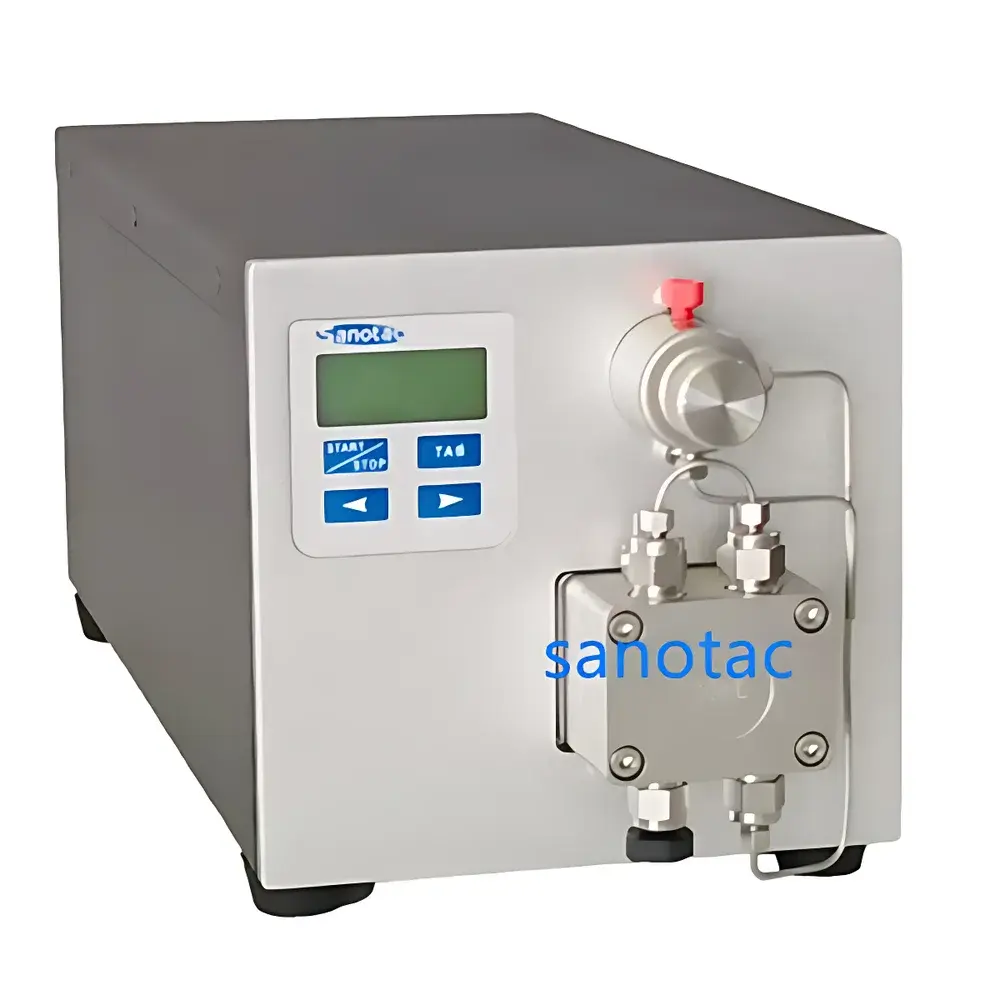
Sanotac QP-0010 Micro High-Pressure Liquid Chromatography Pump
| Brand | Sanotac |
|---|---|
| Origin | Shanghai, China |
| Manufacturer Type | Manufacturer |
| Product Category | Domestic |
| Model | QP-0010 |
| Instrument Type | Quaternary Pump |
| Maximum Pressure | 42 MPa |
| Flow Rate Range | 0.001–10 mL/min |
| Flow Accuracy | ±0.1% |
| Flow Precision (RSD) | ≤0.1% |
Overview
The Sanotac QP-0010 Micro High-Pressure Liquid Chromatography Pump is an engineered precision fluid delivery system designed for demanding analytical and process-scale applications requiring stable, accurate, and pulse-free solvent or reagent delivery under high backpressure. Operating on a dual-piston serial drive architecture with floating piston design, the pump leverages positive displacement mechanics to achieve consistent volumetric output across its full flow range (0.001–9.999 mL/min) while maintaining pressure stability up to 42 MPa (6,090 psi). Its core function—precise metering of low-to-moderate flow rates—is optimized for compatibility with UHPLC, preparative HPLC, supercritical fluid chromatography (SFC), catalytic reaction systems, and closed-loop chemical synthesis platforms. Unlike general-purpose peristaltic or syringe pumps, the QP-0010 employs rigid metal/ ceramic/PTFE wetted path materials and active flow pulse suppression via cam-profile compensation and electronic feedback control—ensuring minimal pressure ripple (≤0.1 MPa) critical for baseline stability in sensitive detection modalities such as UV-Vis, MS, or electrochemical detectors.
Key Features
- Dual-piston serial drive with floating piston mechanism for enhanced seal longevity and reduced mechanical hysteresis
- Multi-point flow calibration across the entire range (0.001–10 mL/min), enabling traceable accuracy of ±0.1% and repeatability ≤0.1% RSD
- Integrated flow pulse suppression: hardware-level cam curve optimization combined with real-time electronic correction
- Column piston rear-wash function to remove particulates and reduce seal wear—extending maintenance intervals
- Configurable pressure protection thresholds and zero-point offset compensation to mitigate thermal drift and line-pressure interference
- Modular communication architecture supporting RS-232/485/422, USB, and Ethernet (wired/wireless); protocols include Modbus RTU/ASCII, Profibus DP, Profinet, and custom ASCII command sets
- Full analog/digital I/O support: 0–5 V / 4–20 mA analog input for external flow setpoint modulation; discrete TTL-level start/stop and fault signaling
- Self-luminous 256×64 dot-matrix LCD display with real-time visualization of flow rate, pressure, program status, and error codes
Sample Compatibility & Compliance
The QP-0010 accommodates a broad spectrum of chemically aggressive and viscous fluids—including organic solvents (acetonitrile, THF, chloroform), aqueous buffers, supercritical CO₂, catalyst slurries, and ionic liquids—thanks to its selectable wetted-path material options: 316L stainless steel, Hastelloy C-276, PEEK, PTFE, PCTFE, titanium, and ceramic components (e.g., ruby check valves). All fluidic interfaces conform to standard 1/16″ tubing connections per ASTM F2520 and ISO 8536-4. The pump meets CE electromagnetic compatibility (EMC) Directive 2014/30/EU and Low Voltage Directive 2014/35/EU. While not certified for IEC 61508 SIL or ATEX environments, its robust construction supports operation in ISO Class 7 cleanrooms and GLP-compliant laboratories. Data integrity features—including audit-trail-capable method storage, timestamped parameter logging, and user-access-level controls—align with FDA 21 CFR Part 11 principles when deployed with validated software configurations.
Software & Data Management
Local operation is supported via intuitive front-panel navigation, while remote supervision and automation are enabled through Sanotac’s optional PC-based control suite. This application provides real-time plotting of flow vs. time and pressure vs. time curves, dynamic progress bar visualization during gradient or multi-step programs, and export of raw data in CSV and PNG formats. Users may define and store multiple flow profiles—including constant, linear ramp, stepwise, and composite gradient sequences—with independent pressure limit enforcement per segment. Calibration routines allow user-defined point mapping against gravimetric or timed-volume reference standards, with factory reset capability and version-stamped calibration history. Optional remote access modules support secure HTTPS-based monitoring, alarm notifications via SMTP/SNMP, and integration into third-party SCADA, DCS, or PLC environments using OPC UA or native protocol gateways.
Applications
- Ultra-high-performance liquid chromatography (UHPLC) and preparative HPLC systems requiring sub-mL/min precision
- Automated catalyst dosing in continuous-flow reactors and microreactor arrays
- Supercritical fluid delivery for SFC purification and extraction workflows
- Controlled reagent addition in exothermic or gas-evolving batch reactions
- Weight-based feed control in pilot-scale polymerization or pharmaceutical crystallization units
- Mobile-phase blending in quaternary gradient systems for method development and transfer
- Integration into custom-built electrochemical flow cells or hyphenated LC-MS/MS platforms
FAQ
What is the maximum operating pressure of the QP-0010 pump?
The QP-0010 is rated for continuous operation up to 42 MPa (6,090 psi) at ambient temperatures between 5–40 °C.
Does the pump support gradient elution with four solvents?
Yes—the QP-0010 is classified as a quaternary pump and includes integrated low-dead-volume proportioning valves compatible with four independent solvent channels.
Can flow calibration be performed in-house without specialized equipment?
Yes—calibration can be executed using standard laboratory-grade analytical balances and volumetric flasks; the firmware supports multi-point user-defined calibration with linear or polynomial curve fitting.
Is the pump compatible with GMP-regulated environments?
When used with validated software, audit-trail-enabled configuration, and documented calibration procedures, the QP-0010 supports compliance with GMP Annex 11 and ALCOA+ data integrity principles.
What materials are available for corrosion-resistant fluid paths?
Wetted-path options include 316L stainless steel, Hastelloy C-276, titanium Grade 2, PEEK, PTFE, PCTFE, and ruby/sapphire ceramics—selected based on chemical compatibility and pressure requirements.
Related Products





