
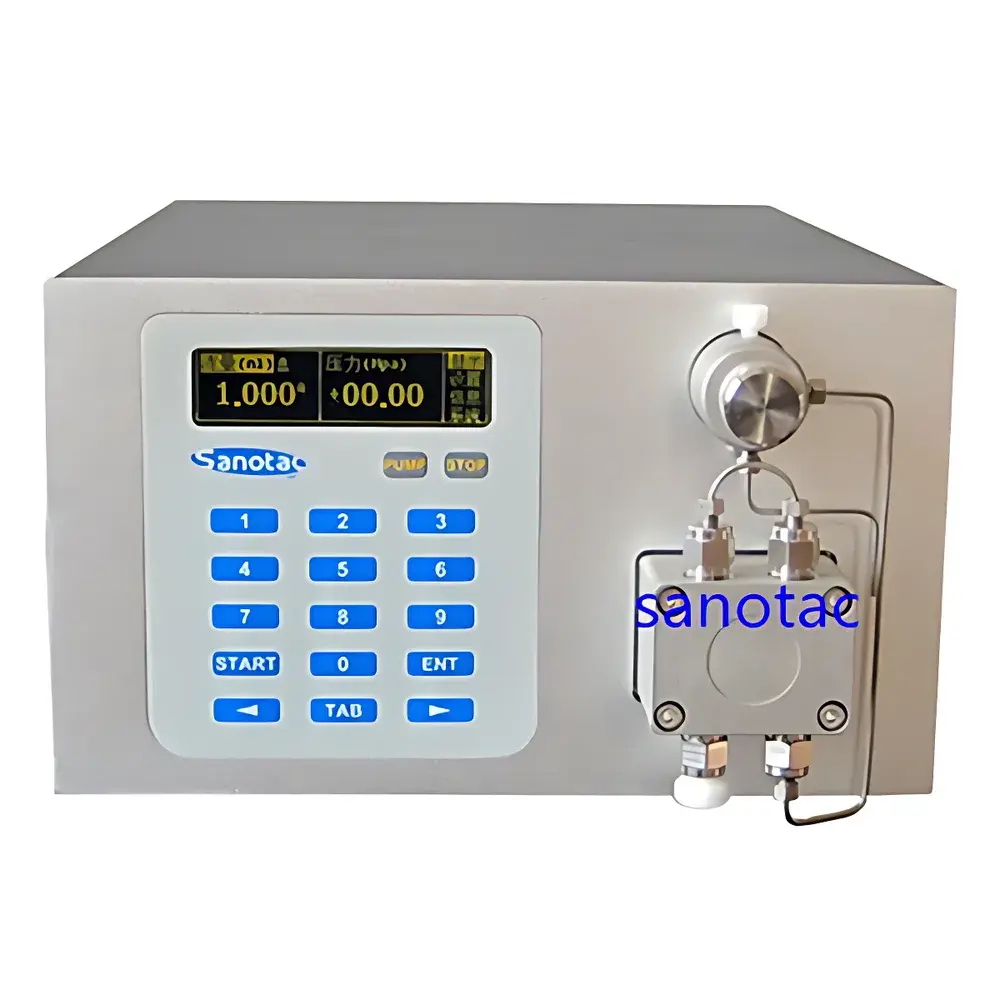
Sanotac S-0150 High-Pressure Metering Pump for Reactor Integration
| Brand | Sanotac |
|---|---|
| Model | S-0150 |
| Origin | Shanghai, China |
| Manufacturer Type | Direct Manufacturer |
| Instrument Type | Isocratic Pump |
| Max. Operating Pressure | 50 MPa (7,250 psi) |
| Flow Rate Range | 0.001–10 mL/min |
| Flow Accuracy | ±0.1% |
| Flow Precision (RSD) | ≤0.1% |
| Pressure Pulsation | ≤0.1 MPa |
| Flow Increment | 0.001 mL/min |
| Fluid Path Materials | 316L Stainless Steel, Sapphire, PTFE, Ceramic |
| Connection | 1/16″ Standard Fittings |
| Display | 256×64 Dot Matrix LCD with Backlight |
| Communication | RS232 & USB (standard), RS485/RS422 (optional) |
| Protocols | Sanotac Proprietary, Modbus RTU/ASCII |
| Power Supply | 85–264 VAC, 50 Hz |
| Dimensions | 370 × 240 × 152 mm |
Overview
The Sanotac S-0150 High-Pressure Metering Pump is an engineered solution for precise, pulse-free fluid delivery in demanding chemical process and analytical environments. Designed specifically for reactor integration—including microreactors, catalytic evaluation systems, supercritical fluid applications, and high-pressure chromatographic workflows—the S-0150 employs a dual-piston series configuration with floating piston architecture to ensure mechanical stability under sustained 50 MPa (7,250 psi) pressure loads. Its operating principle relies on positive displacement via precision-machined sapphire-check valves and ceramic-plunger assemblies, minimizing internal leakage and enabling sub-microliter per minute resolution (0.001 mL/min increment). Unlike conventional HPLC pumps optimized solely for analytical separations, the S-0150 is built for process-critical continuity: it supports extended unattended operation, real-time flow-pressure feedback loops, and closed-loop mass-based dosing when integrated with reactor-scale load cells—making it suitable for GLP-compliant catalysis studies, continuous-flow synthesis validation, and high-fidelity kinetic profiling.
Key Features
- Dual-piston serial drive with floating piston design ensures consistent volumetric displacement across full pressure range (0–50 MPa), reducing mechanical hysteresis and thermal drift.
- Multi-layer flow pulsation suppression: cam-profiled motor control + real-time electronic flow compensation yields pressure ripple ≤0.1 MPa—critical for stable catalyst bed operation and reproducible reaction initiation.
- Onboard zero-point calibration and pressure-setpoint correction algorithms compensate for ambient temperature shifts and fluid compressibility effects.
- Column-piston back-flushing function extends seal life by removing particulate residue from packing interfaces; compatible with aggressive solvents including supercritical CO₂, anhydrous HF, and molten salt mixtures.
- Modular communication interface supports deterministic industrial protocols: Modbus RTU over RS485 (for DCS/SCADA integration), Profinet (via optional gateway), and native USB/RS232 for local method deployment and firmware updates.
- Configurable analog input (0–10 V / 4–20 mA) enables external process variable-driven flow modulation—e.g., synchronizing feed rate with reactor temperature or pH feedback signals.
Sample Compatibility & Compliance
The S-0150 accommodates a broad chemical compatibility envelope due to its fluidic path construction: 316L stainless steel housing, sapphire inlet/outlet check valves, PTFE-sealed ceramic plungers, and chemically inert PTFE tubing connections. It is validated for use with organic solvents (THF, DMF, chlorinated hydrocarbons), aqueous acids/bases (up to 6 M HCl, 4 M NaOH), supercritical fluids (CO₂, ethane), and viscous polymer melts (<500 cP at 150°C). The pump meets CE safety directives (2014/30/EU EMC, 2014/35/EU LVD) and complies with ISO 9001:2015 manufacturing controls. While not certified to FDA 21 CFR Part 11 out-of-the-box, its audit-trail-capable software mode (with timestamped parameter logs, user authentication, and electronic signature support) satisfies ALCOA+ data integrity requirements when deployed in GMP-regulated R&D labs.
Software & Data Management
The embedded firmware supports both standalone and networked operation. Local control includes programmable flow profiles—constant, linear ramp, multi-step gradient, or user-defined time-segmented sequences—with real-time visualization of flow vs. pressure curves on the 256×64 monochrome LCD. All operational data (flow setpoint, actual flow, system pressure, motor current, error codes) are logged at configurable intervals (100 ms–5 s) and exportable in CSV or XLSX format. Method files store complete instrument states—including calibration coefficients, purge cycles, and communication settings—for rapid recall across experimental campaigns. Optional remote monitoring software provides TLS-secured web interface access, enabling cross-site collaboration, alarm notification via email/SMS, and historical trend analysis aligned with external sensor timestamps (e.g., reactor thermocouple or FTIR spectrometer triggers).
Applications
- Continuous-flow catalytic hydrogenation and oxidation in fixed-bed or trickle-bed reactors.
- Supercritical fluid extraction (SFE) and particle formation (RESS, SAS) requiring ultra-stable co-solvent delivery.
- High-pressure liquid-phase reaction kinetics studies under isothermal/isobaric conditions.
- Preparative and analytical-scale SFC (Supercritical Fluid Chromatography) mobile phase delivery.
- Controlled reagent addition in exothermic batch reactions to prevent thermal runaway.
- Integration into automated high-throughput screening platforms for catalyst discovery (HTS).
- Feedstock metering in electrochemical flow cells and PEM electrolyzer test benches.
FAQ
What materials contact the fluid path, and are they compatible with hydrofluoric acid?
The wetted materials are 316L stainless steel, sapphire, PTFE, and alumina ceramic. While PTFE offers excellent HF resistance, prolonged exposure above 40% concentration at elevated temperatures may degrade seals; custom Hastelloy C-276 pump head variants are available for severe HF service.
Can the S-0150 be used as a binary pump by connecting two units to one column?
No—it is a single-channel isocratic pump. For gradient applications, Sanotac offers the S-0250 dual-pump system with synchronized timing and active pressure balancing.
Is flow calibration traceable to NIST standards?
Yes. Factory calibration uses gravimetric measurement against NIST-traceable mass standards (±0.02% uncertainty) and is documented in the Certificate of Conformance supplied with each unit.
Does the pump support automatic solvent degassing?
Not natively; however, it integrates seamlessly with external online degassers (e.g., Parker Hannifin DG-1000) via analog control signal or digital handshake protocol.
What maintenance intervals are recommended for continuous 24/7 operation?
Plunger seals require replacement every 6 months under constant 40 MPa operation; check valves every 12 months. Full preventive maintenance—including cam wear inspection and motor encoder verification—is advised annually per ISO 13374 condition monitoring guidelines.
Related Products






