
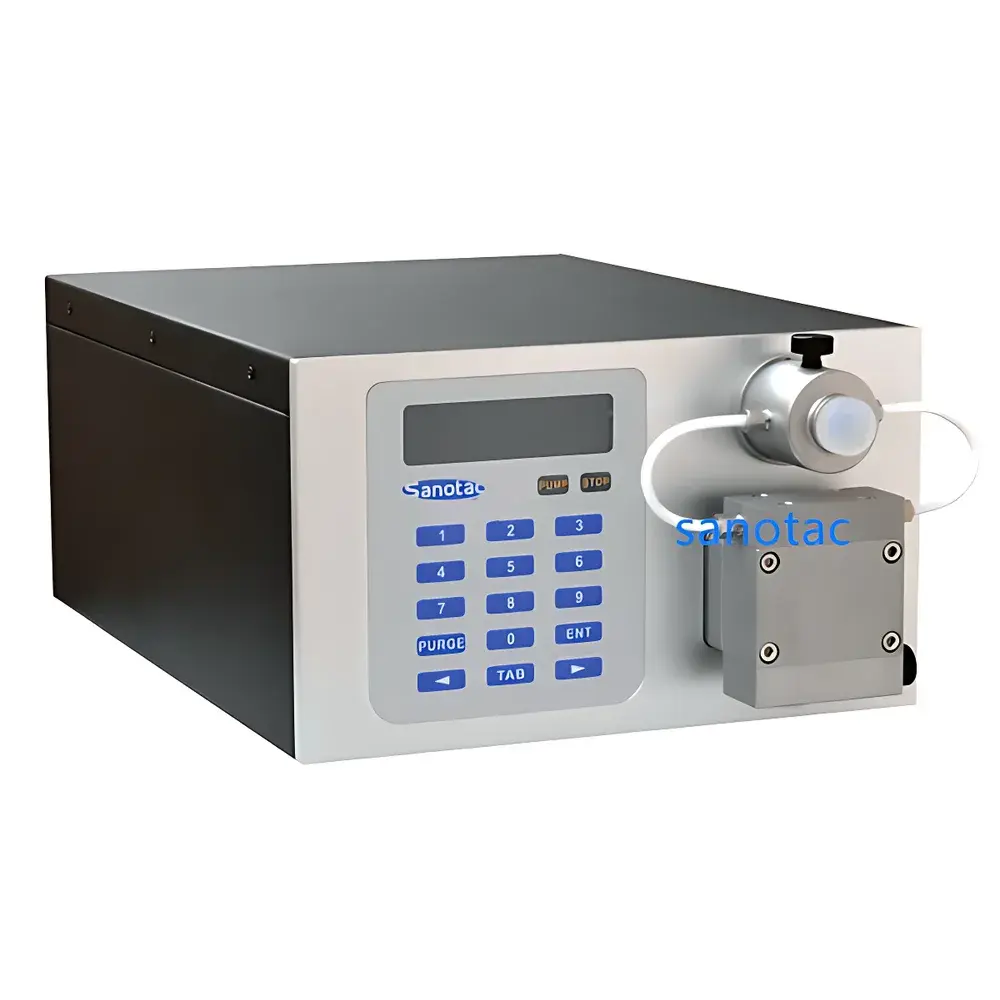
Sanotac SF1005A High-Pressure PTFE-Lined Constant Flow Pump
| Brand | Sanotac |
|---|---|
| Origin | Shanghai, China |
| Manufacturer Type | Direct Manufacturer |
| Model | SF1005A |
| Flow Rate | 0.01–100.00 mL/min (adjustable in 0.01 mL/min increments) |
| Maximum Pressure | 5 MPa |
| Flow Accuracy | ±0.5% |
| Flow Precision (RSD) | ≤0.1% |
| Pressure Pulsation | ≤0.05 MPa |
| Pump Head Material | Stainless Steel with PCTFE Liner |
| Fluid Path Materials | PCTFE, PTFE, Sapphire, Ceramic, Hastelloy |
| Communication Interfaces | RS-232, USB (standard) |
| Protocols | Modbus RTU, ASCII |
| Power Supply | 85–264 VAC, 50 Hz |
| Dimensions | 370 × 240 × 152 mm |
Overview
The Sanotac SF1005A is a high-pressure, chemically inert constant flow pump engineered for precise, pulse-free delivery of aggressive fluids—including concentrated acids, alkalis, halogenated solvents, and supercritical media—in demanding laboratory and pilot-scale process environments. Based on dual-piston parallel architecture with floating plunger design and cam-profiled motion compensation, the SF1005A delivers stable volumetric displacement under sustained 5 MPa (725 psi) backpressure. Its fluidic path—constructed entirely from PCTFE, PTFE, sapphire, ceramic, and Hastelloy—ensures exceptional resistance to corrosion, swelling, and thermal degradation across pH 0–14 and temperatures up to 120 °C. Unlike conventional diaphragm or peristaltic pumps, the SF1005A operates on positive displacement principles with mechanical feedback control, enabling traceable, repeatable dosing in catalytic evaluation, microreactor feeding, supercritical fluid processing, and continuous-flow synthesis systems.
Key Features
- Chemically resistant fluid path: PCTFE-lined stainless steel pump head with sapphire check valves, ceramic plungers, and Hastelloy C-276 spring-loaded open-type seals in direct contact with fluid.
- Low-pressure pulsation (<0.05 MPa RPP) achieved via real-time electronic pulse suppression and optimized cam-driven plunger kinematics.
- Dual-mode delivery: Selectable volumetric (mL/min) or gravimetric (g/min) output, with user-accessible calibration at nine discrete flow points (0.01–100 mL/min).
- Configurable pressure protection: Programmable upper/lower pressure limits with automatic shutdown and alarm logging.
- Flexible control architecture: Supports both standalone operation and synchronized multi-pump gradient programming (up to 32 units via RS-485 daisy chain).
- Integrated column cleaning cycle: Automated solvent flush sequence for extended seal and valve service life.
- Comprehensive data capture: Real-time pressure and flow curve logging to Excel-compatible CSV files with timestamped metadata.
- Full protocol stack: Native support for Modbus RTU and ASCII over RS-232, USB, and optional RS-485/RS-422 interfaces.
- PLC-ready analog I/O: 0–5 V DC and 4–20 mA inputs for external process integration and closed-loop weight-based feed control (customizable to METTLER TOLEDO, Sartorius, or A&D load cell specifications).
Sample Compatibility & Compliance
The SF1005A is validated for use with highly corrosive, viscous, and particulate-laden process streams common in heterogeneous catalysis, hydrofluoric acid handling, electrochemical electrolyte formulation, and CO₂-expanded liquid systems. Its material compatibility aligns with ASTM D543 (resistance to chemical reagents), ISO 15190 (laboratory safety), and USP (analytical instrument qualification). The pump’s firmware supports audit-trail-enabled parameter logging compliant with FDA 21 CFR Part 11 requirements when operated with validated SanoFlu software under controlled IT governance. No lubricants or elastomers contact the fluid path, eliminating leachables and ensuring GLP/GMP suitability for regulated reaction monitoring and catalyst lifetime studies.
Software & Data Management
The SanoFlu Fluid Control Management System provides a Windows-based interface for configuration, real-time visualization, and post-run analysis. It enables simultaneous display of pressure/flow trend plots with overlay capability, user-defined method templates (including ramp, hold, and step profiles), and export of raw time-series data with millisecond resolution. All system events—including pressure limit breaches, motor stall detection, and calibration updates—are recorded with operator ID and timestamp. Data files conform to ISO/IEC 17025-compliant traceability standards, supporting integration into LIMS platforms via OPC UA or custom API extensions. Firmware updates are delivered via signed binary packages with SHA-256 verification.
Applications
- Catalytic testing rigs: Precise co-feeding of reactants and promoters into fixed-bed or slurry-phase reactors under elevated pressure.
- Microreactor systems: Stable reagent introduction for residence time-controlled photochemical or enzymatic transformations.
- Supercritical fluid chromatography (SFC) and extraction: CO₂-miscible modifier delivery at 5 MPa with sub-0.1% RSD.
- Electrolyte formulation labs: Metered addition of LiPF₆, HF scavengers, or fluorinated carbonates into battery-grade solvent blends.
- Continuous polymerization: Controlled monomer/initiator ratio maintenance in tubular or loop reactors.
- Foam extrusion R&D: Accurate blowing agent injection (e.g., HFC-134a, CO₂) into thermoplastic melt streams.
- Green chemistry process development: Safe handling of ionic liquids, deep eutectic solvents, and molten salt precursors.
FAQ
What materials are in direct contact with fluid?
Stainless steel (316L) housing with PCTFE liner; sapphire inlet/outlet valves; ceramic plungers; Hastelloy C-276 spring-loaded open seals.
Is the pump suitable for abrasive slurries?
Yes—when equipped with optional ceramic-plunger and sapphire-valve configuration; maximum suspended solid content: ≤5 wt% with particle size <10 µm.
Can it interface with third-party balance systems for gravimetric feeding?
Yes—via analog 4–20 mA input; compatible with standard industrial load cells and certified analytical balances meeting OIML R76.
Does the device meet electromagnetic compatibility (EMC) requirements for lab environments?
Yes—certified to IEC 61326-1:2013 Class A for emission and immunity in laboratory settings.
How is flow accuracy verified and maintained over time?
Through factory-traceable gravimetric calibration; users perform field recalibration using the built-in multi-point correction algorithm with NIST-traceable reference standards.



