
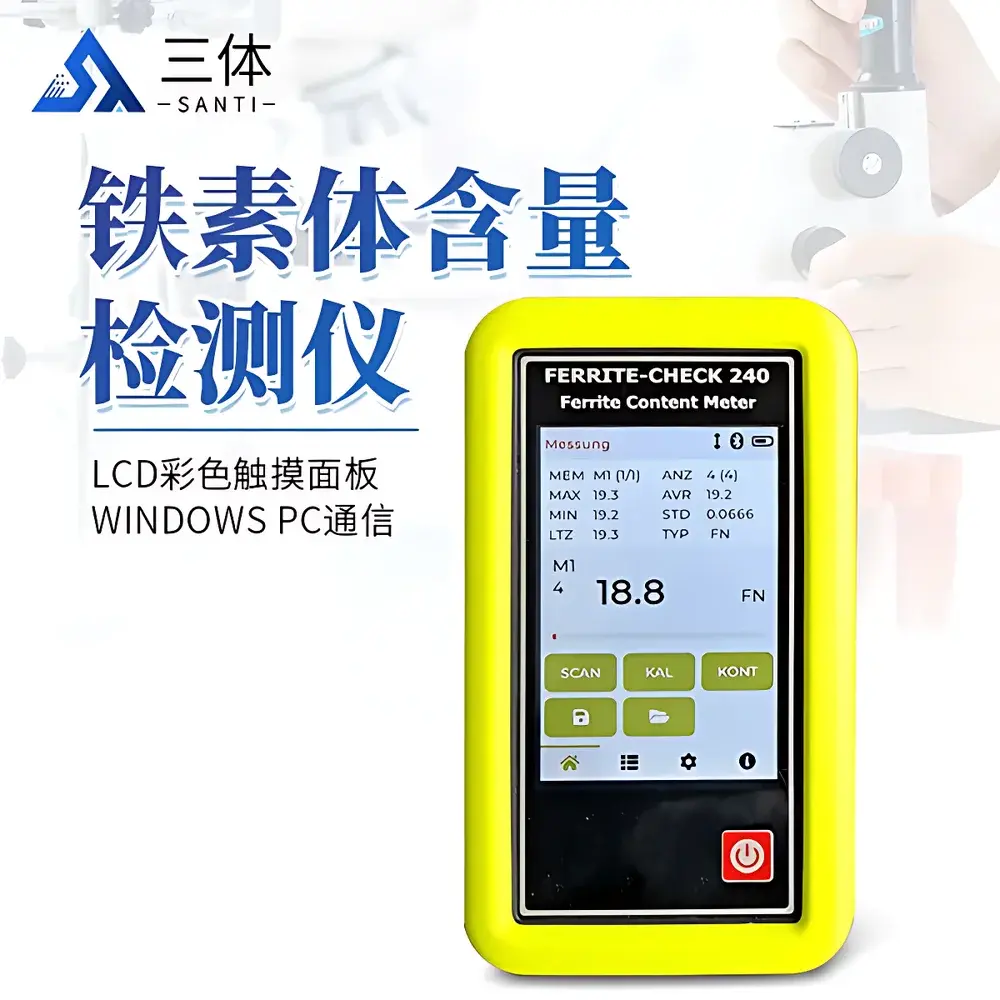
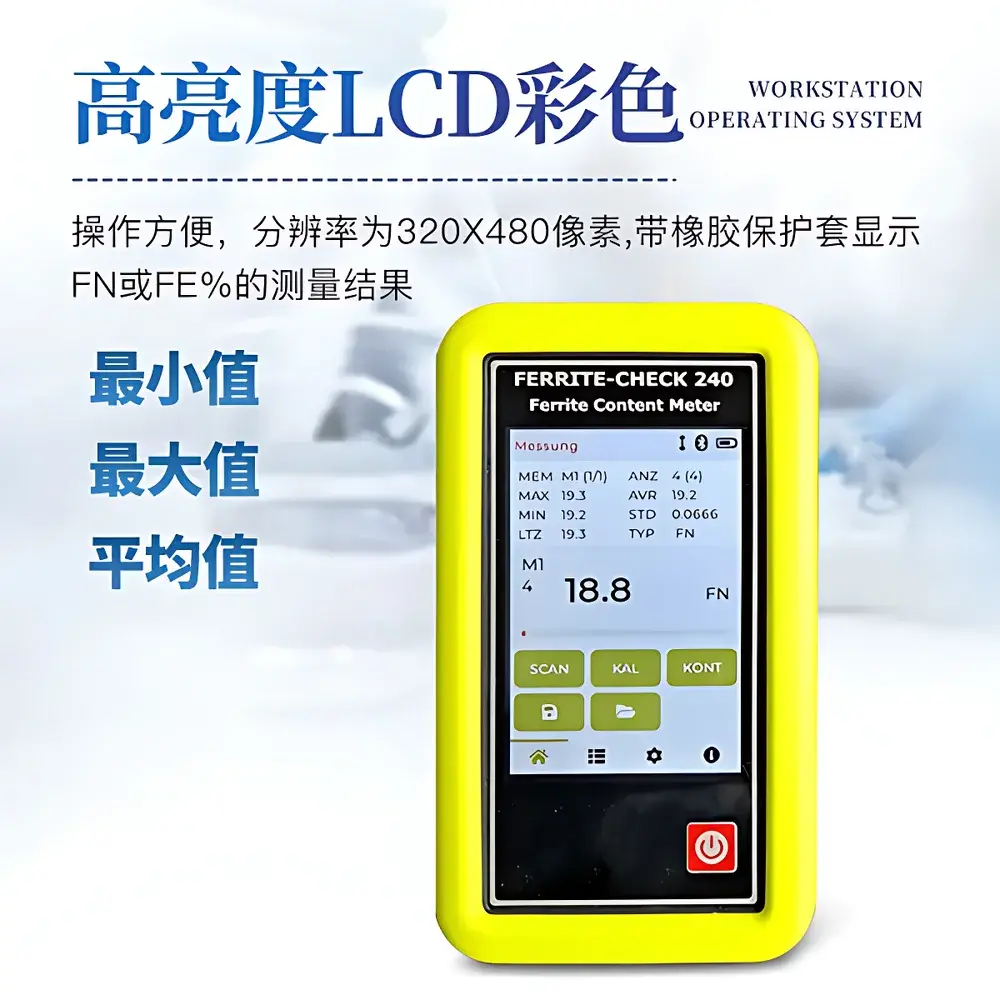
Santiyiqi FERRITE-CHECK 240 Ferrite Meter
| Brand | Santiyiqi |
|---|---|
| Model | FERRITE-CHECK 240 |
| Origin | Shandong, China |
| Manufacturer Type | Manufacturer |
| Country of Origin | China |
| Compliance | DIN EN ISO 8249 |
| Measurement Principle | Magnetic Induction |
| Display | 320×480-pixel color LCD with backlight |
| Probe Interface | Digital signal transmission |
| Calibration Standards | 3 NIST-traceable ferrite standards |
| Output Interface | USB (SCPI-compliant) |
| Operating Mode | Spot measurement & continuous scan mode |
| Units | FN (Ferrite Number) and % Fe (ferrite volume percent) |
| Minimum Detectable Level | 0.2 FN |
| Protective Housing | Rubberized impact-resistant casing |
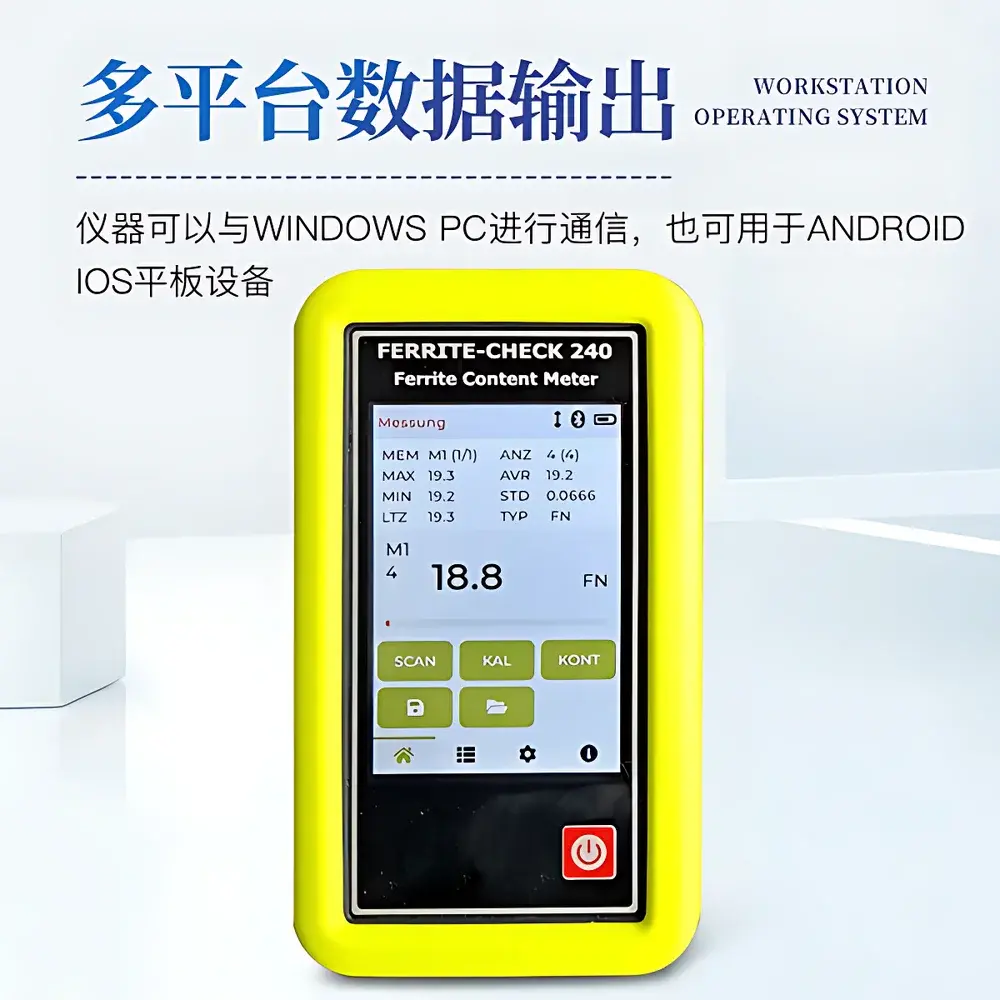
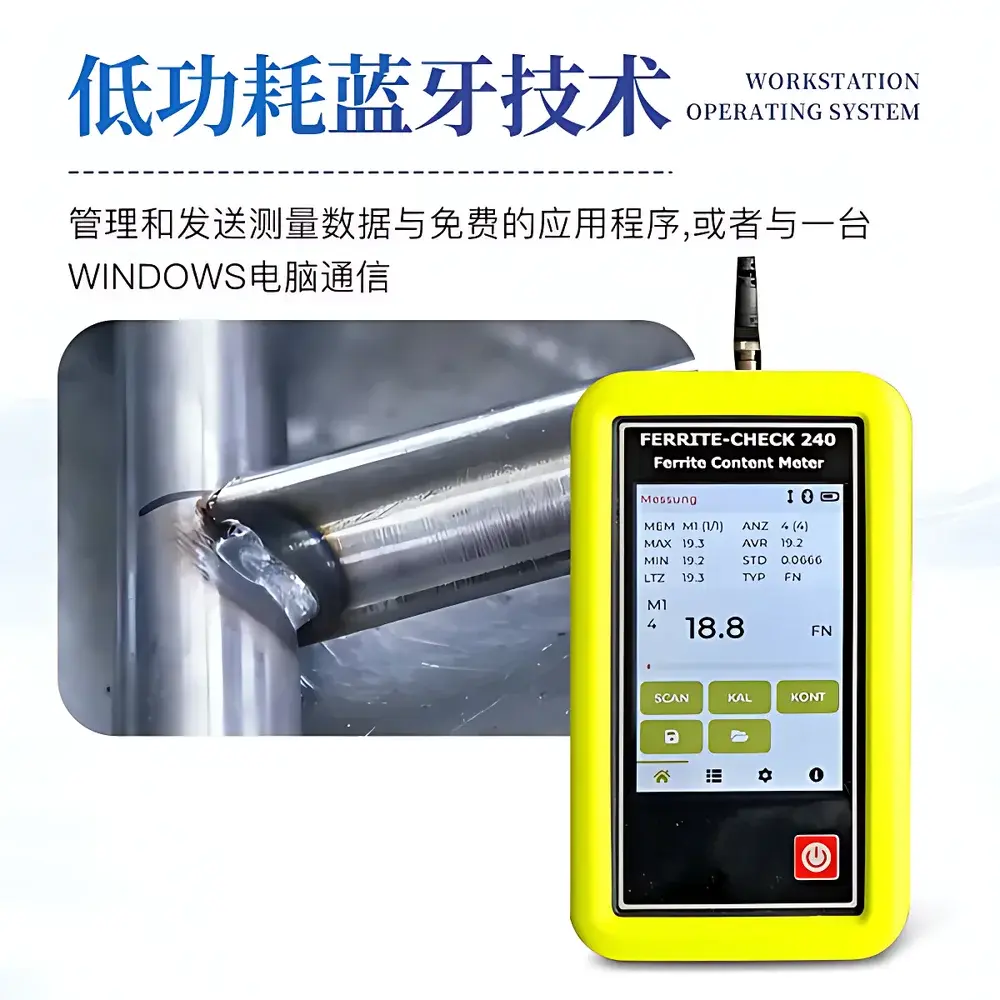
| Software | Lima Connect (free Windows application for statistical analysis and graphical reporting) |
Overview
The Santiyiqi FERRITE-CHECK 240 Ferrite Meter is a precision magnetic induction instrument engineered for quantitative determination of ferrite content in austenitic stainless steels, duplex, and super-duplex stainless steels. It operates on the principle of magnetic permeability contrast between ferritic (magnetic) and austenitic (non-magnetic) phases—where the probe’s high-frequency eddy-current sensor detects localized changes in magnetic flux density induced by the ferromagnetic α-phase. This method is standardized under DIN EN ISO 8249, which defines calibration protocols, measurement uncertainty limits, and acceptance criteria for ferrite quantification in weld metal and base material. The instrument delivers traceable, repeatable results across production environments—from fabrication shops to QA/QC laboratories—supporting metallurgical integrity verification where mechanical performance hinges on phase balance.
Key Features
- Digital probe architecture with high-sampling-rate analog-to-digital conversion ensures immunity to electromagnetic interference and eliminates analog signal drift.
- Two operational modes: single-point measurement for discrete weld passes and continuous scanning mode for profiling ferrite distribution across weld beads or heat-affected zones (HAZ).
- On-device statistical display during scan mode shows real-time min/max/mean values, enabling immediate assessment of phase homogeneity without post-processing.
- Backlit 320×480-pixel color LCD with intuitive touch interface supports both FN (Ferrite Number) and %Fe readouts, conforming to ASTM E562 and ISO 8249 reporting conventions.
- Rubberized ergonomic housing meets IP54 ingress protection requirements for field use in industrial settings with dust and light moisture exposure.
- USB-powered operation with SCPI command set enables integration into automated test benches and programmable logic controller (PLC)-driven inspection workflows.
Sample Compatibility & Compliance
The FERRITE-CHECK 240 is validated for use on flat, curved, and lightly polished surfaces—including as-welded, ground, or pickled stainless steel joints. Surface roughness up to Ra 3.2 µm does not significantly affect accuracy when using the included calibration standards. All measurements comply with DIN EN ISO 8249:2018, ensuring equivalence with reference methods such as metallographic point counting (ASTM E562) and magnetic saturation testing (AWS A4.2). Calibration standards are certified against NIST-traceable reference materials, providing metrological traceability required for ISO/IEC 17025-accredited laboratories. The instrument satisfies documentation requirements for ASME BPVC Section IX, EN 1515-3, and PED 2014/68/EU welding procedure qualification records.
Software & Data Management
Lima Connect—a free Windows-based application—provides full data acquisition, visualization, and statistical evaluation. It logs timestamped measurements with operator ID, probe position metadata, and environmental conditions (optional via external sensors). Reports generate histograms, trend charts, and pass/fail overlays based on user-defined specification limits (e.g., 30–70 FN for duplex welds). Audit trail functionality complies with FDA 21 CFR Part 11 principles for electronic records, including secure user authentication, change history logging, and digital signature support. Export options include CSV, PDF, and XML formats compatible with LIMS and ERP systems.
Applications
- Weld quality assurance in offshore pipeline construction, chemical processing equipment, and nuclear containment vessels.
- In-process verification of filler metal selection and heat input control during TIG, SMAW, and SAW welding of duplex stainless steels.
- Root pass inspection in multi-pass welds where low ferrite content (<15 FN) increases susceptibility to hot cracking.
- Post-weld heat treatment (PWHT) validation to confirm phase re-equilibration after thermal cycling.
- Supplier qualification audits requiring documented ferrite content compliance per material certification (EN 10204 3.1/3.2).
FAQ
What is the minimum measurable ferrite level?
The instrument reliably resolves down to 0.2 FN under controlled surface conditions and proper probe alignment.
Can it measure on curved surfaces?
Yes—the probe geometry accommodates radii ≥25 mm; concave or convex curvature must be reported in calibration records.
Is third-party calibration available?
Yes—certified recalibration services are offered annually, with NIST-traceable certificates issued per ISO/IEC 17025.
Does it require periodic zeroing?
No—digital offset compensation is performed automatically at startup; manual zero is only needed after extreme temperature shifts (>15°C change).
How is traceability maintained during field use?
Each unit ships with three NIST-traceable calibration standards; users must perform daily verification checks and document results per internal QA procedures.
Related Products






