
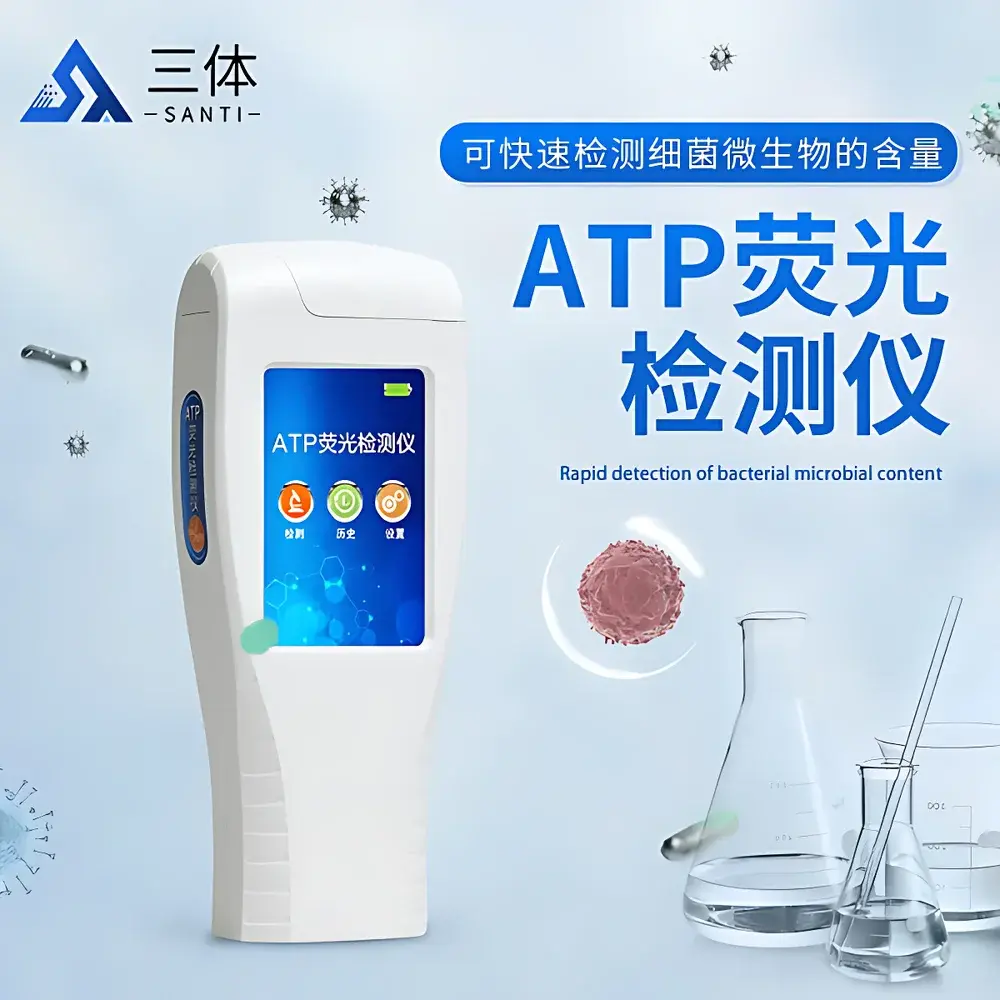
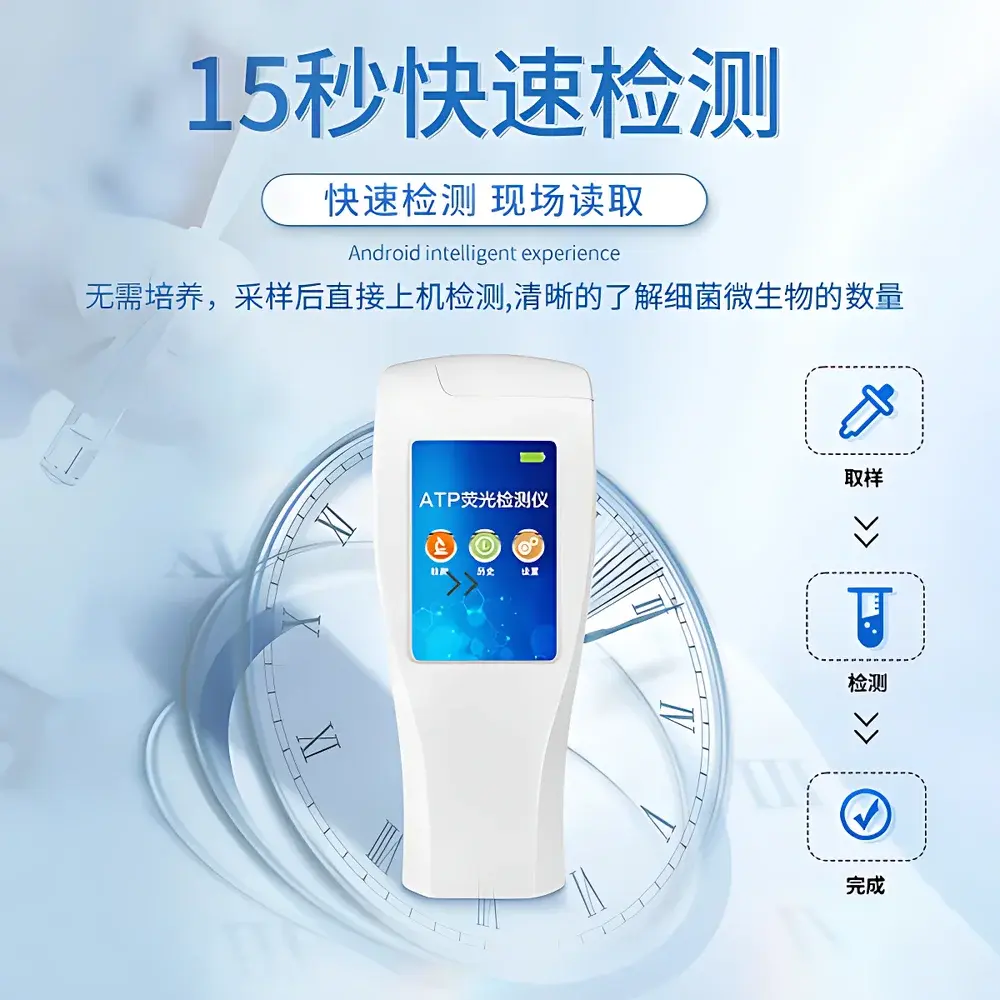
Santiyiqi ST-ATP ATP Bioluminescence Detector
| Brand | Santiyiqi |
|---|---|
| Origin | Shandong, China |
| Manufacturer Type | Direct Manufacturer |
| Country of Origin | China |
| Model | ST-ATP |
| Display | 3.5-inch full-color touchscreen (≥5-color UI) |
| Processor | 32-bit high-speed data processing IC |
| Detection Time | 15 s |
| Measurement Interference | ±5% or ±5 RLU |
| Operating Temperature | 5–40 °C |
| Operating Humidity | 20–85% RH |
| Output Unit | RLU (Relative Light Unit) |
| Pass/Fail Auto-Judgment | Yes |
| Compliance Reporting | Automatic pass rate statistics |
| Built-in Calibration Light Source | Yes |
| Power-On Self-Test Duration | 30 s |
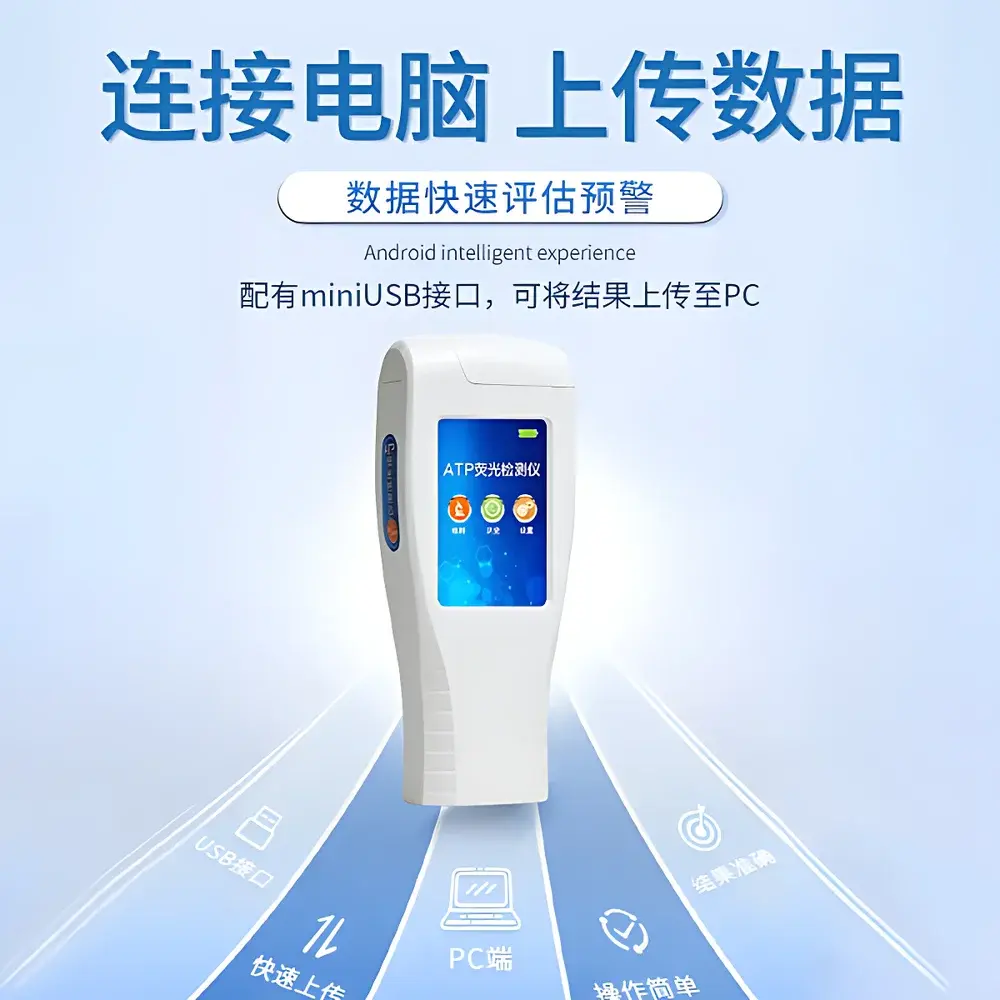
| Connectivity | Mini-USB port + integrated Wi-Fi module |
| Software Delivery | Dedicated USB drive (no CD) |
| Dimensions (W×H×D) | 188 × 77 × 37 mm |
| Power Supply | Rechargeable lithium-ion battery |
| Standby Life (20 °C) | 6 months |
| Standard Accessories | Host unit, aluminum carrying case, driver USB stick, PC data cable, desktop data analysis software, Chinese user manual |
Overview
The Santiyiqi ST-ATP ATP Bioluminescence Detector is a compact, field-deployable instrument engineered for rapid, quantitative assessment of surface hygiene and microbial contamination in food production, processing, and retail environments. It operates on the principle of bioluminescence assay—measuring adenosine triphosphate (ATP) content via the firefly luciferase–luciferin reaction. When ATP extracted from swabbed surfaces reacts with luciferase, photons are emitted proportionally to ATP concentration; the detector quantifies this light output in Relative Light Units (RLU). As ATP is present in all metabolically active cells—including bacteria, yeasts, molds, and residual organic matter—the RLU value serves as a validated surrogate indicator for total viable microbial load and cleaning efficacy. Unlike traditional culture-based methods requiring ≥18 hours for colony formation, the ST-ATP delivers objective, repeatable results within 15 seconds, enabling real-time decision-making at critical control points (CCPs) without laboratory dependency.
Key Features
- 3.5-inch full-color capacitive touchscreen with multi-hue graphical interface—eliminates mechanical buttons and supports intuitive navigation across measurement, calibration, history review, and reporting functions.
- Integrated 32-bit embedded processor ensures sub-second response latency during swab insertion, assay initiation, and result display—critical for high-throughput sanitation verification in fast-paced facilities.
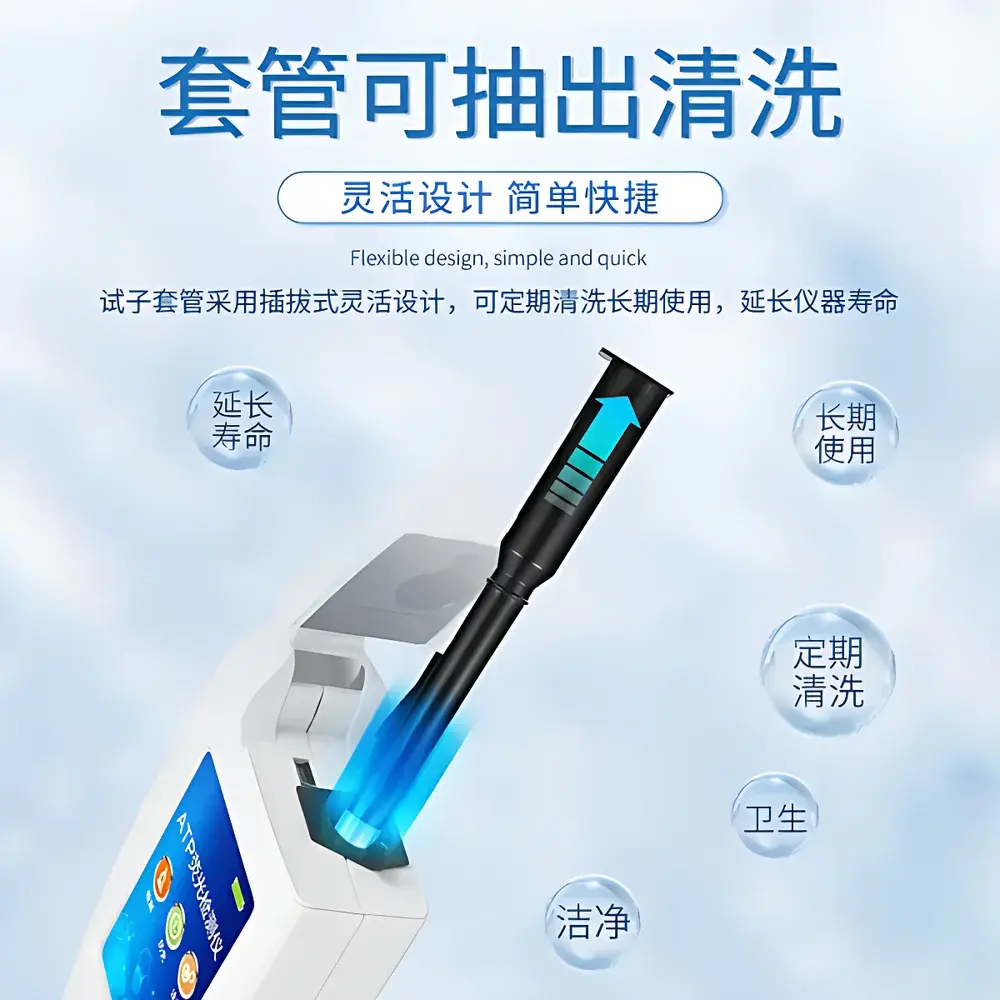
- Plug-and-play swab cartridge design allows repeated cleaning and reuse of the detection chamber, reducing consumable waste and extending service life beyond 10,000 cycles under routine maintenance.
- Onboard self-diagnostic sequence initiates automatically within 30 seconds of power-on, verifying photomultiplier gain stability, LED calibration source integrity, and sensor baseline noise floor—ensuring metrological traceability before first use each day.
- Dual-mode data export: wired transfer via Mini-USB to Windows-compatible desktop software; wireless upload via built-in IEEE 802.11 b/g/n Wi-Fi to centralized sanitation analytics platforms supporting CSV/Excel export and trend visualization.
- Rechargeable lithium-ion battery provides ≥8 hours of continuous operation per charge; standby current draw is optimized for ≤1 µA, enabling six-month shelf retention at 20 °C without capacity degradation.
Sample Compatibility & Compliance
The ST-ATP is validated for use with standardized ATP swabs compliant with ISO 22000:2018 Annex A.3.2 (hygiene monitoring), FDA Food Code §3-202.11 (food contact surface verification), and HACCP Principle 4 (critical limit validation). Its RLU output correlates linearly with ATP concentrations from 0.01 to 100 fmol per swab (equivalent to ~10²–10⁶ CFU/cm² depending on microorganism type), meeting sensitivity requirements outlined in AOAC Official Method 990.12 and NSF/ANSI 151 for food equipment sanitation. The device’s ±5% RLU accuracy specification satisfies internal audit protocols aligned with BRCGS Issue 9 Section 4.10.2 and SQF Edition 9.2 Module 2.8. All firmware and software components support audit trail generation per GLP/GMP expectations, including timestamped operator ID, location tag, swab lot number, and pass/fail threshold metadata.
Software & Data Management
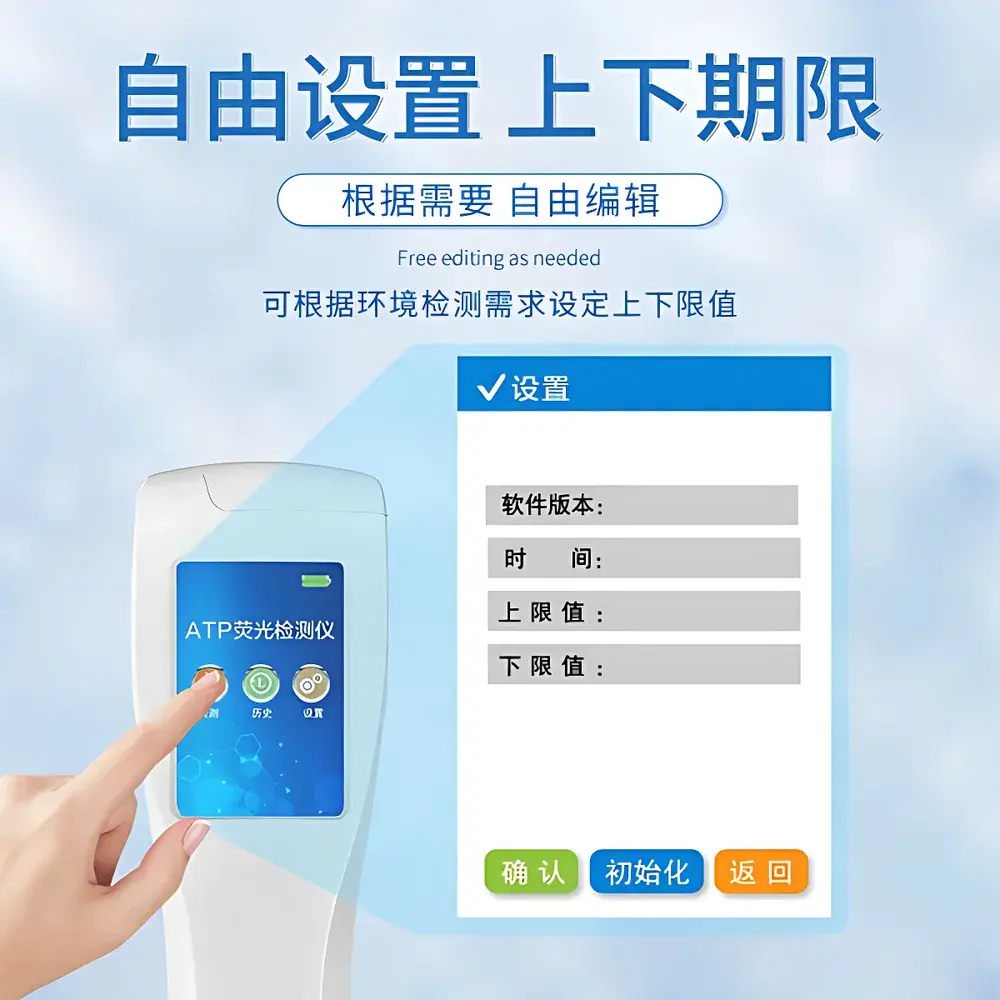
Bundled desktop software (Windows 10/11 compatible) enables comprehensive data governance: historical RLU trending by shift, line, zone, or operator; automated pass/fail flagging against configurable limits (e.g., ≤100 RLU for stainless steel, ≤50 RLU for conveyor belts); and statistical process control (SPC) charting (X-bar/R charts). Raw datasets include embedded EXIF-style metadata: GPS coordinates (if enabled on host PC), environmental temperature/humidity logs, and instrument serial-number-stamped calibration certificates. Wi-Fi-enabled cloud synchronization supports role-based access control (RBAC), multi-site dashboard aggregation, and scheduled PDF report generation compliant with ISO/IEC 17025 Clause 7.8.2 documentation requirements.
Applications
- Routine verification of Clean-in-Place (CIP) and Sanitize-in-Place (SIP) system effectiveness across dairy, meat, and beverage lines.
- Pre-operational sanitation audits prior to startup in ready-to-eat (RTE) production zones.
- Root cause analysis of microbiological non-conformances via spatial RLU mapping across equipment surfaces.
- Training validation for sanitation staff—quantitative feedback replaces subjective visual inspection.
- Supplier qualification assessments where ATP thresholds are contractually specified (e.g., <50 RLU for packaging material suppliers).
FAQ
What does RLU stand for, and how is it calibrated?
RLU stands for Relative Light Unit—a dimensionless photometric output scaled to the instrument’s internal reference light source. Calibration is performed using a built-in stable LED that emits fixed-intensity light at 560 nm, traceable to NIST-traceable photodiode standards. Users perform daily verification using supplied ATP standard swabs (0.1, 1.0, and 10 fmol).
Can the ST-ATP distinguish between bacterial ATP and food residue ATP?
No—RLU reflects total ATP from all biological sources. Therefore, rigorous pre-swab cleaning (e.g., water rinse) is required to minimize false positives from residual carbohydrates or proteins. For speciation, follow-up microbial culture or PCR is recommended.
Is the device compliant with FDA 21 CFR Part 11 for electronic records?
The desktop software supports Part 11 compliance when deployed with Windows Active Directory authentication, electronic signatures, and audit trail archiving—but the handheld unit itself does not store electronic signatures. Full compliance requires site-specific validation per your SOPs.
How often should the swab cartridge be cleaned?
After every 20 measurements or at shift end—whichever occurs first—using 70% isopropyl alcohol and lint-free wipes. Avoid ultrasonic cleaning or abrasive solvents to preserve optical window clarity.




