
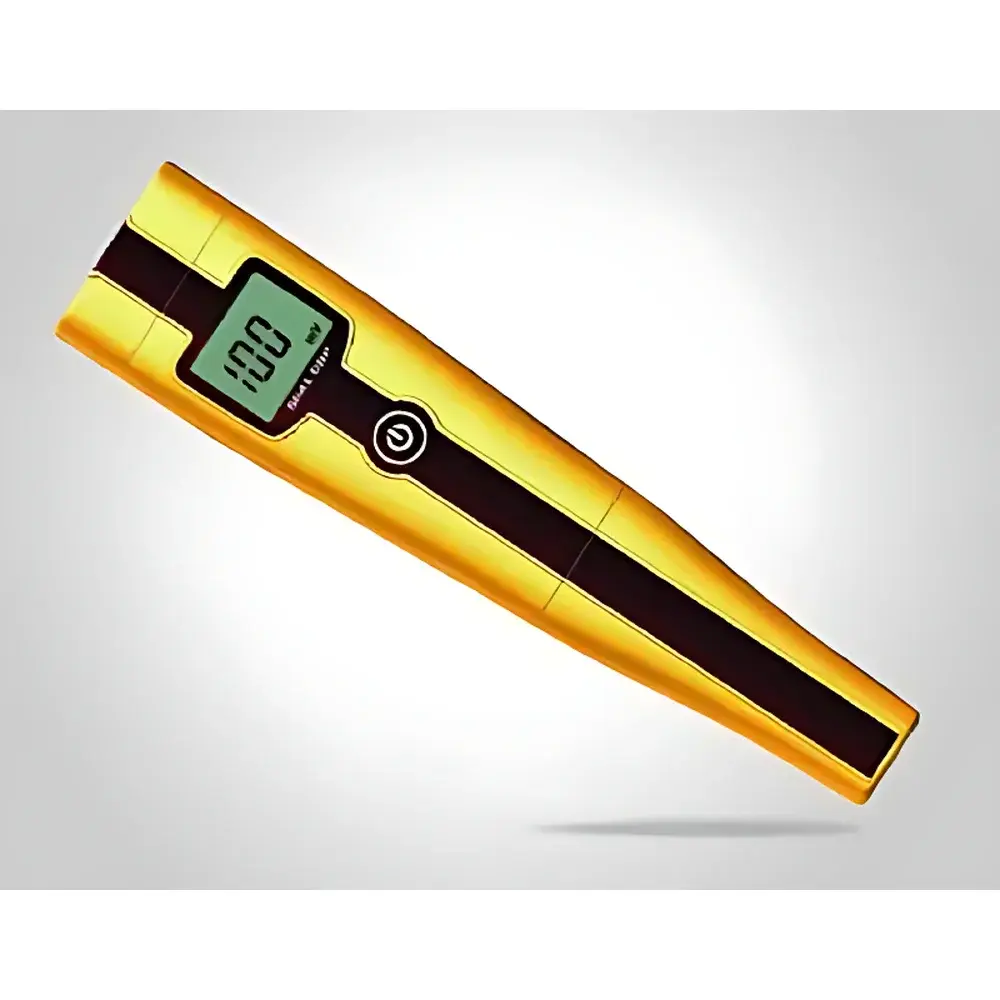
SANXIN 5041 Pocket ORP Meter
| Brand | SANXIN |
|---|---|
| Origin | Shanghai, China |
| Manufacturer Type | Direct Manufacturer |
| Model | 5041 |
| Measurement Range | ±100 mV |
| Resolution | 1 mV |
| Accuracy | ±0.5% FS |
| Power Supply | Two AAA batteries (1.5 V × 2) |
| Dimensions | 39 × 25 × 176 mm |
| Weight | 95 g |
| IP Rating | IP57 |
Overview
The SANXIN 5041 Pocket ORP Meter is a compact, field-deployable electrochemical instrument engineered for rapid, reliable measurement of oxidation-reduction potential (ORP) in aqueous solutions. ORP—expressed in millivolts (mV)—quantifies the thermodynamic tendency of a solution to gain or lose electrons, serving as a critical process control parameter in water treatment, aquaculture, swimming pool management, industrial cooling systems, and environmental monitoring. Unlike pH, which measures hydrogen ion activity, ORP reflects the net redox capacity of all oxidizing and reducing species present. The 5041 employs a robust platinum-sensing element paired with a silver/silver chloride (Ag/AgCl) reference electrode in a single-body composite probe architecture, enabling direct potentiometric measurement against a stable internal reference. Its sealed, pen-style form factor eliminates the need for external cables or junctions, minimizing drift and contamination risk while ensuring consistent electrode geometry and reproducible response kinetics.
Key Features
- Compact, ergonomic pen design optimized for one-handed operation in confined or wet environments
- Integrated Pt/Ag–AgCl composite sensor with chemically inert platinum sensing surface and stable Ag/AgCl reference system
- High-resolution 1 mV digital display with automatic polarity indication (+/−)
- Calibration-free operation: designed for relative trend monitoring and pass/fail compliance checks per standard operational protocols (e.g., EPA Method 180.1, ASTM D1129)
- IP57-rated enclosure: fully protected against dust ingress and immersion in up to 1 m of water for 30 minutes—suitable for splash-prone or outdoor deployment
- Low-power electronics powered by two standard AAA alkaline cells, delivering >100 hours of continuous use without signal degradation
- No user-serviceable parts: hermetically sealed transducer and circuitry ensure long-term stability and eliminate maintenance requirements
Sample Compatibility & Compliance
The 5041 is validated for use with clean to moderately turbid aqueous samples across pH 2–12 and temperatures from 0 to 50 °C. It is not intended for highly viscous, non-aqueous, or strongly proteinaceous media where electrode fouling may compromise response time or baseline stability. While not certified for GLP/GMP-regulated environments requiring full audit trails, its design aligns with general-purpose field instrumentation standards under ISO 5725 (accuracy and precision) and IEC 60529 (IP57 ingress protection). For regulatory applications requiring documented calibration and traceability, users should implement periodic verification using certified ORP standard solutions (e.g., +225 mV Zobell’s solution or +470 mV Light’s solution), recorded manually or via external logging devices.
Software & Data Management
The SANXIN 5041 operates as a standalone, embedded-system device with no onboard memory, Bluetooth, or USB interface. All measurements are displayed in real time on the integrated LCD; no data export or software integration is supported. This architecture prioritizes reliability, battery longevity, and immunity to electromagnetic interference—critical attributes for field technicians performing routine spot checks. Users requiring electronic data capture must pair the instrument with external recording tools (e.g., calibrated handheld loggers or mobile apps with manual entry). No firmware updates or configuration utilities are provided, reflecting its role as a purpose-built, fixed-function tool rather than a programmable platform.
Applications
- Chlorine residual validation in municipal drinking water distribution networks
- Disinfection efficacy monitoring in wastewater effluent prior to discharge
- Oxidation state tracking during electrochemical cleaning or etching processes in semiconductor fabrication
- Redox balance assessment in recirculating aquaculture systems (RAS) and hydroponic nutrient reservoirs
- Sanitizer concentration verification in food processing plant CIP (clean-in-place) rinse cycles
- Field screening of sediment pore water redox conditions in environmental site assessments
FAQ
Does the 5041 require calibration before use?
No—this model is factory-calibrated and designed for zero-adjustment operation. For traceable quality assurance, users may verify performance using NIST-traceable ORP standard solutions at defined intervals.
Can the electrode be cleaned if contaminated?
Yes—gently wipe the platinum tip with lint-free tissue moistened with deionized water; avoid abrasive pads or solvents. Do not soak or ultrasonicate the probe.
Is temperature compensation available?
No—the 5041 provides raw mV output only. Temperature effects on ORP are sample-dependent and must be interpreted contextually by the operator.
What does IP57 mean for field use?
It certifies protection against limited dust ingress and temporary immersion (1 m depth, 30 min), making it suitable for rain, splashing, or accidental submersion—but not prolonged underwater operation.
How often should batteries be replaced?
Under typical intermittent use (≤10 measurements/day), battery life exceeds 12 months; continuous use (>8 hrs/day) warrants replacement every 3–4 months.
Related Products





