
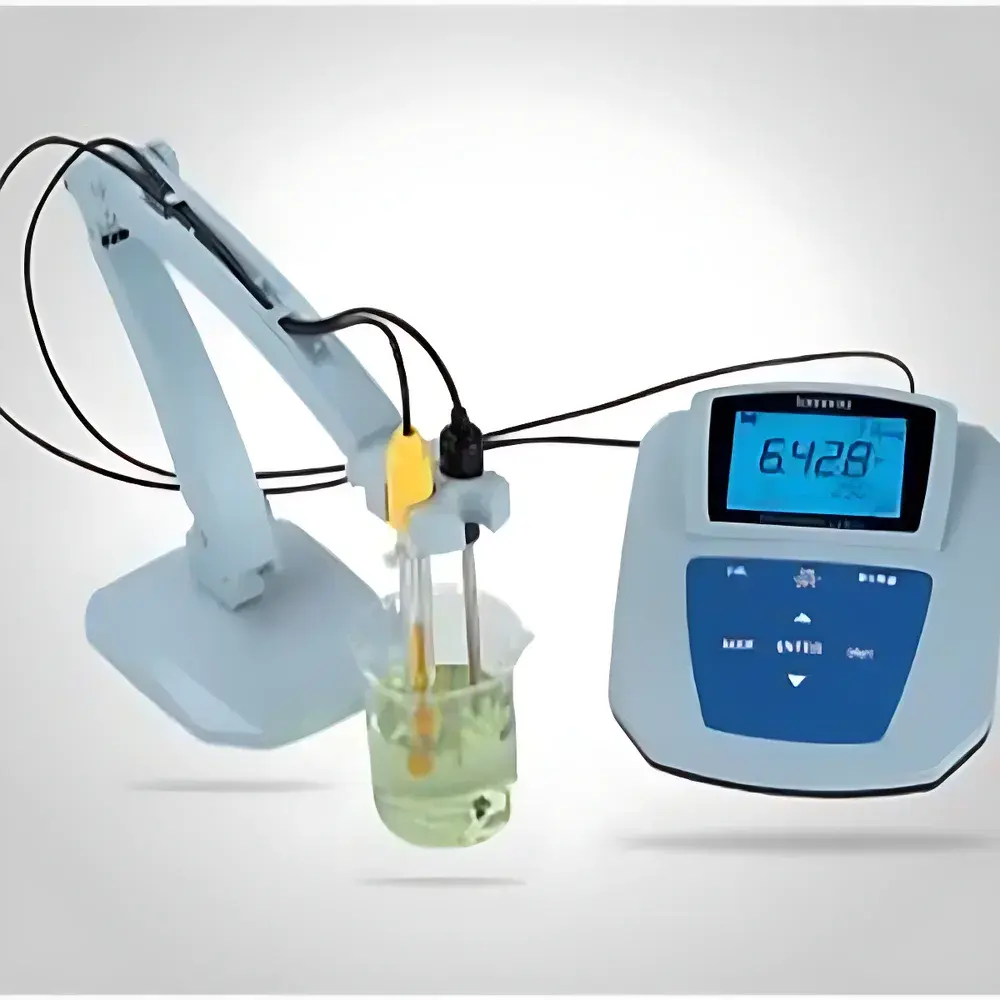
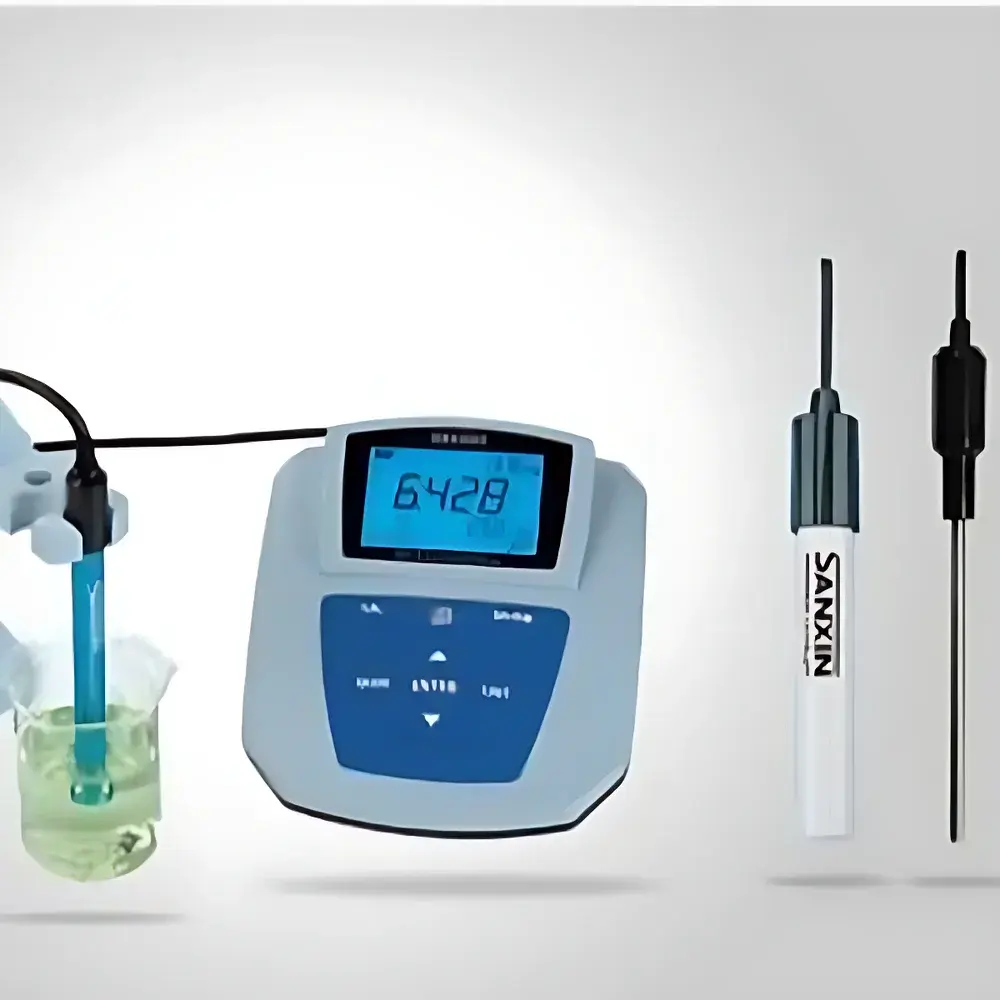
SANXIN MP512 Precision Benchtop pH Meter
| Brand | SANXIN |
|---|---|
| Origin | Shanghai, China |
| Model | MP512 |
| Instrument Type | Benchtop |
| Parameter Type | Single-Parameter (pH/mV/°C) |
| pH Range | −2.000 to 19.999 pH |
| pH Resolution | 0.001 pH |
| pH Accuracy | ±0.002 pH |
| mV Range | −1999.9 to +1999.9 mV |
| mV Resolution | 0.1 mV |
| mV Accuracy | ±0.03% FS |
| Temperature Range | −10 to 110 °C |
| Temperature Resolution | 0.1 °C |
| Temperature Accuracy | ±0.4 °C |
| Input Impedance | ≥3 × 10¹² Ω |
| Input Current | ≤1 × 10⁻¹² A |
| Stability | ±0.002 pH / 3 h |
| ATC Range | 0 to 110 °C |
| Data Storage | 600 sets |
| Storage Content | Measurement ID, pH/mV value, temperature, ATC/MTC status, date & time |
| Interface | RS232 |
| Power Supply | DC 9 V / 300 mA |
| Dimensions | 160 × 190 × 70 mm |
| Weight | 880 g |
| IP Rating | IP54 |
| Certifications | ISO 9001:2000, CE, CMC |
| Operating Environment | 15–30 °C (for 0.001-level accuracy), ≤75% RH |
Overview
The SANXIN MP512 Precision Benchtop pH Meter is an electrochemical measurement system engineered for high-accuracy, trace-level pH quantification in research laboratories, pharmaceutical quality control, power plant water chemistry, and semiconductor-grade ultrapure water analysis. It operates on the principle of potentiometric measurement using a glass membrane electrode to detect hydrogen ion activity relative to a stable reference electrode—compliant with IUPAC pH definition and ASTM D1293 (Standard Test Method for pH of Water). The instrument supports three distinct operational modes—stable display, timed measurement, and continuous monitoring—to accommodate dynamic process validation or static calibration workflows. Its dual-electrode architecture enables seamless transition between routine aqueous samples and low-conductivity media such as deionized water, boiler feedwater, and ammonia-dosed condensate, where conventional pH meters suffer from junction potential drift and slow response.
Key Features
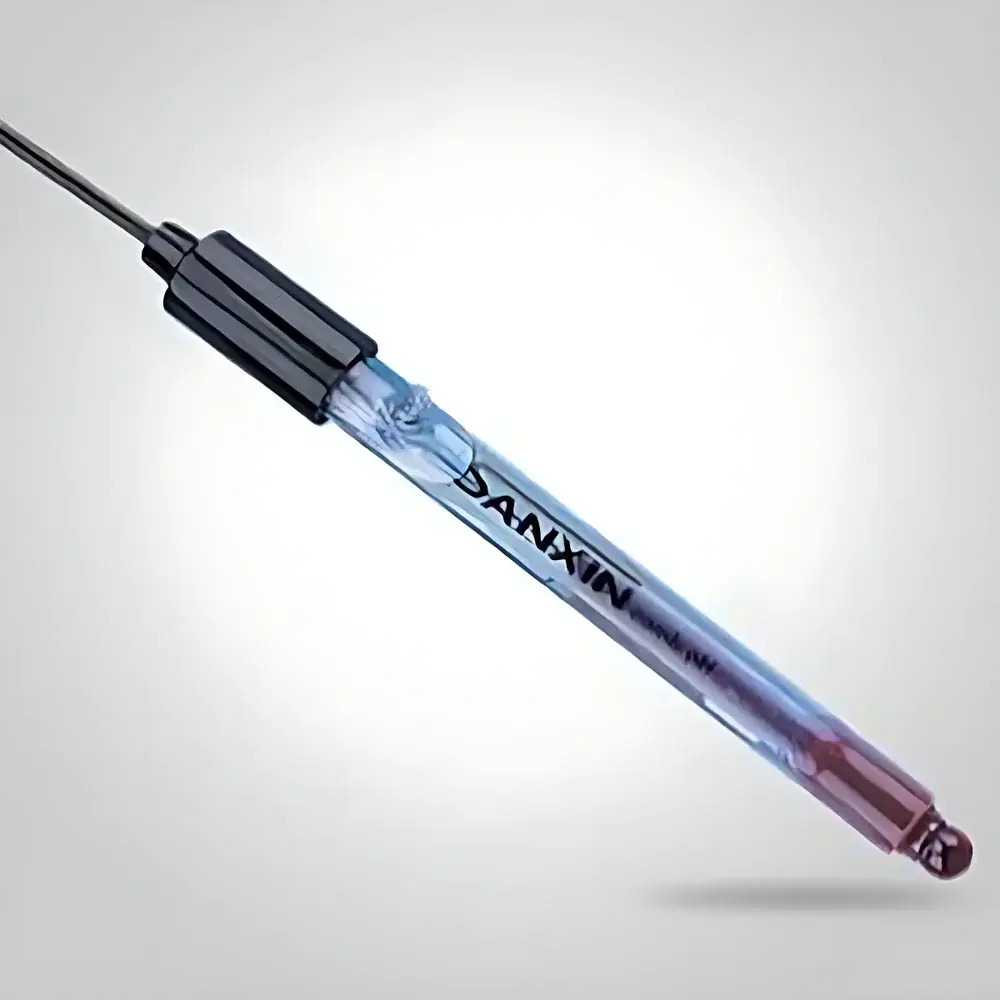
- Triple-electrode compatibility: Ships with 201T-M molded-body pH/ATC combination electrode for general use, 2503-C low-resistance glass pH composite electrode optimized for low-ionic-strength, turbid, or colloidal solutions, and MP500 temperature probe for independent thermal verification.
- GLP-compliant data integrity: Automatic timestamping, operator ID logging (via serial number), audit-ready storage of 600 full measurement records—including pH/mV values, temperature, ATC status, date, and time—enabling traceability per FDA 21 CFR Part 11 requirements when paired with validated software.
- Intelligent buffer recognition: Auto-identifies 13 standard pH buffers across four configurable series—NIST, European (DIN), Chinese (GB/T), and user-defined—reducing calibration errors and supporting multi-regional regulatory alignment.
- Dedicated high-purity water modes: Includes two specialized algorithms—“Ultrapure Water Mode” (compensates for liquid junction potential and CO₂ interference) and “Ammoniated Pure Water Mode” (corrects for NH₃/NH₄⁺ equilibrium effects)—critical for thermal power cycle chemistry monitoring per ASTM D4582 and IAPWS guidelines.
- ORP measurement capability: Measures redox potential in mV vs. SHE with ±0.03% full-scale accuracy, supporting corrosion monitoring, disinfection validation (e.g., chlorine residual), and electrochemical process control.
- Rugged industrial design: IP54-rated enclosure with silicone-sealed electrode ports ensures reliable operation in humid QC labs or field-deployed utility environments; meets EN 61010-1 safety standards for laboratory electrical equipment.
Sample Compatibility & Compliance
The MP512 is validated for direct measurement of aqueous matrices ranging from aggressive acidic digestates (pH −2.000) to strongly alkaline caustic solutions (pH 19.999), including seawater, wastewater effluents, biological buffers, and steam-cycle condensates. Its high-input-impedance circuitry (≥3 × 10¹² Ω) minimizes loading errors during low-conductivity measurements (<1 µS/cm), while the 2503-C electrode’s asymmetric glass formulation mitigates sodium error above pH 12. The system conforms to ISO/IEC 17025 documentation practices for calibration traceability and supports GLP/GMP-aligned workflows through structured data export and electronic signature readiness via RS232 interface.
Software & Data Management
Equipped with proprietary MP512 communication software (included on CD-ROM), the meter enables bidirectional data transfer to Windows-based PCs. Exported datasets retain full metadata—measurement ID, calibrated slope/asymmetry, electrode impedance diagnostics, and environmental timestamps—facilitating integration into LIMS or ELN platforms. Raw ASCII files comply with ASTM E1382 data formatting conventions. Firmware updates and configuration backups are supported via RS232; no cloud dependency or proprietary dongles required. All stored data remain encrypted at rest and are exportable without vendor lock-in.
Applications
- Pharmaceutical manufacturing: USP pH verification of injectables, excipients, and purified water (PW/WFI).
- Power generation: Real-time pH monitoring of turbine condensate, feedwater, and demineralizer effluent per EPRI TR-102302 and IEEE Std 117.
- Environmental testing: ASTM D1293-compliant pH analysis of surface water, groundwater, and leachates.
- Academic research: Kinetic studies requiring sub-millipH resolution in enzymatic or colloidal systems.
- Chemical synthesis: In-process pH control during hydrolysis, neutralization, or crystallization steps.
FAQ
Does the MP512 support automatic calibration with non-standard buffers?
Yes—the instrument allows user-defined buffer entry with adjustable nominal pH values and temperature coefficients, enabling calibration against proprietary or matrix-matched standards.
Can the MP512 be used for ISO 17025-accredited testing?
When operated with certified reference materials (CRM), documented procedures, and validated software, the MP512 meets metrological requirements for scope inclusion under ISO/IEC 17025:2017 clause 7.7 (uncertainty estimation) and 7.8 (reporting).
Is the RS232 interface compatible with modern Windows OS versions?
Yes—drivers and terminal emulation tools are provided; no legacy DOS environment required. USB-to-RS232 adapters are fully supported.
What maintenance is required for long-term stability?
Routine electrode cleaning (KCl soak for clogged junctions), periodic slope verification (>95% typical), and annual verification against NIST-traceable standards are recommended per manufacturer guidelines.
How does the MP512 handle temperature compensation in non-aqueous solvents?
The device defaults to aqueous Nernstian temperature correction; for organic solvents, manual temperature input (MTC mode) is advised, and users must apply solvent-specific correction factors externally.
Related Products






