
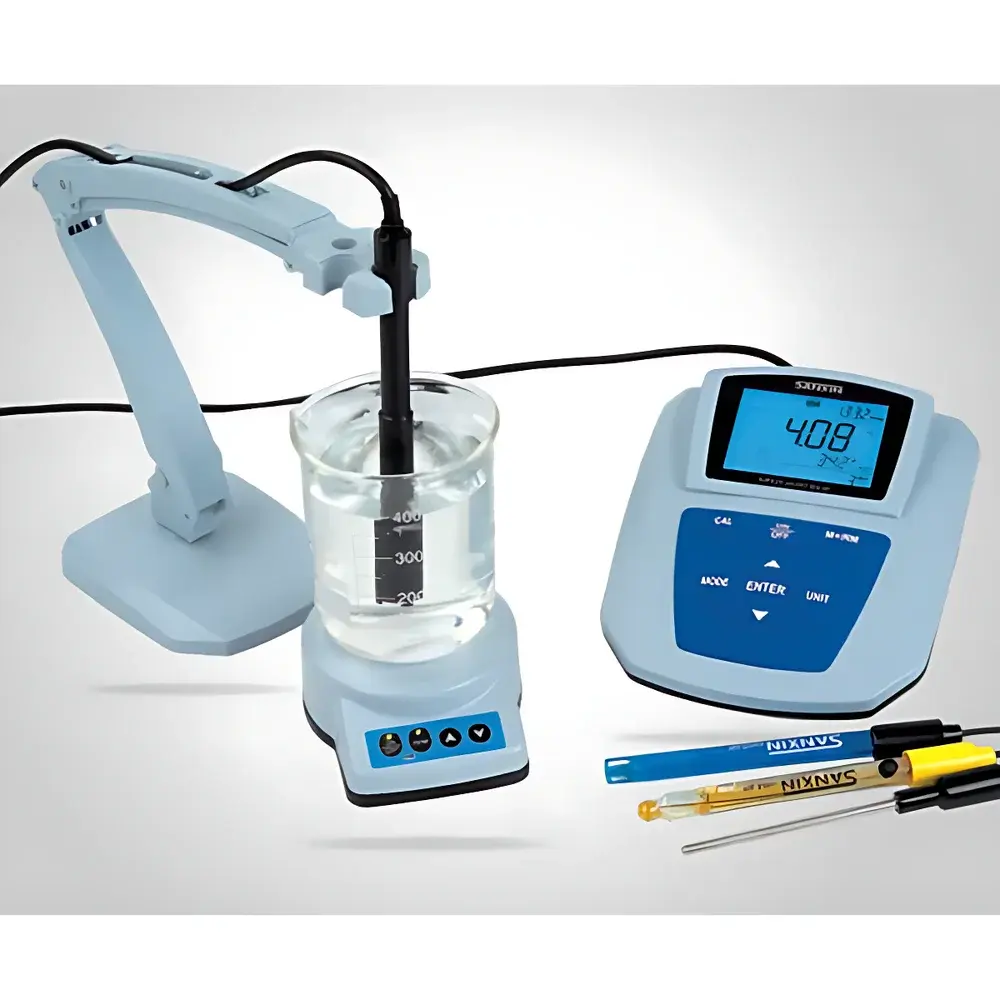
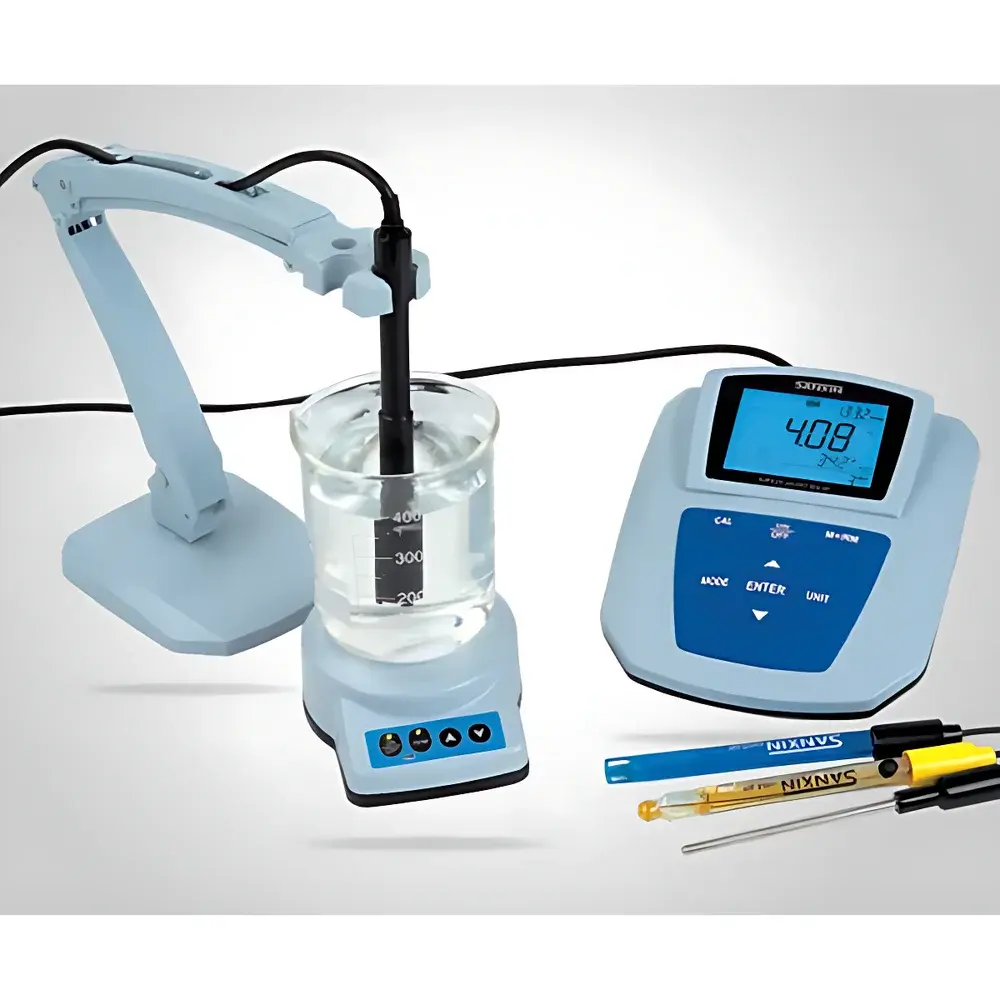
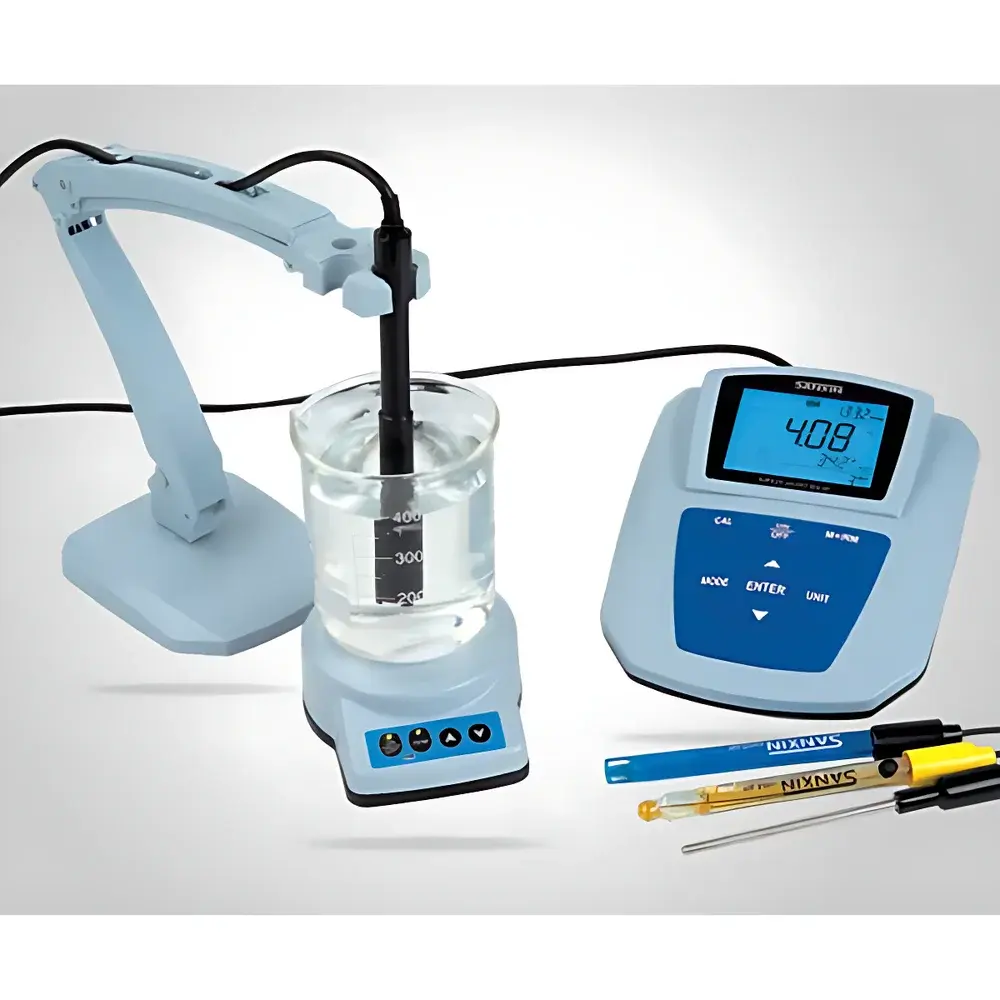
Sanxin MP525 Dual-Parameter Benchtop Electrochemical Analyzer (pH/ORP/Dissolved Oxygen)
| Brand | Sanxin Peirui |
|---|---|
| Origin | Shanghai, China |
| Model | MP525 |
| Instrument Type | Laboratory-grade pH/ORP/Dissolved Oxygen Analyzer |
| Measurement Principles | Potentiometric pH/ORP, Polarographic Dissolved Oxygen |
| Compliance | GLP-compliant design, IP54 rated, ISO 9001:2008 certified, CE & CMC marked |
| Power Supply | DC 9 V / 300 mA |
| Interface | RS232 serial output |
| Dimensions | 160 × 190 × 70 mm |
| Weight | 880 g |
| Data Storage | 900 sets with timestamp, temperature, ATC/MTC status, and measurement mode |
Overview
The Sanxin MP525 Dual-Parameter Benchtop Electrochemical Analyzer is a rigorously engineered laboratory instrument designed for simultaneous, high-fidelity measurement of pH, oxidation-reduction potential (ORP/EH), and dissolved oxygen (DO) in aqueous solutions. Built upon potentiometric sensing principles for pH and ORP—referenced to the standard hydrogen electrode (SHE)—and polarographic amperometry for DO quantification, the MP525 delivers traceable, reproducible electrochemical data essential for quality control, environmental monitoring, and process validation in regulated industrial and research settings. Its architecture adheres to Good Laboratory Practice (GLP) requirements, integrating automated calibration routines, real-time environmental compensation, and audit-ready data logging—features critical for laboratories operating under ISO/IEC 17025, ASTM D888, USP , or EPA Method 4500-O G compliance frameworks.
Key Features
- Triple-parameter capability: Independent yet synchronized measurement of pH (–1.999 to 19.999), ORP (–1999.9 to +1999.9 mV), and dissolved oxygen (0.00–20.00 mg/L or 0–200.0% saturation).
- Intelligent calibration system: Auto-recognition of 13 standardized pH buffer solutions across four internationally aligned series (NIST, DIN/ISO, Chinese GB, and user-defined), supporting both single- and two-point calibration with slope and offset diagnostics.
- Application-specific pH modes: Dedicated algorithms for high-purity water (low-conductivity correction) and ammonia-doped feedwater—enabling accurate alkalinity monitoring in power generation and petrochemical boiler systems per ASTM D1066 and IAPWS guidelines.
- Polarographic DO sensor integration: Self-contained three-in-one probe measures temperature, salinity, and DO simultaneously; factory-calibrated with built-in air-saturation and zero-oxygen reference protocols; polarization time ≤5 minutes at 25 °C.
- Environmental compensation engine: Fully automatic temperature compensation (0–100 °C), salinity compensation (0–45 ppt), and barometric pressure compensation (80–105 kPa) applied in real time during DO measurement.
- Operational flexibility: Three selectable acquisition modes—Stable Read (triggered on signal stability), Timed Interval (programmable sampling intervals), and Continuous Monitoring (real-time streaming to RS232 host).
Sample Compatibility & Compliance
The MP525 is validated for use with aqueous samples across a broad conductivity range (1 µS/cm to 2 S/cm), including ultrapure water, municipal wastewater, seawater analogs, pharmaceutical buffers, and industrial cooling loops. Its input impedance (>3 × 10¹² Ω) and ultra-low input current (<1 × 10⁻¹² A) minimize loading errors in low-ionic-strength matrices. The instrument meets IP54 ingress protection standards for dust and splash resistance, and its electrical safety conforms to IEC 61010-1. All firmware and hardware design elements support traceability per GLP Annex 11 and FDA 21 CFR Part 11 when paired with compliant data management software—ensuring integrity of electronic records during regulatory audits.
Software & Data Management
Data are stored locally in non-volatile memory (900 entries), each tagged with unique identifier, measurement value, calibrated temperature, ATC/MTC activation flag, date/time stamp, and operational mode. RS232 serial interface enables direct export to LIMS, Excel, or custom SCADA platforms using ASCII-based command protocol. Timestamps adhere to ISO 8601 format; all stored values retain native resolution (e.g., pH to 0.001, DO to 0.01 mg/L). Internal clock synchronization eliminates manual time-entry errors, and sequence-numbered records ensure unambiguous chain-of-custody documentation required in ISO/IEC 17025-accredited facilities.
Applications
- Power plant chemistry: Feedwater pH and ORP monitoring per EPRI TR-102366; condensate DO surveillance for corrosion risk assessment.
- Pharmaceutical water systems: USP Purified Water and Water for Injection (WFI) qualification via pH and DO trending per USP .
- Environmental labs: BOD incubation DO profiling, wastewater effluent compliance reporting (EPA 40 CFR Part 136), and sediment pore-water redox characterization.
- Academic research: Kinetic studies of redox reactions, enzyme-catalyzed oxygen consumption assays, and membrane permeability modeling.
- Food & beverage QC: Brine salinity-correlated DO stability testing in canned products and fermentation broth redox potential tracking.
FAQ
Does the MP525 support calibration verification against certified reference materials (CRMs)?
Yes—the instrument’s mV mode allows direct comparison of electrode output against NIST-traceable redox standards (e.g., quinhydrone, Zobell’s solution), and pH calibration can be verified using CRM buffer solutions with stated expanded uncertainty (k=2).
Can the DO electrode be used in high-viscosity or suspended-solid samples?
The polarographic sensor requires laminar flow and minimal fouling; for turbid or particulate-laden samples, optional flow-through cells or membrane-cleaning protocols are recommended to maintain response time and accuracy.
Is firmware upgrade supported via RS232?
Firmware updates are performed exclusively through authorized service centers using proprietary diagnostic tools; field-upgrade capability is not provided to preserve measurement integrity and regulatory compliance.
What is the minimum sample volume required for reliable measurement?
A minimum immersion depth of 25 mm is required for the combined pH/ORP/DO probe; no minimum bulk volume is specified, though static measurements demand stable thermal equilibrium and absence of surface agitation.
How does the MP525 handle temperature drift during extended measurements?
The integrated Pt1000 temperature sensor continuously feeds real-time compensation data to all active measurement channels; long-term stability is specified as ±0.002 pH/3 h at 25 °C, verified under ISO 5725 repeatability conditions.




