
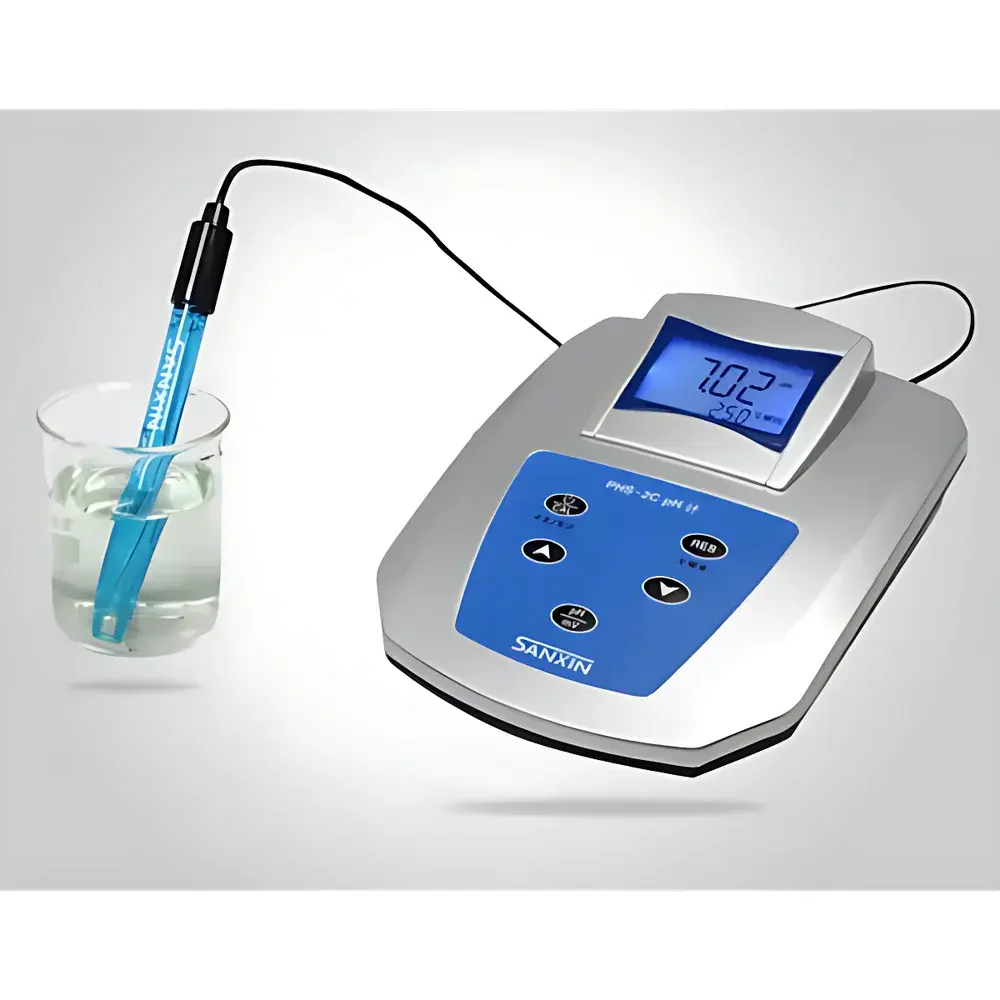
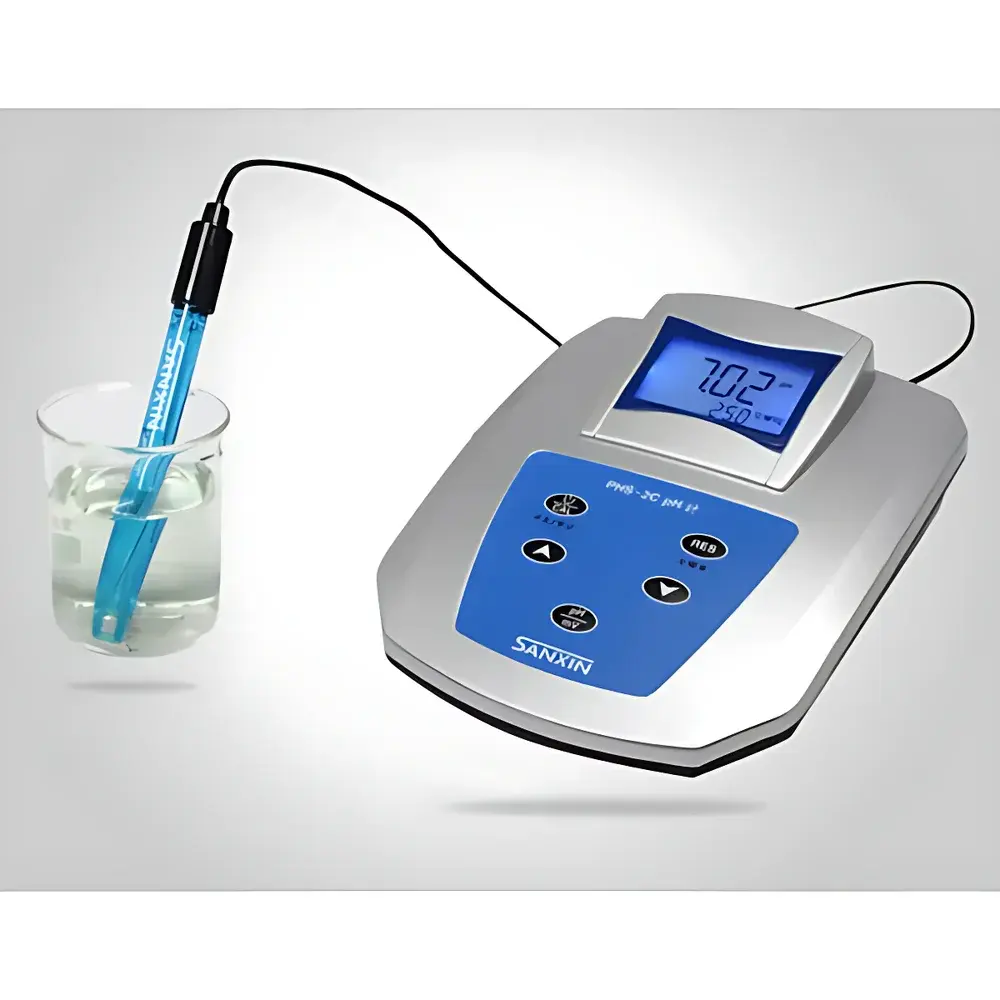
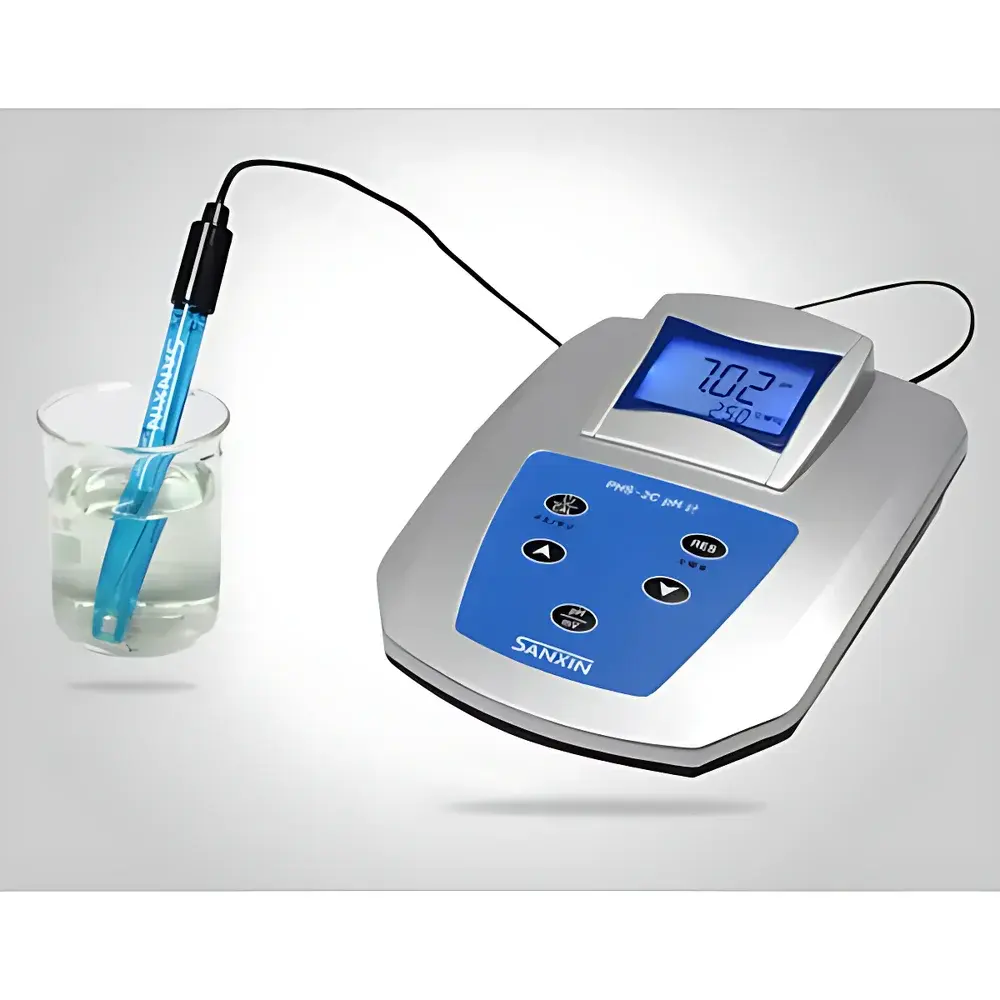
Sanxin PHS-2C Benchtop pH Meter
| Brand | Sanxin Peri |
|---|---|
| Origin | Shanghai, China |
| Model | PHS-2C |
| Instrument Type | Benchtop (not pen-type — corrected per technical specification) |
| Parameter Types | Dual (pH + Temperature) |
| pH Measurement Range | 0.00–14.00 pH |
| Resolution | 0.01 pH |
| Accuracy | ±0.02 pH |
| Temperature Compensation | Manual or Automatic (with optional PHT temperature electrode) |
| Calibration Buffers | pH 4.00, 6.86, and 9.18 (NIST-traceable standard solutions) |
| mV Range | −1500 to +1500 mV |
| mV Resolution | 1 mV |
| mV Accuracy | ±0.15% FS ±1 digit |
| Temperature Measurement | 0–100 °C / 32–212 °F, resolution 0.1 °C, accuracy ±1 °C |
| Input Impedance | ≥1 × 10¹² Ω |
| Stability | ±0.01 pH / 3 h |
| Power Supply | DC 9 V adapter |
| Dimensions | 160 × 190 × 70 mm |
| Weight | 750 g |
| Operating Environment | 5–35 °C, ≤85% RH |
Overview
The Sanxin PHS-2C is a benchtop dual-parameter electrochemical meter engineered for routine pH and millivolt (mV) measurements in quality control laboratories, educational institutions, and industrial process support environments. It operates on the potentiometric principle: measuring the potential difference between a pH-sensitive glass electrode and a stable reference electrode, converted into pH units via the Nernst equation. Designed for reproducible, traceable measurements under ISO/IEC 17025-aligned workflows, the PHS-2C supports both manual and automatic temperature compensation—critical for minimizing thermal drift in aqueous samples. Its high-input-impedance amplifier (≥1 × 10¹² Ω) ensures minimal loading error when used with high-resistance combination electrodes, preserving signal integrity across low-conductivity samples such as deionized water or organic solvents. Unlike portable or pen-style meters, the PHS-2C features a fixed benchtop architecture with enhanced mechanical stability, optimized ergonomics, and a dedicated display interface—making it suitable for extended daily use in regulated settings where instrument consistency is essential.
Key Features
- Backlit LCD display showing simultaneous pH and temperature readings with clear numeric formatting
- 1–3 point pH calibration using NIST-traceable buffer standards (pH 4.00, 6.86, and 9.18), with real-time slope calculation and display (% slope and offset)
- Configurable temperature compensation: manual entry or automatic mode (requires optional Sanxin PHT-series temperature electrode)
- Dual buffer series selection—Chinese national standard (GB/T 27503) or international (DIN 19266 / ASTM D1293) pH buffer sets—for cross-regional method compatibility
- Selectable temperature units (°C or °F) and adjustable contrast for ambient lighting adaptability
- Stable baseline performance: ±0.01 pH drift over 3 hours under controlled lab conditions
- Robust housing design (160 × 190 × 70 mm, 750 g) with non-slip base and cable management slots for long-term bench deployment
Sample Compatibility & Compliance
The PHS-2C is validated for aqueous and mildly buffered solutions across environmental, food, pharmaceutical, and academic applications. It complies with general requirements of IEC 61010-1 for electrical safety and electromagnetic compatibility (EMC). While not certified for GMP or FDA 21 CFR Part 11 out-of-the-box, its calibration logging capability—when paired with external documentation practices—supports GLP-compliant recordkeeping. The instrument accepts standard BNC-input pH electrodes and optional temperature probes meeting DIN 19266 mechanical and electrical specifications. Buffer solution compatibility includes both Chinese national standard buffers (e.g., GB/T 27503–2011) and internationally recognized formulations (e.g., NIST SRM 186, DIN 19266 Class A), enabling method transfer between regional regulatory frameworks.
Software & Data Management
The PHS-2C operates as a standalone instrument without embedded data storage or USB connectivity. All measurement data must be recorded manually or captured externally via analog output (if equipped with optional analog module) or through visual transcription. Calibration records—including date, buffer IDs, measured mV values, calculated slope, and offset—are displayed post-calibration and intended for inclusion in laboratory notebooks or electronic lab notebooks (ELNs) per internal SOPs. For audit readiness, users are advised to maintain a calibration logbook referencing ISO/IEC 17025 clause 6.4.10 (equipment verification) and USP guidelines for pH meter qualification.
Applications
- Quality assurance testing of purified water and WFI (Water for Injection) in pharmaceutical manufacturing
- pH monitoring during fermentation, brewing, and dairy processing
- Environmental water analysis (surface water, wastewater effluent, leachate) per EPA Method 150.1
- Academic teaching labs for electrochemistry fundamentals and calibration protocol training
- Raw material screening in chemical synthesis and polymer formulation
- Validation of cleaning-in-place (CIP) rinse endpoints in bioprocessing facilities
FAQ
Does the PHS-2C support automatic calibration recognition (Auto-Read)?
No—the PHS-2C requires manual initiation of each calibration step; it does not auto-detect buffer pH values.
Is the instrument compliant with FDA 21 CFR Part 11?
No—it lacks electronic signature capability, audit trail generation, or secure user access controls required for Part 11 compliance.
Can I use non-Sanxin pH electrodes with this meter?
Yes—any standard BNC-output pH electrode with impedance ≤1 × 10¹² Ω is compatible, though performance validation is recommended per ISO 17025 Section 6.4.3.
What is the recommended recalibration frequency?
Per ISO 17025 and typical QC practice, recalibrate before each analytical batch or at least once per shift when used continuously.
Does the PHS-2C include a temperature probe?
No—the unit supports automatic temperature compensation only when paired with the optional Sanxin PHT-series temperature electrode (sold separately).




