
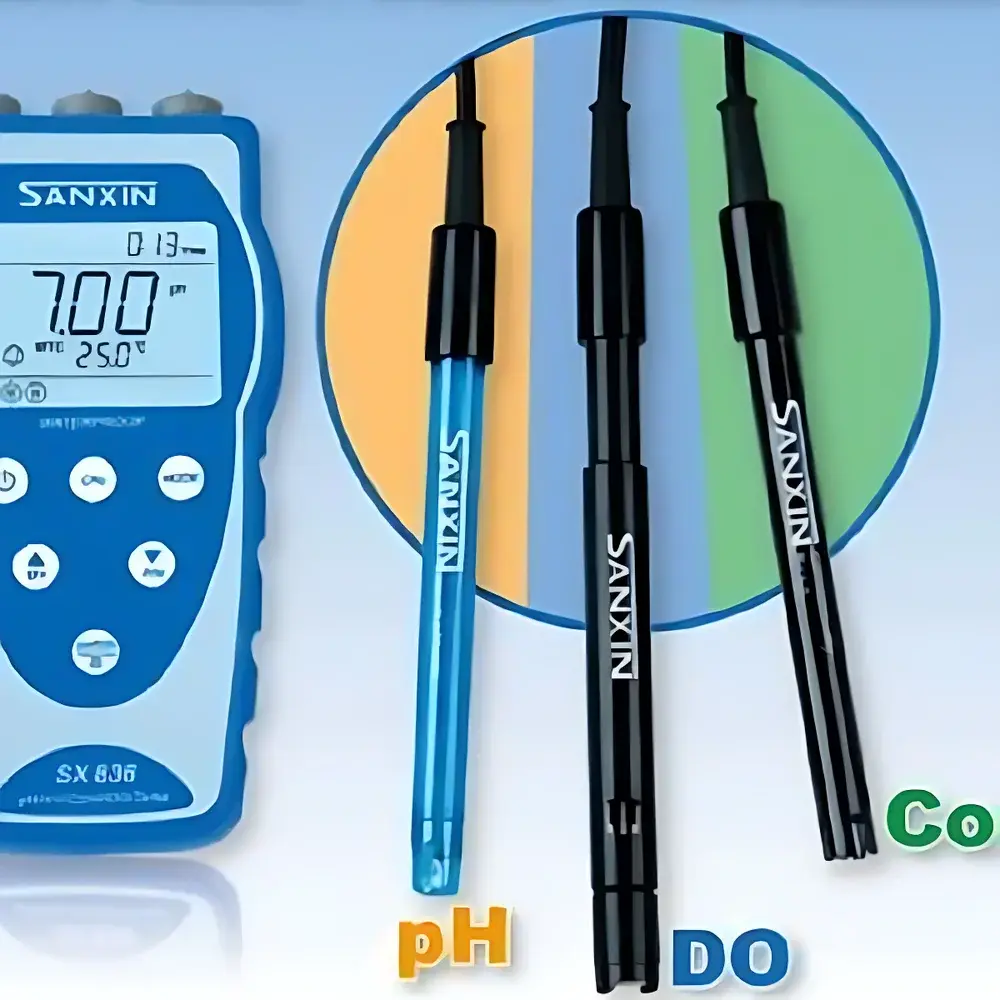
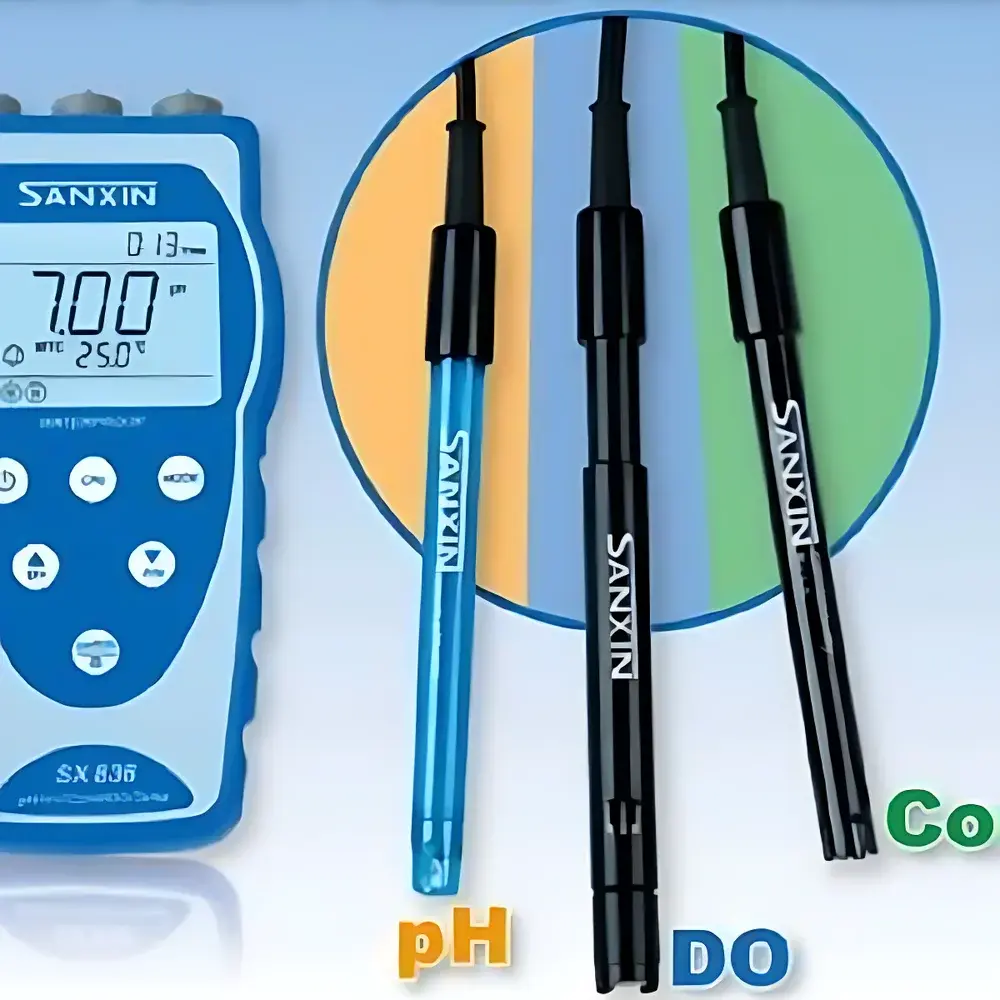
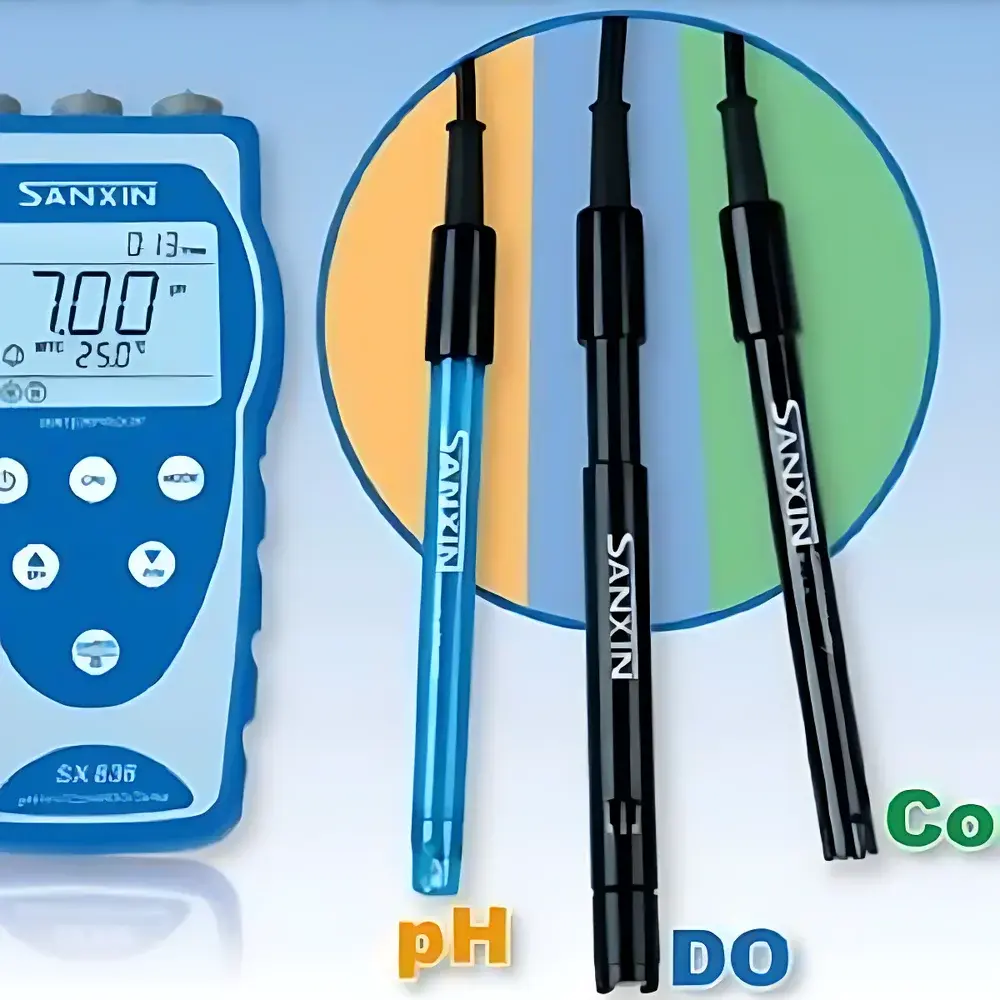
Sanxin SX836 Portable Multi-Parameter Meter (pH / Conductivity / Dissolved Oxygen)
| Brand | Sanxin Peri |
|---|---|
| Origin | Shanghai, China |
| Model | SX836 |
| Portability | Pen-style handheld |
| Intended Use | Laboratory & Field |
| Conductivity Range | 0–200 mS/cm |
| TDS Range | 0–100 g/L |
| Resistivity Range | 0–100 MΩ·cm |
| Salinity Range | 0–100 ppt |
| Temperature Range | 0–100 °C |
| Accuracy | ±1.0% FS |
| Resolution | 0.01/0.1/1 µS/cm, 0.01/0.1 mS/cm |
Overview
The Sanxin SX836 Portable Multi-Parameter Meter is an integrated electrochemical analyzer engineered for simultaneous, real-time measurement of pH, conductivity (including TDS, salinity, and resistivity), and dissolved oxygen (DO) in aqueous samples. Designed around a modular probe architecture, it employs potentiometric sensing for pH/mV, four-electrode or two-electrode conductometric detection for conductivity parameters, and Clark-type polarographic technology for dissolved oxygen quantification. Its dual-mode temperature compensation—automatic and manual—supports accurate readings across diverse sample matrices, from ultrapure water in power plant feedwater systems to saline wastewater in environmental monitoring. The instrument complies with fundamental metrological principles outlined in ISO/IEC 17025 for calibration traceability and supports routine verification per ASTM D1125 (conductivity), ASTM D888 (dissolved oxygen), and USP (pH). It is not intended for in vivo or hazardous area use.
Key Features
- Triple-sensor compatibility: Accepts up to three independently calibrated electrodes—pH, conductivity, and DO—mounted simultaneously on a single multi-probe cap for synchronized multi-parameter acquisition.
- Intelligent calibration management: Auto-recognition of 12 pH buffer standards (USA, NIST, CH series); auto-detection of 8 conductivity standards; guided calibration workflows with pass/fail diagnostics and timestamped calibration history.
- Advanced temperature compensation: Non-linear algorithms for high-purity water conductivity (below 10 µS/cm); automatic salinity and barometric pressure compensation for DO; configurable ammonia-added pure water pH mode per IAPWS guidelines.
- Ruggedized industrial design: IP57-rated enclosure with soft-grip rubber overmold; fold-out stand for benchtop operation; dual power options (rechargeable Li-ion battery or USB-C bus power).
- GLP-compliant data handling: Real-time clock stamping, manual and auto-timed storage (intervals 1 s–24 h), 500-point internal memory with overwrite protection, and USB 2.0 interface for CSV export.
Sample Compatibility & Compliance
The SX836 is validated for use with deionized water, tap water, boiler feedwater, cooling tower effluent, surface water, wastewater, and pharmaceutical process water. It excludes non-aqueous solvents, viscous suspensions (>100 cP), or samples containing sulfides, cyanides, or heavy metals above 1 mg/L (which may poison the DO membrane or coat pH glass). All measurements adhere to standard reference methods including ISO 7888 (conductivity), ISO 5814 (electrochemical DO), and ISO 10523 (pH of dilute aqueous solutions). The device meets CE marking requirements under the EMC Directive 2014/30/EU and RoHS 2011/65/EU. While not FDA 21 CFR Part 11–certified out-of-box, audit trails, user access logs, and electronic signature readiness can be implemented via optional firmware upgrade and external LIMS integration.
Software & Data Management
Data capture follows Good Laboratory Practice (GLP) principles: each stored record includes parameter value, unit, timestamp, electrode ID, temperature, calibration status flag, and operator ID (user-configurable). Internal memory retains metadata such as last calibration date, probe serial numbers, and sensor drift alerts. USB transfer enables direct import into Excel or laboratory information management systems (LIMS) without proprietary software. No cloud connectivity or remote firmware update capability is embedded—ensuring data sovereignty and network isolation required in regulated QC environments. Optional CSV template mapping supports automated parsing in statistical process control (SPC) platforms compliant with ISO 9001 Annex A.3.
Applications
- Power generation: Monitoring condensate purity (resistivity >5 MΩ·cm), hydrazine-treated feedwater pH, and turbine inlet conductivity.
- Pharmaceutical manufacturing: USP purified water (PW) and water-for-injection (WFI) release testing per Chapters and .
- Environmental field surveys: Rapid DO profiling in rivers and lakes; salinity-driven conductivity correction in estuarine studies.
- Academic teaching labs: Student experiments in electrochemistry fundamentals, calibration theory, and sensor cross-interference analysis.
- Food & beverage QA: Batch verification of rinse water conductivity post-CIP, and dissolved oxygen in carbonated beverage headspace.
FAQ
Does the SX836 support automatic electrode identification?
Yes—via embedded EEPROM chips in Sanxin-certified pH, conductivity, and DO probes. Third-party electrodes require manual configuration and do not trigger auto-recognition.
Can the instrument perform simultaneous real-time logging of all three parameters?
Yes—when equipped with the tri-cap assembly, the SX836 acquires and displays pH, conductivity, and DO values concurrently at 1-second intervals, with synchronized timestamps.
Is the DO electrode membrane replaceable in the field?
Yes—the polarographic sensor uses a standardized 3-piece cap system (membrane, electrolyte gel, cathode seal); replacement kits include pre-filled electrolyte and calibrated membranes.
What is the minimum conductivity range with guaranteed accuracy?
For measurements below 10 µS/cm (e.g., ultrapure water), the SX836 applies non-linear temperature compensation per IEC 60404-8-11, achieving ±2.0% FS accuracy down to 0.1 µS/cm.
How is compliance with ISO/IEC 17025 maintained during calibration?
Users must document calibration using traceable standards (e.g., NIST SRM 1692 for conductivity), record environmental conditions, and retain raw data files—including stability checks and repeatability assessments—for audit review.





