
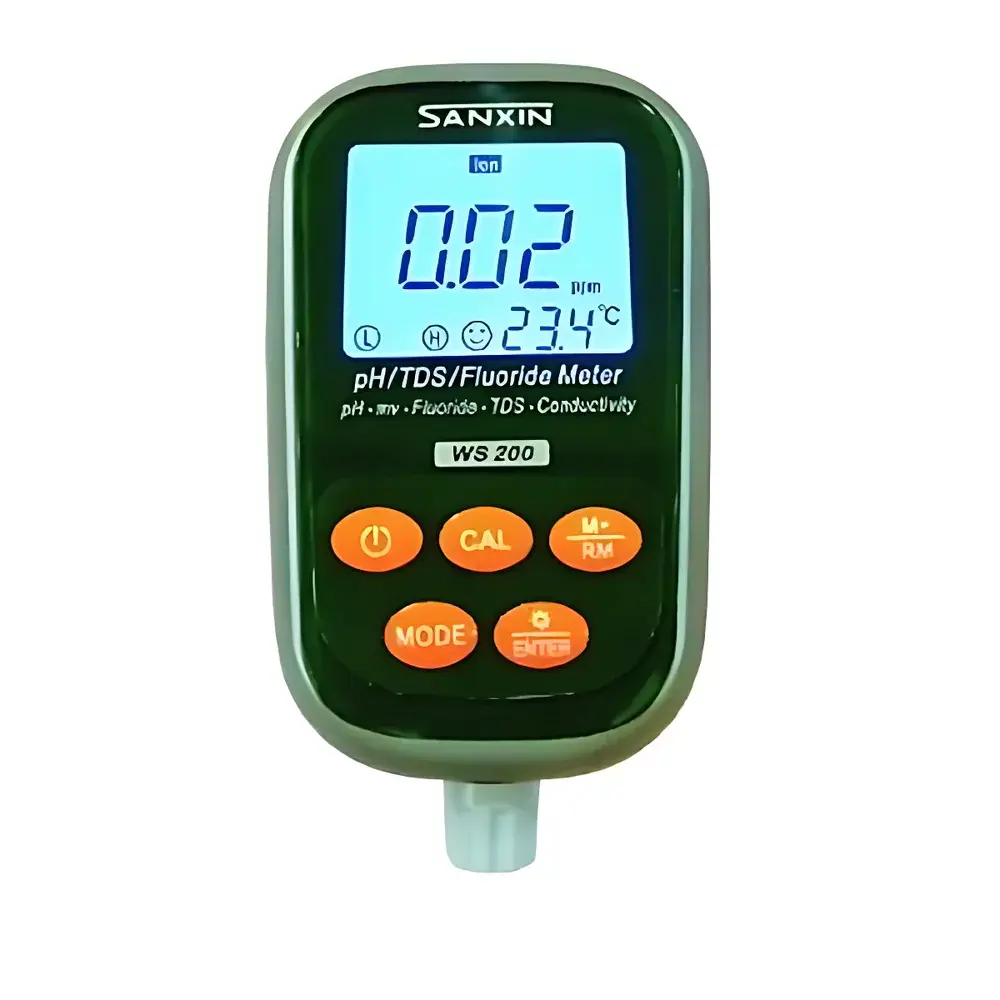
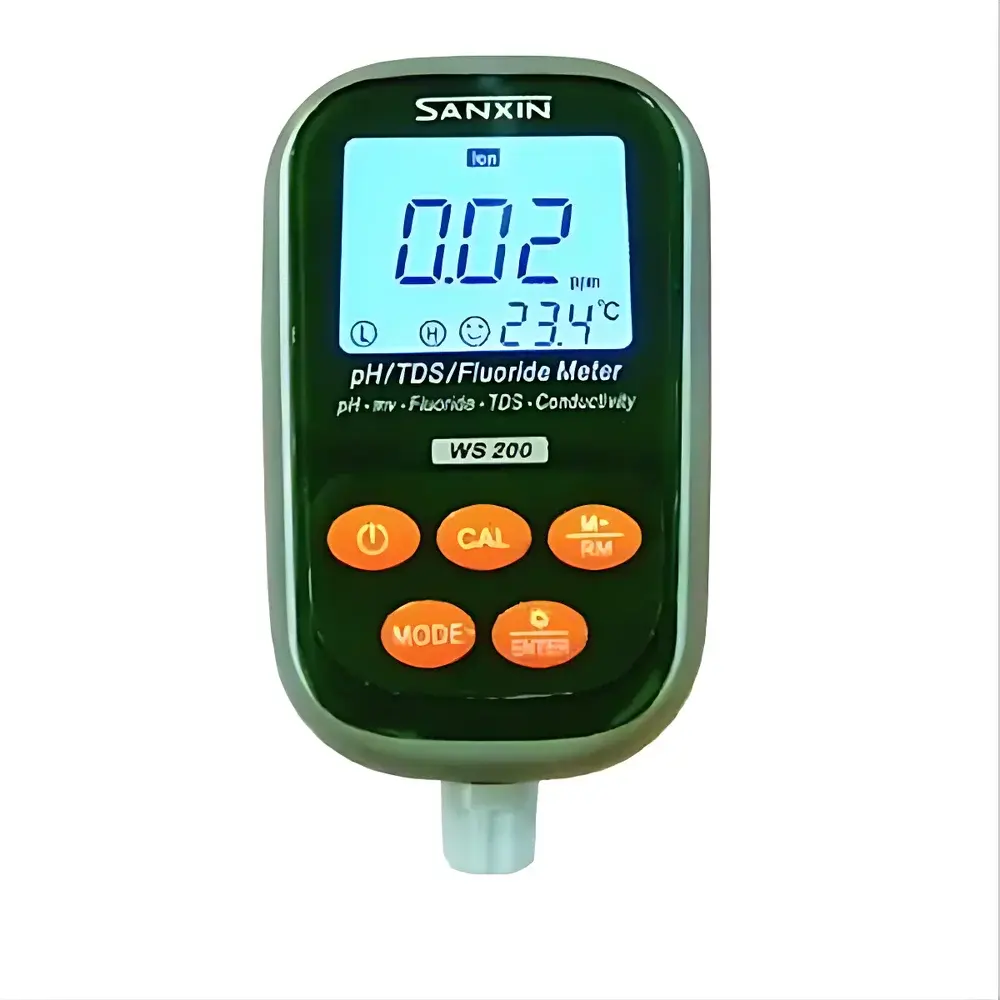
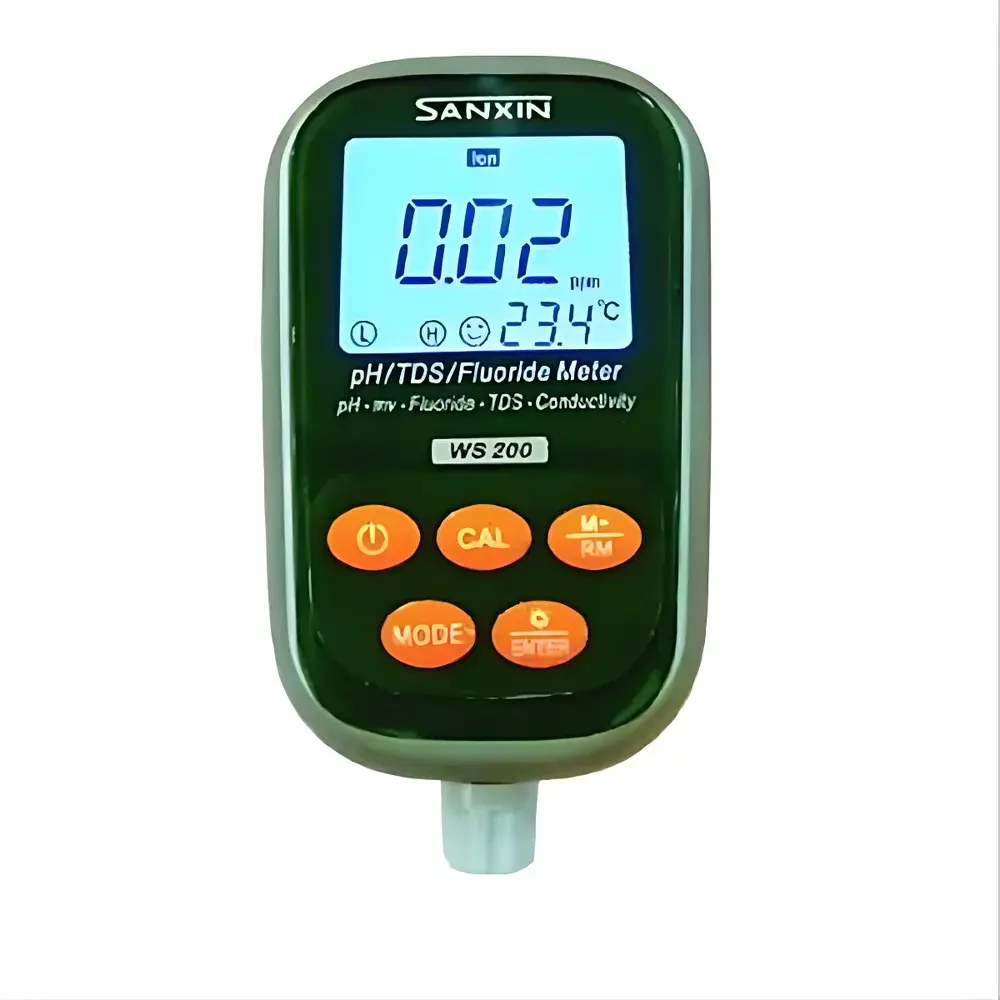
SANXIN WS200 Portable pH / TDS / Fluoride Ion Concentration Meter
| Brand | SANXIN Peri |
|---|---|
| Origin | Shanghai, China |
| Manufacturer Type | Authorized Distributor |
| Product Category | Domestic Instrument |
| Model | WS200 |
| Quotation | Upon Request |
| Net Weight | ~500 g (portable) |
| Operating Temperature | 0–80 °C (fluoride measurement) |
| Power Supply | 4 × 1.5 V AA batteries or optional external DC adapter |
| Repeatability | pH ≤ ±0.01 pH |
| Response Time | ≤5 s |
| Accuracy | pH ±0.01 pH |
Overview
The SANXIN WS200 is a field-deployable, multi-parameter water quality analyzer engineered for precise, real-time measurement of pH, oxidation-reduction potential (ORP), fluoride ion activity (pF), conductivity, total dissolved solids (TDS), salinity, resistivity, and temperature in aqueous solutions. It operates on the principle of potentiometric ion-selective electrode (ISE) detection for fluoride, combined with glass-membrane pH sensing and four-electrode conductivity measurement—enabling simultaneous, trace-level quantification without reagent addition or mechanical agitation. Designed for compliance with routine environmental monitoring protocols—including those aligned with EPA Method 300.0 (for fluoride), ASTM D1293 (pH of water), and ISO 7888 (conductivity)—the WS200 delivers laboratory-grade accuracy in a rugged, handheld platform suitable for regulatory sampling, source water assessment, and point-of-use verification.
Key Features
- Integrated triple-composite fluoride ISE: Combines fluoride-selective membrane, Ag/AgCl reference, and NTC thermistor in a single probe—ensuring stable potential, <5 s response time, and automatic temperature compensation across 0–80 °C.
- Simultaneous multi-parameter acquisition: Measures pH (0.00–14.00), ORP (±1999 mV), fluoride (0.00–9.00 pF), conductivity (0–199.9 mS/cm), TDS (0–100 g/L), salinity (0–100 ppt), and resistivity (0–100 MΩ·cm) in one instrument cycle.
- Intelligent embedded firmware: Supports auto-calibration routines (2-/3-point pH, 2-point fluoride, 1-/2-/3-point conductivity), adaptive temperature compensation (0–100 °C), and programmable electrode constants (0.1 / 1.0 / 10 cm⁻¹).
- Rugged portable architecture: IP57-rated enclosure withstands dust ingress and temporary immersion; compact dimensions (65 × 120 × 31 mm) and low mass (186 g instrument only) enable extended field operation.
- Power flexibility: Operates on four standard AA alkaline cells (typical life >200 hours) or optional regulated DC input—eliminating dependency on mains power during remote surveys.
Sample Compatibility & Compliance
The WS200 is validated for use with natural waters (groundwater, surface water, drinking water), wastewater effluents, and treated municipal supplies. Its fluoride ISE exhibits minimal interference from common anions (Cl⁻, NO₃⁻, SO₄²⁻) at typical environmental concentrations when used with ionic strength adjuster (ISA). The instrument meets GLP documentation requirements through timestamped data logging (200 entries), including sample ID, measured values, units, and ambient temperature. While not certified to IEC 61000-4 electromagnetic immunity standards, its analog front-end design minimizes noise susceptibility in field environments. Calibration traceability aligns with NIST-traceable buffer and standard solutions (e.g., pH 4.01/7.00/10.01, fluoride 1.00–6.00 pF standards).
Software & Data Management
Data are stored internally with full metadata: sequence number, parameter value, unit (pF, mg/L, µS/cm, etc.), temperature reading, and timestamp. Export is supported via manual transcription or optional USB-to-serial interface (not included). The firmware implements audit-ready features including automatic low-battery warning, self-diagnostic startup checks, and forced auto-shutdown after 10 minutes of inactivity. All calibration events—including date, buffer values used, slope, and offset—are retained in non-volatile memory. For regulated environments, the device supports 21 CFR Part 11–compliant workflows when paired with validated third-party data capture software (e.g., LabArchives or custom LIMS integrations), though native electronic signature functionality is not embedded.
Applications
- Drinking water safety verification: Rapid screening of fluoride concentration against WHO guideline values (1.5 mg/L) and national regulatory limits (e.g., US EPA MCL 4.0 mg/L).
- Environmental field monitoring: On-site profiling of pH and conductivity gradients in rivers, lakes, and aquifers—supporting hydrochemical classification per Piper diagram conventions.
- Wastewater treatment process control: Tracking pH shifts and ionic load changes across neutralization, coagulation, and disinfection stages.
- Educational laboratories: Teaching core concepts in electroanalytical chemistry—including Nernst equation application, ISE selectivity, and temperature compensation theory.
- Industrial pretreatment validation: Confirming rinse water quality prior to electroplating or semiconductor wafer cleaning processes where fluoride residuals may affect etch uniformity.
FAQ
Does the WS200 require ionic strength adjustment for accurate fluoride measurement?
Yes—fluoride activity measurements using ISEs demand consistent ionic background. A TISAB (Total Ionic Strength Adjustment Buffer) must be added to samples to mask hydroxide interference and fix activity coefficients. Typical ratio is 1:1 v/v.
Can the instrument store calibration data separately for different electrode types?
No—the WS200 retains only the most recent calibration set per parameter. Users must manually re-perform calibration when switching between pH and fluoride modes or changing conductivity cell constants.
Is the fluoride electrode compatible with high-turbidity or particulate-laden samples?
Direct immersion is possible, but suspended solids may foul the membrane. Pre-filtration (0.45 µm) is recommended for samples exceeding 5 NTU to maintain electrode longevity and signal stability.
What temperature reference standards are supported for conductivity compensation?
The device allows selection among 25 °C, 20 °C, and 18 °C as linear compensation baselines—configurable per measurement session to match regional reporting conventions.
How is measurement uncertainty estimated for fluoride readings?
Combined standard uncertainty includes contributions from electrode slope deviation (±0.5 mV), reference junction potential drift (±0.2 mV), temperature sensor error (±0.3 °C), and ISA addition variability—yielding expanded uncertainty (k=2) of ±0.02 pF under controlled conditions.







