
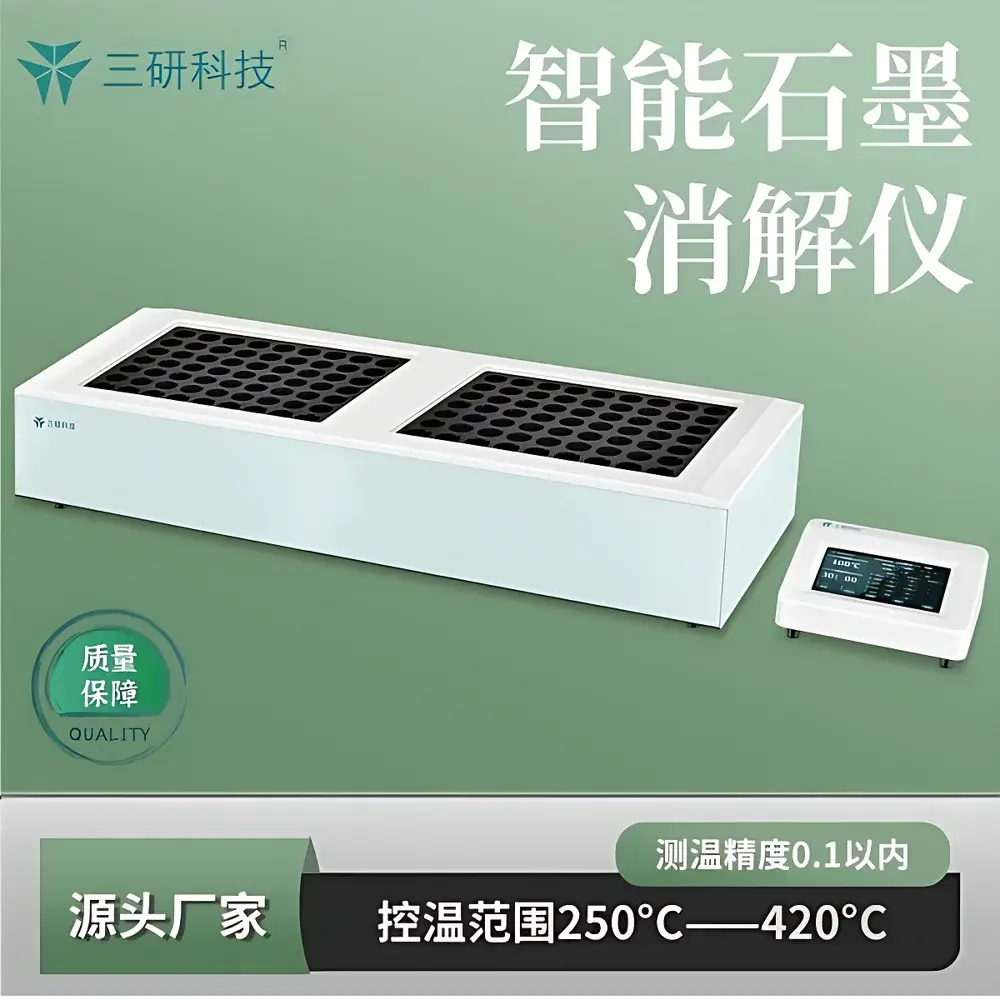
Sanyan Technology LF-72 Intelligent Graphite Block Digestion System
| Brand | Sanyan Technology |
|---|---|
| Origin | Guangdong, China |
| Manufacturer Type | Direct Manufacturer |
| Regional Classification | Domestic (China) |
| Model | LF-72 |
| Instrument Category | Electric Heating Digestion System |
| Automation Level | Semi-Automatic |
| Digestion Positions | 144 |
| Max. Heating Temperature | 250 °C |
| Temperature Control Accuracy | ±0.1 °C |
| Heating Principle | Resistive heating via high-purity graphite block with integrated electronic PID temperature control |
| Reagent Delivery | Manual reagent addition — no integrated fluidic channels |
Overview
The Sanyan Technology LF-72 Intelligent Graphite Block Digestion System is a semi-automated, high-capacity sample preparation instrument engineered for reproducible, trace-metal–compatible acid digestion of solid and semi-solid matrices in environmental, food, pharmaceutical, and geological laboratories. It operates on the principle of uniform resistive heating through a monolithic, high-density graphite block—leveraging graphite’s exceptional thermal conductivity (≈150 W/m·K), chemical inertness, and low thermal mass to deliver rapid, homogeneous heat transfer across all 144 digestion positions. Unlike ceramic or metal-heated blocks, graphite minimizes thermal gradients and eliminates hot-spot formation, ensuring consistent digestion kinetics across the entire sample array. The system is designed to support open-vessel digestion protocols using HNO₃, HCl, HF, H₂O₂, and aqua regia under controlled thermal ramping—enabling complete mineralization of organic matter and refractory inorganic compounds while preserving analyte integrity for downstream ICP-OES, ICP-MS, or AAS analysis.
Key Features
- 144-position high-density graphite digestion block with precision-machined PTFE-coated wells (compatible with standard 50 mL borosilicate or quartz digestion tubes)
- Wide operating temperature range: ambient to 250 °C, with real-time PID-controlled accuracy of ±0.1 °C (verified per ASTM E220)
- Dual independent heating modules enabling dynamic power redistribution—reducing localized thermal stress and extending graphite block service life beyond 5,000 digestion cycles
- Semi-automated operation: programmable multi-step temperature ramps (up to 10 segments), hold times, and cooling profiles; manual reagent addition ensures full operator control over reaction stoichiometry
- Full-enclosure housing constructed from molded polytetrafluoroethylene (PTFE), providing Class A resistance to concentrated acids (including HF), alkalis, and oxidizing agents per ISO 17025-compliant corrosion testing
- Detachable intelligent controller with 7-inch capacitive touchscreen, supporting method storage (≥500 protocols), time-scheduled start, and real-time graphical display of temperature vs. time curves
Sample Compatibility & Compliance
The LF-72 accommodates diverse sample types—including soils, sediments, biological tissues, plant materials, polymers, and food composites—when paired with appropriate digestion vessels and acid mixtures. Its PTFE enclosure and graphite architecture meet key regulatory requirements for trace-metal analysis: it supports EPA Methods 3050B, 3051A, and 3052; ISO 11466 for soil digestion; and USP <231> heavy metals testing. While not fully automated for reagent delivery, its semi-automatic design aligns with GLP and GMP workflows where documented operator intervention is required. All temperature logs and method execution records are timestamped and exportable (CSV/Excel), satisfying audit-trail expectations under FDA 21 CFR Part 11 when used with validated laboratory information management systems (LIMS).
Software & Data Management
The embedded controller firmware supports method creation, validation, and version control without external PC dependency. Each protocol stores target temperatures, ramp rates (°C/min), dwell durations, and cooling parameters—enabling strict adherence to standardized digestion SOPs. Real-time curve visualization allows immediate deviation detection (e.g., unexpected boiling, exothermic spikes). Data export includes raw temperature readings at 1-second intervals, method metadata, and operator ID (if integrated with network authentication). No cloud connectivity is built-in; data remains locally stored on the controller’s industrial-grade SD card—ensuring compliance with data sovereignty policies common in EU and APAC laboratories.
Applications
- Preparation of environmental samples (soil, sludge, airborne particulates) for multi-element quantification by ICP-MS
- Decomposition of pharmaceutical excipients and active ingredients prior to residual catalyst screening (e.g., Pd, Pt, Rh)
- Mineralization of seafood, cereals, and infant formula for nutritional element profiling (Ca, Mg, Zn, Se, As)
- Geochemical digestion of silicate rocks and ores using HF-HNO₃ mixtures under reflux conditions
- Quality control digestion in contract testing labs requiring method traceability, inter-batch repeatability, and ISO/IEC 17025 documentation readiness
FAQ
Does the LF-72 support closed-vessel microwave-assisted digestion?
No—the LF-72 is an open-vessel, conductive-heating system designed for atmospheric-pressure digestion only. It does not integrate pressure vessels or microwave generation.
Can the graphite block be replaced independently of the main unit?
Yes—the graphite block is a field-replaceable modular component with standardized mounting and thermocouple interface, minimizing downtime during maintenance.
Is the PTFE housing resistant to hydrofluoric acid (HF)?
Yes—tested per ASTM D543, the molded PTFE enclosure exhibits no measurable weight loss or surface degradation after continuous exposure to 48% HF at 120 °C for 72 hours.
What calibration standards are recommended for routine verification?
NIST-traceable RTD probes (e.g., Fluke 729 with dry-well calibrator) are recommended for annual temperature verification at three points: 100 °C, 180 °C, and 250 °C, per ISO/IEC 17025 Clause 6.5.2.
How is user access managed in shared-lab environments?
The controller supports configurable operator levels (Guest, Technician, Administrator) with password protection for method editing and system configuration—enabling role-based workflow governance without third-party software.



