
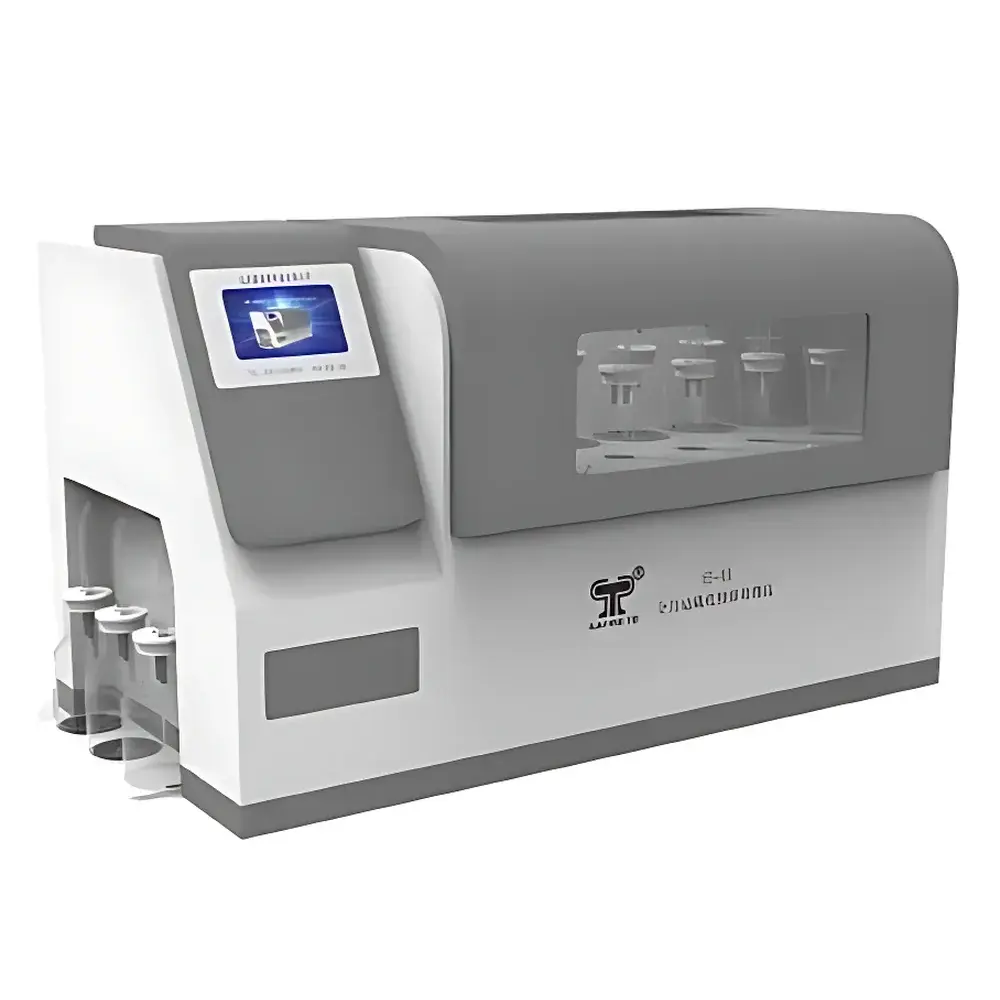
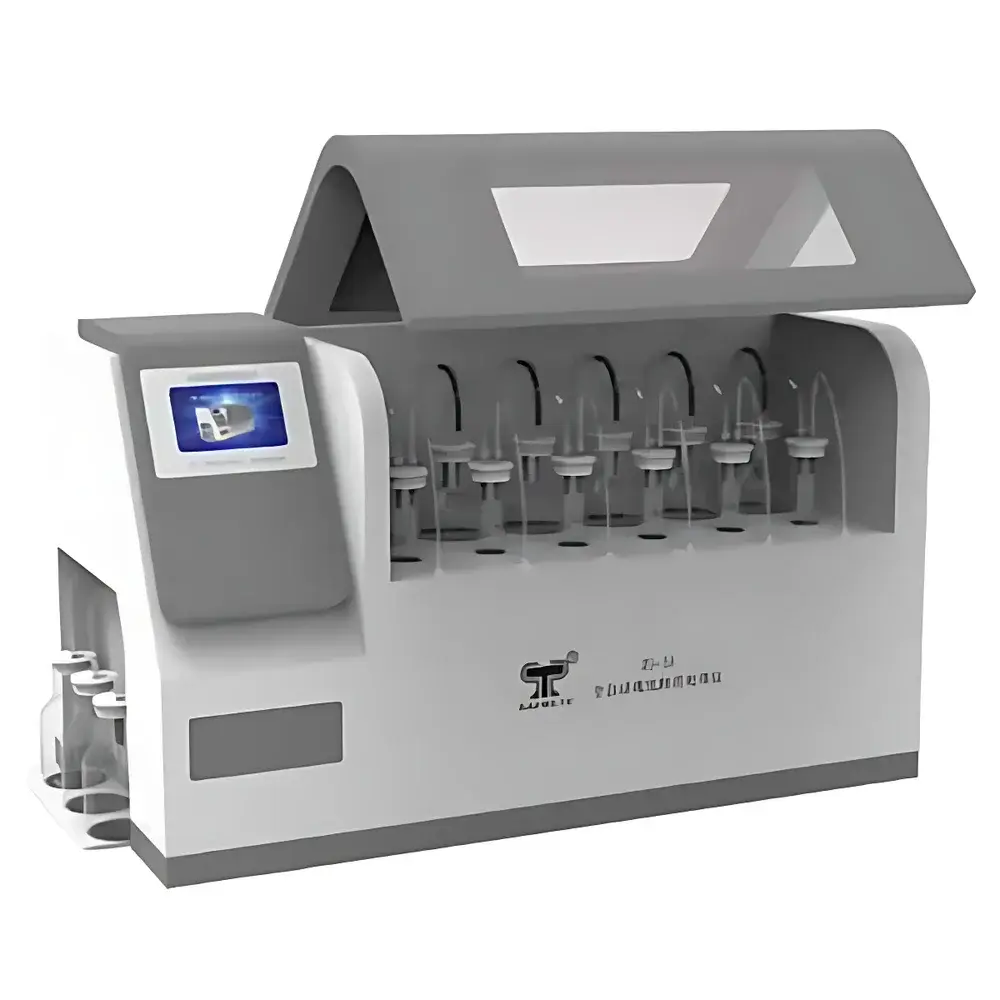
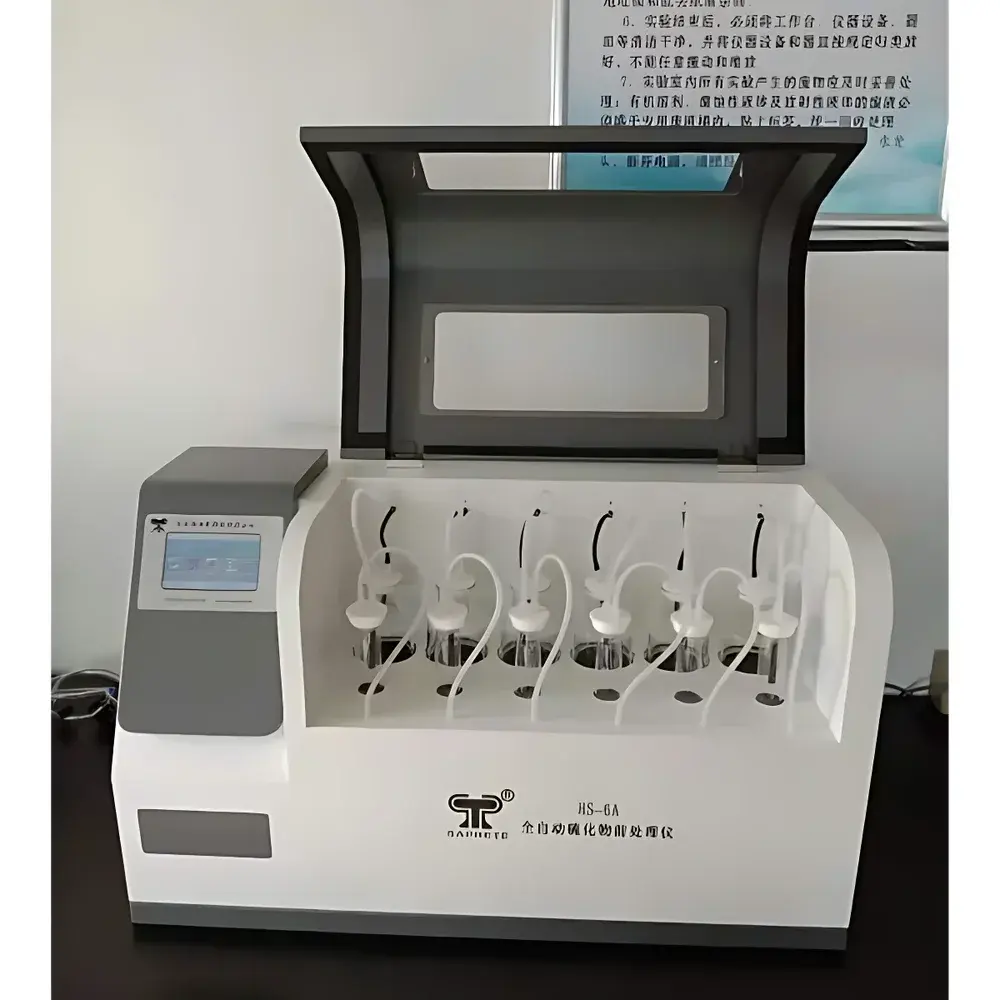
Saprete HS-6A Automated Sulfide Acidification and Purge System
| Brand | Saprete |
|---|---|
| Origin | Beijing, China |
| Manufacturer Type | Direct Manufacturer |
| Product Category | Domestic |
| Model | HS-6A |
| Price Range | USD 7,000–10,000 (FOB) |
| Instrument Type | Laboratory Benchtop System |
| Sample Capacity | 6 positions |
| Flow Control | Motor-driven digital mass flow control (not manual rotameter) |
| Acid Addition | Programmable per-sample automated reagent injection |
| Operation Mode | Fully automated sequence-controlled workflow |
| Enclosure | Sealed vapor-tight chamber |
| Heating Method | Integrated water bath with PID temperature regulation |
| Interface | 7-inch capacitive touchscreen HMI |
Overview
The Saprete HS-6A Automated Sulfide Acidification and Purge System is a dedicated laboratory instrument engineered for standardized, reproducible sample preparation in sulfide quantification workflows. It implements the acidification–purge–trapping principle—where sulfide species (S²⁻, HS⁻, H₂S) in aqueous or solid-phase samples are converted to volatile hydrogen sulfide gas under controlled acidic conditions, then selectively swept from solution by inert carrier gas and quantitatively trapped in an absorbent solution (e.g., zinc acetate or NaOH). This methodology forms the foundational pretreatment step for subsequent spectrophotometric analysis per established regulatory methods including GB/T 16489–1996 (methylene blue), HJ/T 60–2000 (iodometric titration), and HJ 833–2017 (soil and sediment matrices). The HS-6A replaces manual, operator-dependent procedures with deterministic automation—minimizing analyst exposure to H₂S, eliminating inter-operator variability in acid addition timing/volume, and ensuring strict adherence to purge duration, temperature, and gas flow parameters required for method compliance.
Key Features
- Six independent sample processing stations with synchronized yet individually addressable control—enabling batch processing without cross-contamination.
- Digital mass flow controllers (MFCs) replace analog rotameters, delivering precise, programmable, and stable carrier gas flow (N₂ or air) across all positions (typical range: 50–500 mL/min, ±1% FS accuracy).
- Automated acid delivery system using peristaltic pumps calibrated for volumetric precision; supports sequential or parallel acid injection with adjustable volume (0.5–10 mL) and rate.
- Integrated water bath with PID-regulated heating (ambient to 95 °C, ±0.5 °C stability) and real-time temperature monitoring per station—critical for consistent H₂S generation kinetics.
- Hermetically sealed reaction chamber with negative-pressure exhaust interface, eliminating need for external fume hood integration while maintaining OSHA-compliant H₂S exposure limits (<1 ppm TWA).
- Embedded 7-inch industrial-grade capacitive touchscreen HMI running deterministic real-time OS; preloaded with method templates aligned to GB/T, HJ, and ISO 11072 (water quality—determination of sulfide).
Sample Compatibility & Compliance
The HS-6A accommodates standard 100–500 mL borosilicate glass sample bottles (with septum-sealed caps) and is validated for use with surface water, wastewater, groundwater, sludge digests, and acid-leached soil/sediment extracts per HJ 833–2017. All wetted components—including acid lines, gas manifolds, and trap interfaces—are constructed from chemically resistant PTFE, FEP, and borosilicate glass to prevent sulfide adsorption or catalytic decomposition. The system design conforms to GLP documentation requirements: audit trails record operator ID, start/stop timestamps, parameter setpoints, deviations, and calibration events. Data export supports CSV and PDF formats compatible with LIMS integration. While not certified as FDA 21 CFR Part 11 compliant out-of-the-box, the firmware architecture supports optional electronic signature modules and role-based access control for regulated environments.
Software & Data Management
Firmware v3.2 provides intuitive workflow navigation, multi-language UI (English/Chinese), and method library management. Users define custom protocols—including acid type/concentration, purge time (1–60 min), bath temperature, flow rate ramping profiles, and post-purge nitrogen flush sequences. All operational data—including real-time gas flow, bath temperature, acid dispense volume, and error logs—are timestamped and stored internally (8 GB flash memory) with automatic backup to USB drive. Exported datasets include metadata essential for ISO/IEC 17025 traceability: instrument ID, calibration dates, environmental conditions (room temp/humidity), and analyst credentials. Remote diagnostics via Ethernet port support preventive maintenance scheduling based on pump actuation cycles and MFC performance drift metrics.
Applications
- Regulatory compliance testing for municipal and industrial wastewater discharge permits (e.g., China’s “Discharge Standard of Pollutants for Municipal Wastewater Treatment Plants” GB 18918–2002).
- Environmental monitoring programs assessing eutrophication risk and anaerobic degradation in lakes, rivers, and estuaries.
- Soil and sediment toxicity screening in contaminated site remediation projects (HJ 833–2017).
- Method validation and interlaboratory comparison studies requiring high inter-run precision (RSD <3% for duplicate n=6 at 10 µg/L S²⁻ level).
- Research applications in biogeochemical sulfur cycling, including microbial sulfate reduction assays.
FAQ
Does the HS-6A support non-standard acid reagents such as phosphoric acid or citric acid?
Yes—the acid reservoir and tubing are compatible with pH 0–2 mineral and organic acids; users must validate recovery efficiency for alternative reagents against reference materials.
Can the system be integrated with a downstream UV-Vis spectrophotometer for fully automated analysis?
Not directly; however, its trap solution output is standardized for manual or robotic transfer to spectrophotometers equipped with autosamplers (e.g., Shimadzu UV-2600, PerkinElmer Lambda 365).
What maintenance intervals are recommended for the peristaltic acid pump tubing?
Tubing should be replaced every 3 months under continuous operation or after 500 acid dispense cycles—whichever occurs first—to ensure volumetric accuracy.
Is calibration certificate traceable to NIM (National Institute of Metrology, China) included?
A factory calibration report with uncertainty statements is supplied; NIM-traceable certification is available as an optional service with lead time.
How does the system handle foaming samples during acidification?
The water bath temperature ramping profile and stepwise acid addition algorithm minimize foaming; optional antifoam dispensing module (HS-6A-Foam) can be added upon request.







