
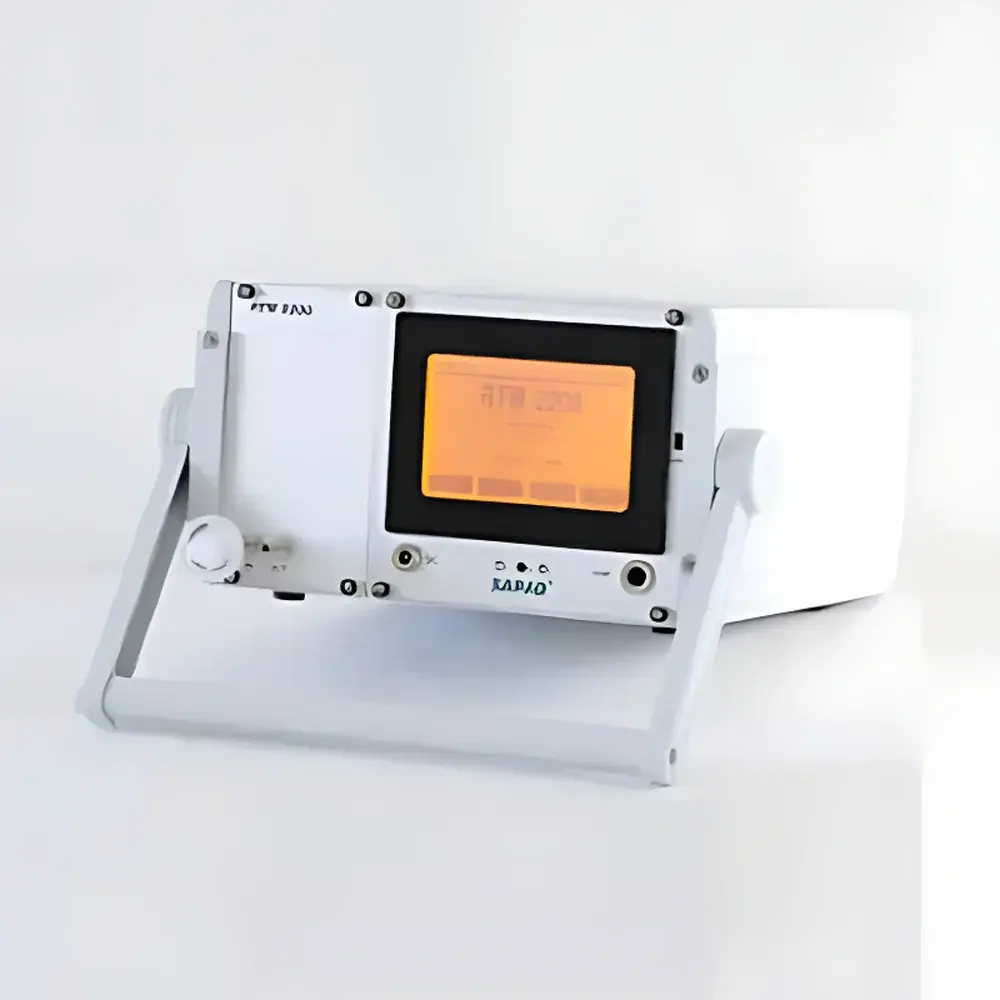
SARAD RTM2200 Radon Monitor
| Brand | SARAD |
|---|---|
| Origin | Germany |
| Model | RTM2200 |
| Sampling Method | Active |
| Measurement Range | 0–10,000,000 Bq/m³ |
| Minimum Detectable Concentration | 1 Bq/m³ |
| Response Time | 12 min (Po-214 excluded) / 120 min (Po-214 included) |
| Detector Type | Silicon semiconductor alpha spectrometer with deep ion implantation |
| Sensitivity | 3.2 cpm/(kBq/m³) (Po-214 excluded) / 7 cpm/(kBq/m³) (Po-214 included) |
| Chamber Volume | ~135 mL |
| Built-in Pump Flow Rate | 300–800 mL/min |
| Operating Interface | 240 × 128 pixel graphical touchscreen |
| Data Storage | SD card with GPS tagging (optional) |
| Communication Interfaces | USB, RS232 (supports GSM modem, ZigBee, or Wi-Fi adapter upgrade) |
| Dimensions | 235 × 140 × 255 mm |
| Environmental Sensors (standard) | Air temperature, relative humidity, flow rate, barometric pressure, battery status |
Overview
The SARAD RTM2200 Radon Monitor is a high-precision, field-deployable instrument engineered for quantitative radon-222 (²²²Rn) and its short-lived progeny (notably ²¹⁸Po and ²¹⁴Po) measurement in air, soil gas, and water headspace. It operates on the principle of electrostatic collection coupled with alpha-particle energy spectroscopy—utilizing SARAD’s proprietary deep-ion-implanted silicon semiconductor detectors housed within multiple low-volume, high-field electrostatic chambers (~135 mL each). This architecture enables direct, isotope-resolved detection without chemical separation or scintillation conversion. Unlike passive diffusion-based or Lucas cell instruments, the RTM2200 employs active sampling with integrated flow control, delivering real-time, spectrally deconvoluted alpha spectra that distinguish ²¹⁸Po (6.00 MeV), ²¹⁴Po (7.69 MeV), and residual ²¹⁰Po (5.30 MeV) contributions—thereby eliminating interference from long-lived background isotopes and enabling accurate equilibrium ratio calculations. Its design meets the metrological requirements of ISO 11665-2 (2021) for active radon-in-air measurement and supports traceable calibration per IEC 61577-1.
Key Features
- Multi-chamber electrostatic collection system optimized for sensitivity and humidity resilience—no desiccant or drying tube required, even at >95% RH.
- Alpha-energy-resolving silicon semiconductor detector with deep ion implantation, delivering <15 keV FWHM energy resolution at 5.3–7.7 MeV.
- Simultaneous multi-point monitoring capability: up to four external radon chambers (e.g., soil probes, indoor air inlets) can be sequentially or concurrently sampled via programmable valve manifold.
- Integrated environmental sensing: onboard temperature, relative humidity, barometric pressure (in bar), and volumetric flow sensors support decay-correction and diffusion-modeling compliance per ASTM D6765.
- Full spectral data logging: every alpha spectrum (channel counts vs. energy) is stored with timestamp, GPS coordinates (if module installed), and chamber identification—enabling retrospective QA/QC and audit-ready traceability.
- Modular expandability: optional NaI(Tl) gamma spectrometer, CO/H₂/CH₄ electrochemical sensors, and wireless ZigBee/Wi-Fi adapters enable deployment in uranium mining, geophysical surveys, and building diagnostics under GLP/GMP-aligned workflows.
Sample Compatibility & Compliance
The RTM2200 is validated for gaseous samples across diverse matrices: indoor/outdoor ambient air, soil gas (via stainless-steel probe with PTFE membrane), water headspace (using equilibration vials), and mine ventilation ducts. Its active sampling architecture complies with ISO 11665-4 (soil gas), ISO 11665-7 (water), and EPA Method RPD-200 for residential radon screening. The absence of hygroscopic components ensures stable performance in tropical, subterranean, and high-moisture environments where conventional charcoal or scintillation cells degrade. All firmware and data handling routines adhere to FDA 21 CFR Part 11 requirements when configured with electronic signature and audit-trail modules—making it suitable for regulatory submissions in EU Member States (BfS, SSK), US NRC licensees, and Canadian CNSC-licensed facilities.
Software & Data Management
Data acquisition and configuration are managed via the embedded 240 × 128 pixel resistive touchscreen interface, supporting up to 16 pre-programmed measurement protocols (e.g., 1-hr indoor survey, 24-hr soil gas diurnal profile, continuous 7-day basement monitoring). Raw spectra and processed results (Bq/m³, equilibrium equivalent concentration EEC, unattached fraction estimation) are stored on removable SD cards in CSV and binary .SAR formats. The optional WinRadon PC software provides spectral deconvolution, decay-corrected time-series visualization, uncertainty propagation (Type A/B), and automated report generation compliant with ISO/IEC 17025 documentation standards. RS232 output supports integration into SCADA systems or remote telemetry via GSM modems; USB-C port enables fast bulk transfer and firmware updates.
Applications
- Indoor radon risk assessment in residential, educational, and healthcare buildings per WHO Handbook on Indoor Radon (2009) and EU Council Directive 2013/59/Euratom.
- Soil gas radon mapping for uranium exploration, geological fault-line characterization, and earthquake precursor studies.
- Long-term radon flux monitoring in landfill cover systems, nuclear waste repository near-field zones, and decommissioned uranium processing sites.
- Validation of radon mitigation system efficacy—including sub-slab depressurization, positive pressurization, and active ventilation—through pre-/post-intervention time-series analysis.
- Research-grade alpha spectrometry for progeny equilibrium studies, aerosol attachment kinetics, and dose coefficient modeling in ICRP Publication 137 frameworks.
FAQ
Does the RTM2200 require calibration against a radon reference source?
Yes—initial factory calibration uses traceable ²²²Rn sources accredited to PTB (Physikalisch-Technische Bundesanstalt); users must perform annual recalibration using certified secondary standards per ISO/IEC 17025.
Can the instrument operate unattended for extended periods?
Yes—internal Li-ion battery supports >12 h continuous operation; external 15 V DC input enables indefinite field deployment with solar-charged power banks.
Is spectral data export compatible with third-party analysis tools?
Yes—CSV exports include full energy-channel arrays, live-time stamps, and detector-specific efficiency coefficients, enabling import into OriginLab, MATLAB, or GammaVision for advanced peak fitting.
How does the RTM2200 handle thoron (²²⁰Rn) interference?
Its alpha spectroscopy resolves ²¹²Po (8.78 MeV) from ²¹⁴Po (7.69 MeV), allowing quantitative thoron subtraction when co-measured—critical for granite-rich geologies and legacy uranium mill tailings.
What maintenance is required for long-term reliability?
No consumables or replaceable filters; only periodic verification of pump flow rate (±2% tolerance), chamber cleanliness (isopropanol wipe), and detector baseline stability via background spectrum review every 6 months.
Related Products







