
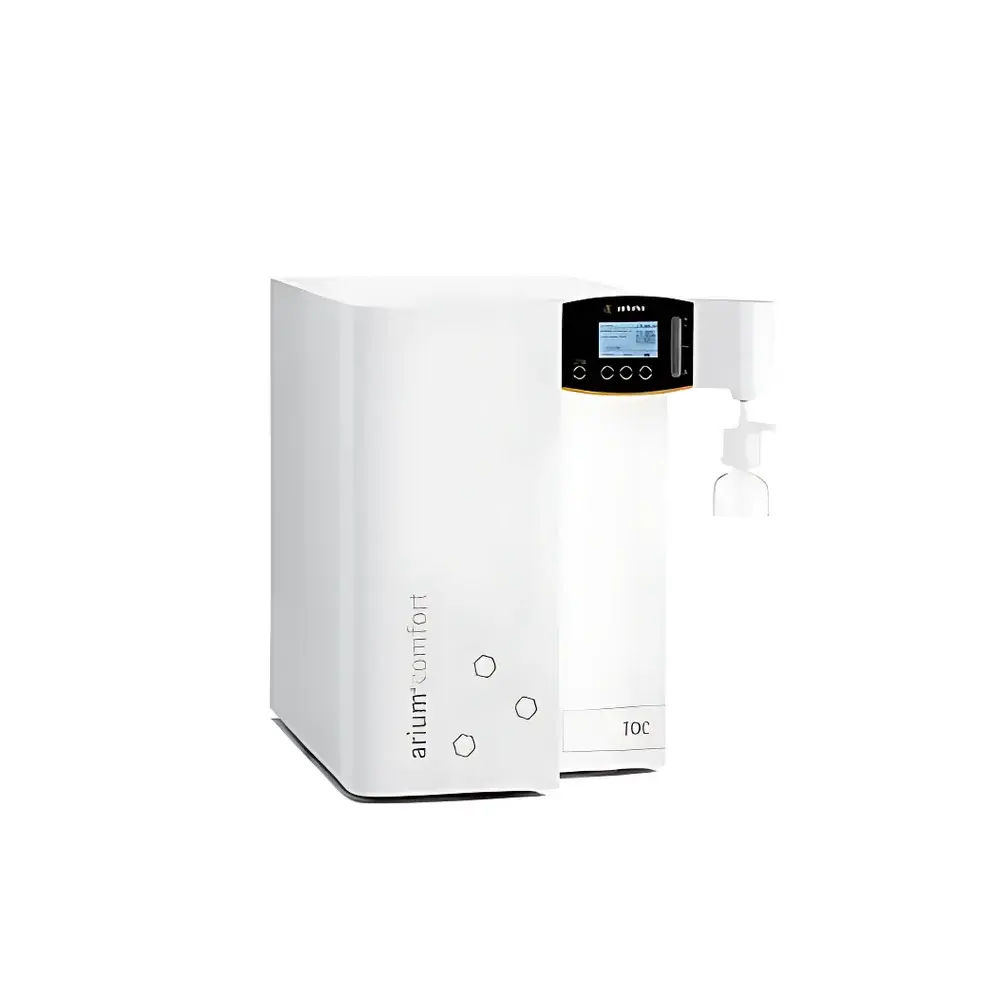
Sartorius arium® Comfort I Integrated Pure & Ultrapure Water System
| Brand | Sartorius |
|---|---|
| Origin | Germany |
| Model | arium® Comfort I |
| Purified Water Grade | ASTM Type 3 |
| Ultrapure Water Grade | ASTM Type 1 |
| Resistivity | 18.2 MΩ·cm (at 25 °C) |
| Heavy Metals & Soluble Silica | < 0.1 ppm |
| Total Organic Carbon (TOC) | < 2 ppb |
| Microbial Count | < 1 CFU/1000 mL |
| Endotoxins | < 0.001 EU/mL |
| Particles (>0.1 µm) | < 1 particle/mL |
| Flow Rate (Ultrapure) | up to 2 L/min |
| Flow Rate (Pure) | up to 3 L/min |
| Storage Tank Options | Bag-type, disposable, 42 L standard |
| Conductivity Monitoring | Inlet & outlet, temperature-compensated to 25 °C |
| UV Wavelengths | 185 nm & 254 nm |
| Final Filtration | Sartopore® 2 150 capsule filter (0.45 + 0.2 µm PES) |
Overview
The Sartorius arium® Comfort I is an integrated, space-efficient laboratory water purification system engineered to simultaneously produce both ASTM Type 3 pure water and ASTM Type 1 ultrapure water from municipal or softened feed water. Designed for reliability and regulatory readiness in analytical, life science, and quality control laboratories, the system employs a multi-stage purification architecture grounded in established physicochemical principles: reverse osmosis (RO) for bulk ion and organic removal, followed by electrodeionization-free mixed-bed ion exchange, dual-wavelength ultraviolet photo-oxidation (185/254 nm), and sterile final filtration. Its closed-loop bag-type storage tank eliminates biofilm formation risks associated with traditional stainless-steel reservoirs, while real-time, temperature-compensated conductivity and TOC monitoring ensure continuous verification of water quality at point-of-use. The system operates without requiring external pretreatment beyond standard municipal supply conditioning—making it suitable for installation in diverse lab environments where footprint, maintenance predictability, and compliance traceability are critical.
Key Features
- Dual-Wavelength UV Oxidation: Horizontally mounted 185 nm / 254 nm UV lamps enable simultaneous photolysis of organic molecules and microbial inactivation, achieving sustained TOC levels < 2 ppb and reducing viable microorganisms to < 1 CFU/1000 mL.
- iJust Adaptive Feedwater Optimization: Proprietary algorithm dynamically adjusts drain valve opening based on real-time CaCO3 saturation index and CO2 concentration measurements—minimizing waste water volume while maintaining consistent RO rejection efficiency and extending membrane service life.
- Full-Downflow High-Capacity Polishing Cartridge: Integrates catalytic granular activated carbon, high-capacity mixed-bed ion exchange resin, and sub-micron particulate retention—designed to prevent resin stratification and maximize contaminant loading capacity per cartridge change cycle.
- Sartopore® 2 150 Sterile Final Filter: Dual-layer polyethersulfone (0.45 µm + 0.2 µm) capsule filter validated per HIMA and ASTM F838-22 standards for bacterial retention; installed downstream of UV to ensure end-point sterility and endotoxin control (< 0.001 EU/mL).
- Disposal Bag-Type Storage Tank: Single-use, pre-sterilized polymer bag housed within a rigid outer enclosure—eliminates cleaning validation, chemical sanitization, and associated downtime while ensuring microbiological integrity during storage and distribution.
- Intuitive Touch Interface with Audit Trail: 7-inch color TFT display with multilingual support, PIN-protected access levels, and embedded logging compliant with GLP/GMP data integrity requirements (21 CFR Part 11-ready when paired with optional software modules).
Sample Compatibility & Compliance
The arium® Comfort I is validated for continuous production of water meeting or exceeding international specifications for critical laboratory applications. Its output complies with ASTM D1193-20 (Type I and Type III), ISO 3696:1987 (Grade 1 and Grade 3), CLSI EP23-A, and USP “Water for Pharmaceutical Purposes” for non-sterile applications. All sensors—including conductivity cells and TOC analyzers—are calibrated traceable to NIST standards. The system’s automated log records all operational events (e.g., cartridge replacement timestamps, alarm triggers, flow deviations, and user actions), supporting FDA 21 CFR Part 11 compliance when deployed with secure networked data export (RS-232, Ethernet, SD card). No external pretreatment is required beyond standard municipal feed water meeting EPA or local drinking water regulations.
Software & Data Management
The embedded firmware supports full-cycle data capture without third-party software dependency. Key parameters—including inlet/outlet conductivity, real-time TOC, UV lamp status, pressure differentials across RO and polishing stages, and cumulative volume dispensed—are logged at user-configurable intervals (default: 1-minute resolution). Data export is supported via removable SD card (FAT32 formatted, ≥4 GB), enabling offline review and long-term archival. Optional connectivity kits allow direct transmission to laboratory information management systems (LIMS) or centralized monitoring dashboards via TCP/IP. Alarm conditions trigger visual indicators on-screen and audible alerts; all notifications are timestamped and retained in the internal event log for ≥12 months. Firmware updates are performed via encrypted USB stick with digital signature verification.
Applications
This system serves as a primary water source for instrumentation demanding stringent purity thresholds. It supplies ultrapure water for high-sensitivity analytical techniques including HPLC, GC-MS, ICP-MS, AAS, and ion chromatography—where trace-level organics or ions would otherwise compromise detection limits or column longevity. It also provides ASTM Type 3 water for glassware rinsing, buffer preparation, media formulation, autoclave feed, and washer-disinfector operation. The low endotoxin and particle content make it suitable for cell culture media preparation (when used with additional sterile filtration), ELISA assay diluents, and molecular biology workflows such as qPCR and next-generation sequencing library prep. Its stable resistivity and minimal TOC drift ensure reproducibility across multi-day experiments and inter-laboratory method transfers.
FAQ
What feed water quality is required for optimal performance?
Municipal tap water meeting WHO or EPA drinking water guidelines is sufficient. Softened water (≤ 50 ppm hardness) is recommended to maximize RO membrane lifespan; no dechlorination or sediment prefiltration is needed due to the integrated catalytic carbon stage.
How frequently must consumables be replaced?
Typical service intervals: RO membranes every 2–3 years (dependent on feed water TDS), polishing cartridges every 6–12 months (based on usage and inlet water quality), UV lamps annually, and Sartopore® 2 filters every 3–6 months—automatically tracked and displayed on the touchscreen interface.
Is the system compatible with remote monitoring platforms?
Yes. Via optional Ethernet or RS-232 interface, the system can transmit real-time status and historical logs to SCADA, LIMS, or custom dashboards using Modbus TCP or ASCII protocol.
Does the bag-type tank require periodic sanitization?
No. The disposable polymer bag is gamma-irradiated and certified sterile upon installation; replacement occurs only after reaching its rated volume capacity (typically 6–12 months under normal use), eliminating validation of cleaning cycles.
Can the system be configured for multiple dispensing points?
Yes. With optional distribution manifolds and remote dispensing valves (e.g., wall-mounted or benchtop), the system supports up to four independent outlets—all monitored for flow rate, volume, and quality consistency.



