
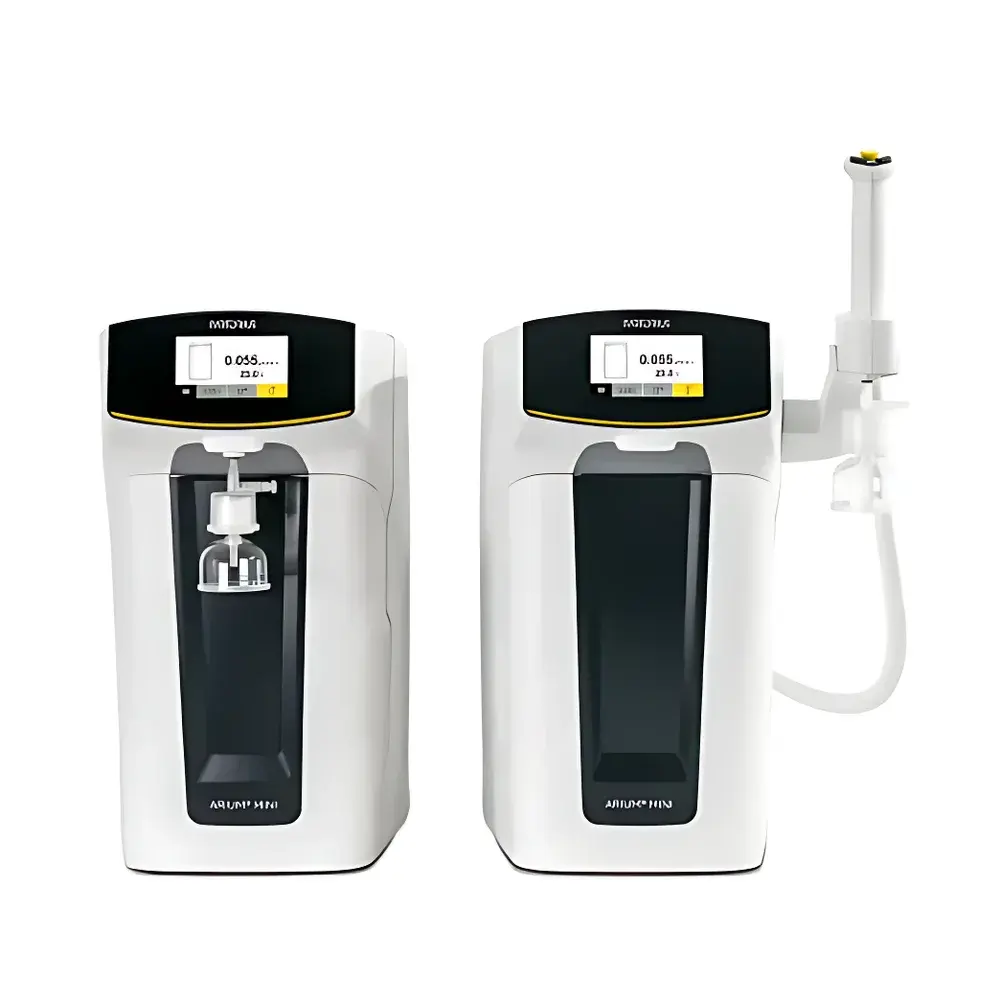
Sartorius Arium® Mini Extend Laboratory Ultra-Pure Water System
| Brand | Sartorius |
|---|---|
| Origin | Germany |
| Model | Arium® Mini Extend |
| Water Grade | Type I (ASTM D1193-20) |
| Resistivity | 18.2 MΩ·cm at 25 °C |
| Heavy Metals & Soluble Silica | <1 ppt |
| Total Organic Carbon (TOC) | ≤5 ppb |
| Microbial Count | <0.001 EU/mL |
| Particles (>0.1 µm) | <1 particle/mL |
| Daily Output Capacity | Up to 10 L |
| Footprint | 28 cm width (base unit) |
| Display | Full-color capacitive touchscreen interface |
| Feedwater Compatibility | Pre-treated water (e.g., reverse osmosis or deionized feed) |
| Technology | Integrated Bagtank™ disposable reservoir system |
Overview
The Sartorius Arium® Mini Extend is a compact, high-performance laboratory ultra-pure water system engineered to deliver consistent Type I water (ASTM D1193-20, ISO 3696 Class 1, CLSI EP21-A) for critical applications in analytical chemistry, molecular biology, cell culture, and pharmaceutical quality control. Utilizing a multi-stage purification architecture—including dual-wavelength UV oxidation (185/254 nm), electrodeionization (EDI), and final 0.1 µm membrane filtration—the system achieves stringent purity specifications: resistivity ≥18.2 MΩ·cm at 25 °C, TOC ≤5 ppb, endotoxin <0.001 EU/mL, and particulate count 0.1 µm). Its modular design centers on the patented Bagtank™ technology—a single-use, pre-sterilized polyolefin reservoir that eliminates traditional stainless-steel tank maintenance, microbial recontamination risks, and chemical sanitization cycles. This architecture supports GLP/GMP-aligned workflows by minimizing operator intervention and ensuring batch-to-batch reproducibility without scheduled downtime for tank cleaning or validation.
Key Features
- Compact footprint (28 cm wide base unit) optimized for benchtop integration in space-constrained labs—ideal for satellite workstations or cleanroom peripheries.
- Mobile dispensing unit (adds 9 cm depth) with ergonomic arm, integrated flow sensor, and programmable volume delivery (0.1–9.9 L increments).
- Capacitive color touchscreen interface with intuitive icon-driven navigation, multilingual support (EN/DE/FR/ES/CN), and real-time display of resistivity, TOC, temperature, and system status.
- Bagtank™ technology: disposable, gamma-irradiated reservoir with integrated 0.2 µm vent filter; eliminates biofilm formation, reduces validation burden, and ensures full traceability via lot-numbered consumables.
- Integrated UV oxidation (185/254 nm) and PALL® 0.1 µm hydrophilic membrane filter for continuous TOC reduction and particle removal.
- Automatic leak detection, pressure monitoring, and alarm logging compliant with ISO/IEC 17025 documentation requirements.
Sample Compatibility & Compliance
The Arium® Mini Extend is validated for compatibility with sensitive downstream instruments including HPLC, LC-MS, ICP-MS, PCR, and ELISA platforms. Its output meets or exceeds specifications defined in ASTM D1193-20 (Type I), ISO 3696:1987 (Grade 1), CLSI EP21-A (for diagnostic reagent water), and USP Purified Water and Water for Injection (WFI) supporting protocols. All wetted materials comply with USP Class VI biocompatibility standards and FDA 21 CFR 177.2600 (food-contact polymers). System firmware supports audit trail functionality per FDA 21 CFR Part 11 requirements, including electronic signature capability, user access levels, and immutable event logging for regulatory inspections.
Software & Data Management
The embedded control software enables local data capture of all critical parameters—including resistivity, TOC, UV lamp intensity, flow rate, and bag usage hours—with automatic timestamping and CSV export via USB port. Optional Ethernet connectivity allows integration into centralized lab information management systems (LIMS) using Modbus TCP protocol. Calibration logs, maintenance records, and consumable replacement history are stored onboard for ≥12 months and can be exported for internal QA review or external audit preparation. All firmware updates are digitally signed and delivered via secure Sartorius Service Portal, ensuring integrity and version control.
Applications
- HPLC and UHPLC mobile phase preparation requiring low TOC and metal-free water to prevent column fouling and baseline drift.
- Cell culture media preparation where endotoxin and nuclease contamination must remain below detectable limits.
- Next-generation sequencing (NGS) library preparation and qPCR master mix formulation demanding ultralow background interference.
- Calibration standard dilution for ICP-MS analysis, where sub-ppt elemental carryover compromises detection limits.
- Pharmaceutical stability testing per ICH Q5C guidelines, where water quality directly impacts degradation pathway interpretation.
- Electrophysiology and patch-clamp experiments requiring stable resistivity and absence of ionic contaminants.
FAQ
What feedwater quality is required for optimal performance?
The Arium® Mini Extend is designed for use with pre-treated feedwater—typically RO or DI water with conductivity <5 µS/cm. It is not intended for direct connection to municipal tap water; for such applications, the Arium® Mini Plus with integrated pretreatment module is recommended.
How often must the Bagtank™ be replaced?
Bagtank™ lifetime is determined by total volume processed and usage frequency. Under typical lab conditions (≤10 L/day), replacement is required every 6–12 months. The system displays remaining capacity and triggers visual/audible alerts at 10% and 0% thresholds.
Does the system support remote monitoring or network integration?
Yes—via optional Ethernet interface and Modbus TCP protocol, enabling real-time parameter streaming to SCADA or LIMS platforms. Local USB export remains available for offline data retrieval without network dependency.
Is the Arium® Mini Extend compliant with ISO 13485 for medical device manufacturing environments?
While the system itself is not certified to ISO 13485, its design, documentation, and validation support packages align with ISO 13485 Annex C requirements for ancillary equipment used in sterile process water generation, and it is widely deployed in Class A/B cleanrooms under QSR-compliant quality systems.
Can the mobile dispensing unit be sterilized or autoclaved?
No—the dispensing arm and tubing are constructed from medical-grade thermoplastics rated for gamma irradiation only. Autoclaving would compromise structural integrity and calibration accuracy. Sterility is maintained through Bagtank™ integrity and 0.1 µm terminal filtration.



