
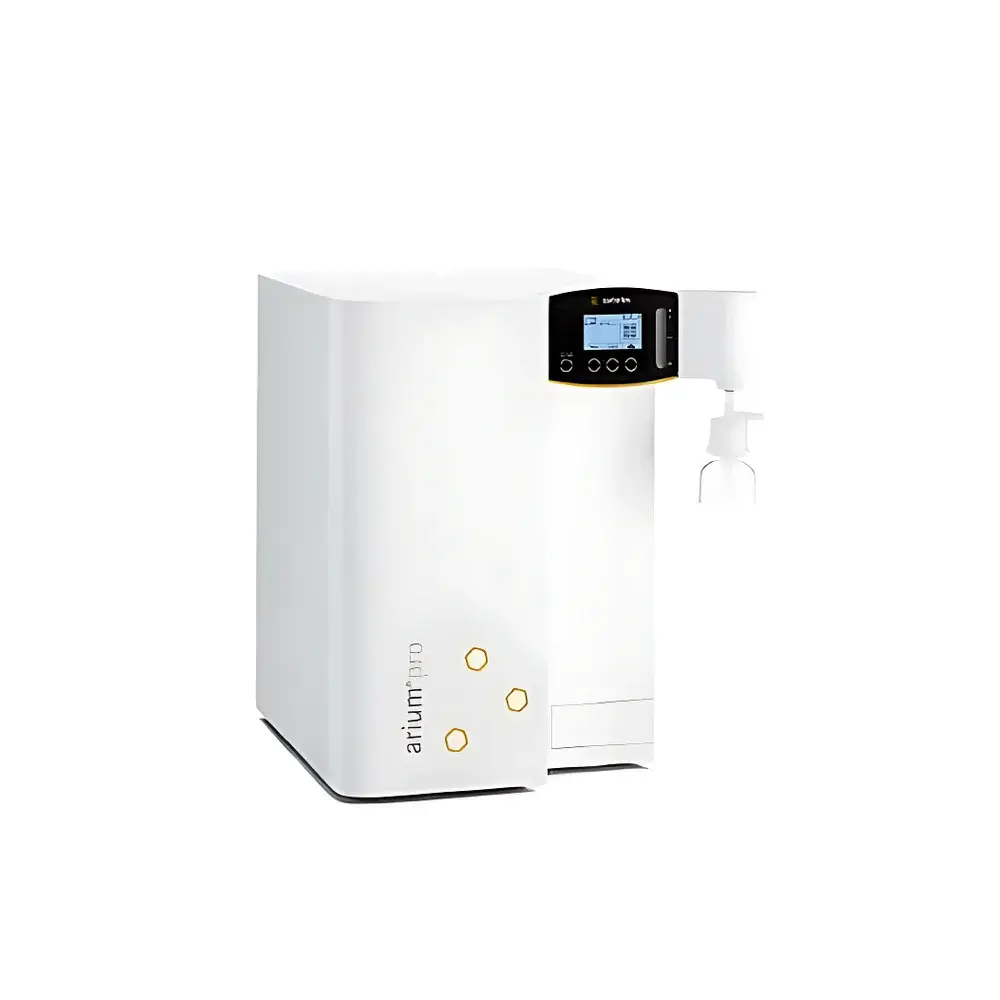
Sartorius arium® Pro Basic Ultra Pure Water System
| Brand | Sartorius |
|---|---|
| Origin | Germany |
| Model | arium® Pro Basic |
| Purified Water Grade | ASTM Type I |
| Resistivity | 18.2 MΩ·cm at 25 °C |
| Heavy Metals & Soluble Silica | < 0.1 ppm |
| Total Organic Carbon (TOC) | < 1000 ppb (feed water) / < 20 ppb (product water) |
| Particles (> 0.2 µm) | < 1 per mL |
| Bacteria | < 1 CFU/1000 mL |
| Feed Water Requirements | DI, RO, or EDI with conductivity ≤ 100 µS/cm, TOC ≤ 1000 ppb, turbidity < 1 NTU, silica < 1000 ppb, minimum inlet pressure 6.9 bar |
| Max. Flow Rate | 2 L/min at 2 bar |
| Dimensions (W×D×H) | 350 × 451 × 492 mm |
| Weight (empty/fully loaded) | 17 kg / 27 kg |
| Power Supply | 100–240 V AC, 50–60 Hz, max. 130 VA |
| Interfaces | RS232 (printer), touchscreen GUI with real-time monitoring and service alerts |
| Compliance | Meets or exceeds ASTM D1193-23, ISO 3696:1987, USP <1231>, CLSI EP21-A |
Overview
The Sartorius arium® Pro Basic Ultra Pure Water System is an engineered solution for laboratories requiring consistent, high-fidelity Type I ultrapure water in standard analytical and preparative workflows. Designed and manufactured in Germany, this integrated purification platform employs a multi-stage process—comprising pre-treatment conditioning, reverse osmosis (RO) or deionization (DI) feed compatibility, dual-stage ion exchange, and final 0.2 µm terminal filtration via Sartopore® 2 membrane—to deliver water meeting stringent international specifications for critical applications. Its core measurement principle relies on real-time conductivity monitoring (converted to resistivity at 25 °C), coupled with continuous TOC detection and flow-integrated particle counting. The system is not intended for endotoxin- or nucleic acid-sensitive applications (e.g., molecular biology or cell therapy), as it does not incorporate ultrafiltration or UV photooxidation modules beyond the base configuration. It operates as a point-of-use system, supporting flexible installation (benchtop, under-bench, or wall-mounted) without requiring external plumbing modifications.
Key Features
- Touchscreen glass interface with intuitive, text-supported menu navigation—no training required for routine operation
- Real-time display of feed water conductivity, product water resistivity (18.2 MΩ·cm), temperature, cumulative volume dispensed, and time-based service countdowns
- Configurable dispensing modes: manual (0.5–2.0 L/min flow control) and timed (30 sec–59 min), with memory retention for both volume and duration settings
- Integrated alarm architecture with graphical status indicators and context-specific notifications (e.g., low cartridge life, pressure deviation, conductivity excursion)
- RS232 serial interface for direct connection to printers or legacy laboratory data loggers; no proprietary software license required for basic data export
- Modular consumables design—including application-specific purification cartridges—enabling customization based on local feed water quality and end-use requirements
- Robust mechanical architecture: stainless steel and medical-grade polymer housing, certified electrical safety (IEC 61010-1), and stable thermal management for continuous 24/7 operation
Sample Compatibility & Compliance
The arium® Pro Basic is validated for use with feed water sources meeting minimum specifications: conductivity ≤ 100 µS/cm (RO), ≤ 20 µS/cm (DI), or ≤ 4 µS/cm (distillate); TOC ≤ 1000 ppb; turbidity < 1 NTU; and inlet pressure ≥ 6.9 bar. Product water consistently achieves resistivity ≥ 18.2 MΩ·cm at 25 °C, TOC < 20 ppb (with ≤ 1000 ppb feed), bacterial load < 1 CFU/1000 mL, and particulate count 0.2 µm). These performance metrics satisfy ASTM D1193-23 (Type I), ISO 3696:1987 (Grade 1), USP (Purified Water), and CLSI EP21-A guidelines for analytical reagent water. While the system supports GLP-aligned documentation through timestamped service logs and parameter history, it does not provide FDA 21 CFR Part 11-compliant electronic signatures or audit trails out of the box—users requiring full GMP traceability must integrate third-party LIMS or configure external validation protocols.
Software & Data Management
No embedded operating system or cloud connectivity is present; all functionality resides in firmware-controlled microprocessor logic. Water quality parameters—including instantaneous conductivity, temperature-compensated resistivity, total volume dispensed, and cartridge usage hours—are stored in non-volatile memory with a rolling 30-day event log. Data can be exported in plain-text CSV format via RS232 to compatible printers or terminal emulators. No driver installation or vendor-specific software is needed. System diagnostics—including pump duty cycle, sensor calibration status, and pressure transducer output—are accessible via service-level menus protected by PIN authentication. Firmware updates are performed offline using USB-to-serial adapters and publicly available binaries from Sartorius Technical Support portals.
Applications
- Atomic absorption spectroscopy (AAS) and flame photometry sample dilution and blank preparation
- Inductively coupled plasma optical emission spectrometry (ICP-OES) rinse solutions and standard matrix preparation
- Routine HPLC mobile phase preparation (excluding gradient-sensitive methods requiring sub-5 ppb TOC)
- Glassware rinsing prior to gravimetric analysis or volumetric calibration
- Preparation of general-purpose cell culture media supplements (non-serum-free formulations)
- Synthesis of buffers and reagents for ELISA, Western blotting, and colorimetric assays
- Calibration standards for pH meters and conductivity probes
FAQ
What feed water types are compatible with the arium® Pro Basic?
RO permeate, deionized water, or distilled water meeting conductivity ≤ 100 µS/cm, TOC ≤ 1000 ppb, and minimum inlet pressure of 6.9 bar.
Does the system include TOC monitoring?
Yes—integrated TOC sensor measures both feed and product water; typical output is < 20 ppb for product water when feed TOC is ≤ 1000 ppb.
Can the arium® Pro Basic be connected to a building’s central RO loop?
Yes, provided inlet pressure and quality specifications are maintained; a pressure-regulating valve may be required depending on facility distribution dynamics.
Is UV germicidal irradiation included?
No—microbial control is achieved solely via 0.2 µm Sartopore® 2 terminal filtration; optional UV modules are not supported in this model tier.
How often must consumables be replaced?
Cartridge lifetime depends on feed water quality and daily usage volume; system displays remaining capacity (%) and triggers visual alerts at 10% residual life.
Is remote monitoring or Ethernet connectivity available?
No—this model lacks network interfaces; only RS232 serial communication is provided for local data capture.



