
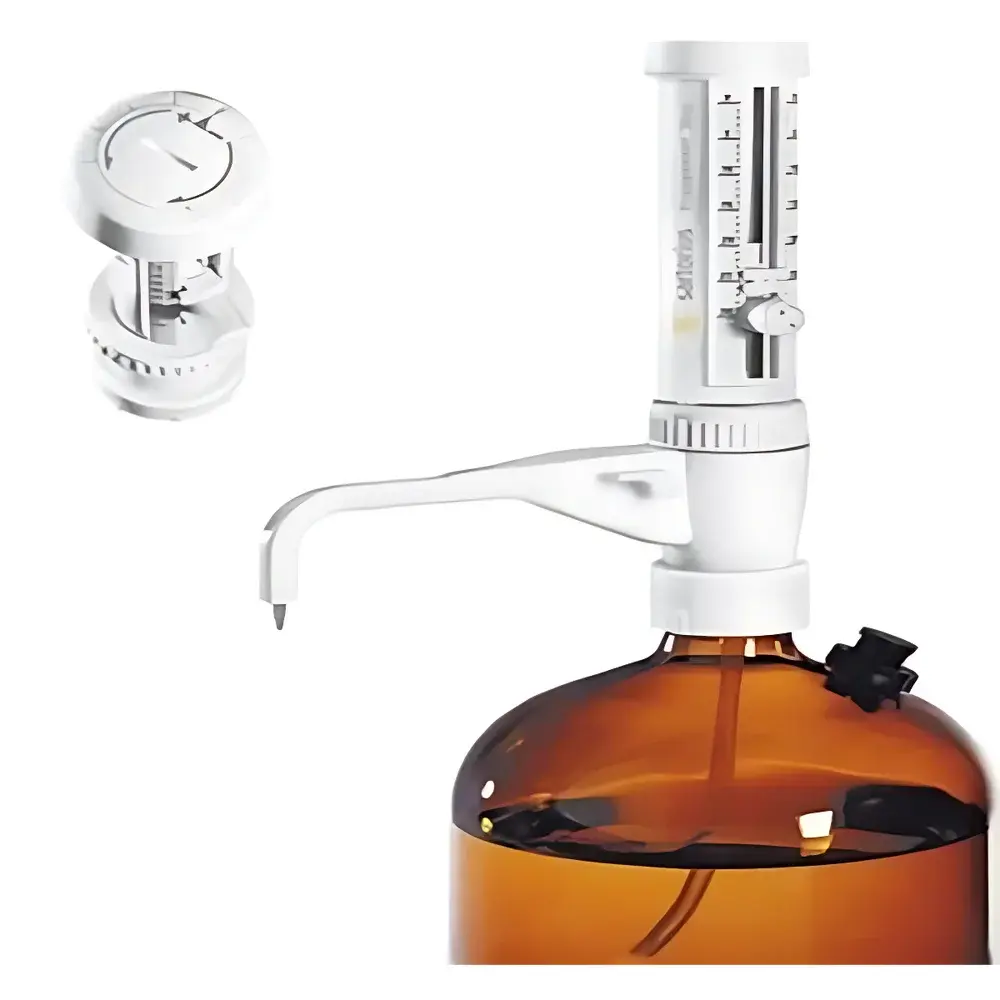
Sartorius Bottle Top Dispenser LH-723063
| Brand | Sartorius |
|---|---|
| Origin | Germany |
| Model | LH-723063 |
| Type | Manual Bottle Top Dispenser |
| Volume Range | 0.1 mL to 1.0 mL |
| Increment | 0.01 mL |
| Accuracy | ≤ ±0.6% |
| Precision (Repeatability) | ≤ ±0.2% |
| Sterilization | Autoclavable at 121 °C, 2 bar, 20 min |
| Chemical Resistance | Full PTFE, FFKM, and borosilicate glass wetted path |
| Compliance | ISO 8655-3, ISO 9001-aligned calibration procedure |
Overview
The Sartorius Bottle Top Dispenser LH-723063 is a precision-engineered manual liquid handling device designed for repeatable, traceable, and chemically resistant dispensing in regulated laboratory environments. Based on positive displacement piston technology, it delivers volumetric accuracy through a calibrated glass syringe barrel and chemically inert sealing system—ensuring consistent delivery across aggressive media including concentrated mineral acids (e.g., HCl, HNO₃), strong alkalis (e.g., NaOH, KOH), and organic solvents (e.g., acetone, acetonitrile, chloroform). Its design conforms to the metrological principles defined in ISO 8655-3 for piston-operated volumetric apparatus, supporting quantitative transfer where gravimetric or titrimetric validation is required. The LH-723063 is intended for use in quality control laboratories, pharmaceutical R&D, and academic analytical workflows where manual dispensing must meet GLP-compliant documentation standards without reliance on electronic interfaces.
Key Features
- Full autoclave compatibility: Entire unit withstands sterilization at 121 °C, 2 bar for 20 minutes—validated per ISO 17665-1—enabling reuse in sterile applications such as cell culture reagent preparation or microbiological media dispensing.
- Chemically inert fluid path: Wetted components consist of borosilicate glass (barrel), PTFE (piston seal and valve body), and FFKM (perfluoroelastomer) O-rings—providing resistance to hydrolysis, oxidation, and swelling under prolonged exposure to corrosive agents.
- Two-stage mechanical adjustment: Coarse volume setting via rotating dial (0.1–1.0 mL range in 0.01 mL increments) supplemented by fine-tuning knob for sub-microliter optimization—enabling reproducible dispensing across ≥100 cycles without recalibration.
- Integrated anti-drip safety valve: Mechanically actuated shut-off prevents post-dispense dripping and vapor escape during volatile solvent handling; eliminates need for secondary caps or stoppers during storage.
- Modular disassembly: No tools required—base, piston assembly, and dispensing tip separate cleanly for ultrasonic cleaning or visual inspection of sealing surfaces, reducing carryover risk in multi-analyte workflows.
- Universal bottle interface: Accommodates GL45, GL32, and GL25 threaded necks (DIN 16072); optional extension nozzles support dispensing into narrow-bore vials (≥4 mm ID) or deep-well plates without splashing.
Sample Compatibility & Compliance
The LH-723063 maintains performance integrity across Class I–III solvents per ASTM D471 and resists degradation from pH 0–14 solutions over extended contact periods. It is certified for use with USP A-class analytical instruments and supports audit-ready operation under FDA 21 CFR Part 11 when paired with Sartorius’ optional calibration logbook (ref. YLD-LOG-01). All units ship with individual factory calibration certificates traceable to PTB (Physikalisch-Technische Bundesanstalt), Germany, and comply with ISO/IEC 17025 requirements for measurement uncertainty reporting (k=2). Routine user verification follows ISO 8655-6 protocols using certified reference weights and Class A volumetric flasks.
Software & Data Management
As a manually operated instrument, the LH-723063 does not incorporate embedded electronics or connectivity features. However, its mechanical calibration system aligns with ISO 9001:2015 Clause 7.1.5.2 for monitoring and measuring resource control. Users document calibration events—including date, operator ID, standard used, and deviation values—in paper-based or LIMS-integrated logs. Sartorius provides downloadable PDF templates compliant with Annex 11 expectations for manual instrument qualification, covering IQ/OQ elements such as leak testing, volume verification, and seal integrity assessment.
Applications
- Preparation of standardized acid/base titrants in environmental testing labs (EPA Method 300.0, ISO 9963-1).
- Dispensing corrosion inhibitors into electrochemical test cells under inert atmosphere gloveboxes.
- Accurate metering of viscous solvents (e.g., DMF, DMSO) into HPLC mobile phase reservoirs prior to filtration.
- Formulation of buffer stock solutions in biopharmaceutical upstream processing suites.
- Controlled addition of catalysts or initiators in polymer synthesis where stoichiometric precision directly impacts molecular weight distribution.
FAQ
Is the LH-723063 compatible with hydrofluoric acid (HF)?
No—HF etches borosilicate glass and degrades PTFE seals over time. For HF handling, consult Sartorius’ PFA-lined dispenser series (e.g., BD-100-PFA).
Can this dispenser be calibrated in-house without external certification?
Yes—user calibration is supported per ISO 8655-6 using gravimetric methods; however, regulatory audits may require annual third-party verification for GMP environments.
What is the maximum viscosity limit for reliable operation?
Up to 500 mPa·s at 20 °C (e.g., 60% glycerol/water); above this, dispensing speed must be reduced to avoid piston lag and volume under-delivery.
Does the autoclaving cycle affect long-term accuracy?
Repeated sterilization causes no measurable drift if cooling occurs naturally post-cycle; forced-air drying or thermal shock must be avoided to preserve glass barrel geometry.
How often should the FFKM seals be replaced?
Under daily use with non-oxidizing solvents, replacement is recommended every 12 months; with halogenated solvents or oxidizers, inspect quarterly and replace at first sign of surface crazing.
Related Products



