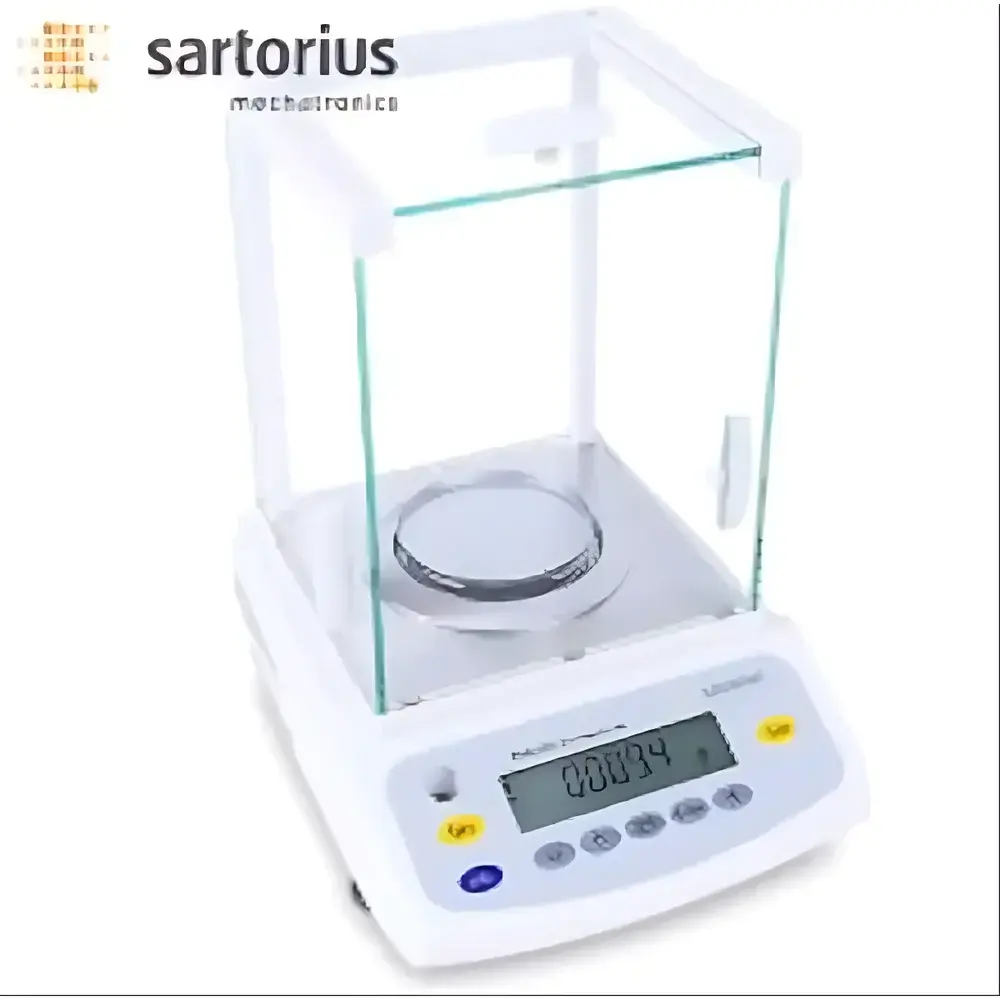
Sartorius BSA124S-CW Analytical Balance
| Brand | Sartorius |
|---|---|
| Origin | Germany |
| Model | BSA124S-CW |
| Type | Analytical Balance |
| Max Capacity | 120 g |
| Readability | 0.1 mg |
| Repeatability | 0.1 mg |
| Calibration | Internal |
| Dimensions (L×W×H) | 460 × 390 × 530 mm |
| Display | 15 mm high, white backlight, high-contrast LCD |
Overview
The Sartorius BSA124S-CW is a high-performance analytical balance engineered for precision mass measurement in regulated laboratory environments. Based on electromagnetic force compensation (EMFC) technology, it delivers stable, drift-free weighing results with exceptional long-term stability and temperature independence. Designed and manufactured in Germany, the BSA124S-CW complies with international metrological standards including OIML R76 and EN 45501, and meets the essential requirements of ISO/IEC 17025 for testing and calibration laboratories. Its 120 g maximum capacity and 0.1 mg readability make it suitable for routine quantitative analysis, formulation, sample preparation, and quality control procedures where trace-level accuracy is critical—particularly in pharmaceutical development, chemical synthesis, and academic research labs requiring GLP-compliant documentation.
Key Features
- Electromagnetic force compensation (EMFC) sensor architecture ensuring high reproducibility and minimal thermal drift
- Internal calibration system with automatic recalibration triggered by time, temperature change (≥1.5 °C), or user command
- High-contrast, 15 mm digit LCD display with white LED backlight for optimal readability under varied ambient lighting conditions
- Integrated draft shield included as standard equipment—designed to minimize air currents and static interference during low-mass measurements
- LevelControl™ integrated bubble level and adjustable stainless-steel feet for rapid, precise instrument leveling
- Robust die-cast aluminum housing with chemical-resistant surface finish for durability in multi-user lab environments
- RS232 interface standard; optional USB and Ethernet connectivity available via firmware upgrade for integration into LIMS or ELN systems
Sample Compatibility & Compliance
The BSA124S-CW supports a wide range of sample types—including powders, granules, liquids in tared containers, and small solid components—provided they fall within the 120 g load limit and do not exceed the pan diameter (approx. 90 mm). Its design conforms to ISO 8655-6 for gravimetric pipette calibration and supports USP and requirements for balance verification and performance qualification. The internal calibration function satisfies ASTM E898–22 recommendations for periodic verification intervals in GxP settings. All operational parameters—including calibration logs, weighing events, and error messages—are timestamped and stored locally, supporting audit readiness for FDA 21 CFR Part 11 and EU Annex 11 compliance when paired with validated software protocols.
Software & Data Management
Data export is supported via ASCII-formatted RS232 output compatible with Sartorius’ optional LabX® Lite software or third-party laboratory information management systems (LIMS). LabX Lite enables customizable report templates, electronic signature support, and automated data archiving with configurable retention policies. The balance stores up to 999 weighing records internally, each containing date/time stamp, gross/net/tare values, stability indicator, and calibration status. All data transfers are non-volatile and retain integrity during power interruption. Firmware updates are performed via USB stick and include cryptographic signature verification to ensure authenticity and regulatory traceability.
Applications
- Pharmaceutical: Active pharmaceutical ingredient (API) dispensing, reference standard weighing, excipient ratio validation per ICH Q5C guidelines
- Chemistry: Stoichiometric reagent preparation, catalyst loading, gravimetric titration endpoint confirmation
- Materials Science: Coating thickness calculation via mass loss/gain, nanoparticle yield quantification
- Environmental Testing: Filter weight determination for particulate matter (PM2.5/PM10) analysis per EPA Method 201A
- Academic Research: Isotope ratio sample preparation, micro-scale reaction monitoring, teaching lab calibration exercises
FAQ
What is the difference between readability and repeatability in this balance?
Readability (0.1 mg) defines the smallest increment displayed; repeatability (0.1 mg) reflects the standard deviation of repeated weighings of the same load under identical conditions—both values indicate the instrument’s resolution and short-term precision.
Does the BSA124S-CW meet ISO/IEC 17025 requirements for accredited testing labs?
Yes—the balance’s EMFC design, internal calibration traceability to national standards, documented uncertainty budget, and audit-ready data logging support compliance with ISO/IEC 17025:2017 Clause 6.4 (Equipment) and Clause 7.7 (Ensuring validity of results).
Can the balance be connected to a network for centralized data collection?
While native Ethernet is not built-in, optional communication modules enable TCP/IP connectivity; alternatively, RS232-to-Ethernet gateways allow seamless integration into existing lab networks using standard Modbus RTU or ASCII protocols.
Is the draft shield removable for cleaning or large-sample handling?
Yes—the transparent acrylic draft shield is fully detachable and autoclavable (up to 121 °C, 20 min), facilitating thorough decontamination without compromising optical clarity or structural integrity.
How frequently must the balance be calibrated in a GMP environment?
Per EU GMP Annex 15 and USP , calibration frequency depends on risk assessment—but internal calibration every 2–4 hours combined with daily performance checks using certified weights is typical for Class A applications.