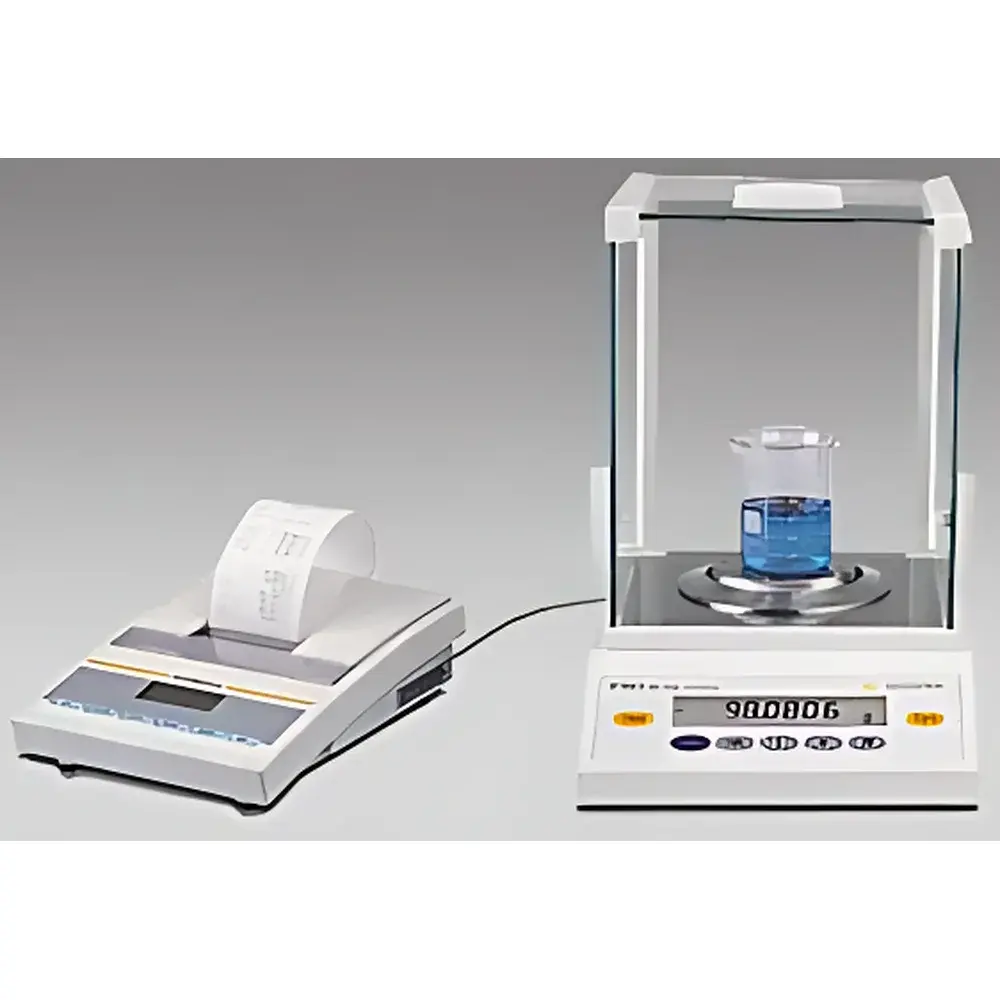
Sartorius BT2202S Precision Balance
| Brand | Sartorius |
|---|---|
| Origin | Germany |
| Type | Imported Laboratory Balance |
| Capacity | 2200 g |
| Readability | 10 mg |
| Pan Diameter | 150 mm |
| Internal Automatic Calibration Weight | Yes |
| Compliance | ISO/GLP-Compliant Output Format (with YDP03-OCE printer) |
| Connectivity | RS-232 interface |
| Features | Four-level shock absorption, dynamic temperature compensation, automatic fault diagnostics, overload protection, underhook weighing, multiple application modes (piece counting, percentage weighing, net weight, animal weighing), 19 unit conversions |
| Power Options | AC adapter, DC input, or rechargeable battery |
Overview
The Sartorius BT2202S Precision Balance is an entry-level yet highly reliable analytical-grade weighing instrument engineered for routine laboratory and quality control environments where reproducibility, traceability, and operational robustness are essential. Designed and manufactured in Germany, it employs electromagnetic force restoration (EMFR) technology—a principle widely adopted across Sartorius’s precision balance portfolio—to deliver stable, drift-resistant measurements under variable ambient conditions. With a 2200 g capacity and 10 mg readability, the BT2202S bridges the functional gap between top-loading balances and higher-resolution analytical instruments, making it suitable for applications requiring moderate precision without compromising on regulatory compliance or long-term calibration stability. Its compact footprint and integrated underhook enable both standard pan-based weighing and suspended measurement of large-volume or irregularly shaped samples—such as reaction vessels, filtration assemblies, or biological specimens—without sacrificing accuracy.
Key Features
- Four-stage mechanical shock absorption system minimizes vibration-induced drift, ensuring consistent results in non-dedicated lab spaces or near centrifuges and HVAC units.
- Internal motorized calibration mechanism with built-in reference weights enables fully automated, time-stamped calibration routines—adjustable for user-defined offset correction to maintain metrological integrity over extended service intervals.
- Dynamic temperature compensation continuously monitors internal sensor thermal gradients and applies real-time corrections, reducing drift caused by diurnal or seasonal lab temperature fluctuations.
- Integrated overload protection safeguards the load cell from accidental overloading up to 150% of nominal capacity, extending service life and minimizing downtime.
- RS-232 serial interface supports bidirectional communication with PCs, LIMS, or printers—including the YDP03-OCE—enabling automated data capture and audit-ready record generation.
- Multiple preprogrammed weighing modes: piece counting (with statistical evaluation of average piece weight), percentage weighing (relative to a reference mass), animal/dynamic weighing (for live specimens), net/gross/tare operations, and conversion among 19 SI and imperial units—including carat, grain, troy ounce, and dram.
Sample Compatibility & Compliance
The BT2202S accommodates diverse sample types via its 150 mm diameter stainless-steel weighing pan and optional underhook configuration, supporting containers up to 200 mm in height when suspended. Its design meets fundamental requirements for Good Laboratory Practice (GLP) and ISO/IEC 17025–accredited environments: all calibration events, zero adjustments, and parameter changes are timestamped and stored in non-volatile memory. When paired with the YDP03-OCE thermal printer, it generates ISO/GLP-compliant printouts including date/time stamp, operator ID (if configured), balance ID, calibration status, environmental conditions (if external sensors are connected), and full traceability of net/gross/tare values. While not inherently 21 CFR Part 11 compliant due to lack of electronic signature capability, its data export functionality supports integration into validated systems where audit trails and user access controls are managed at the host software level.
Software & Data Management
The BT2202S operates independently without proprietary software but supports ASCII-based data streaming via RS-232 at configurable baud rates (9600–115200). It outputs raw mass values, status flags (e.g., “STABLE”, “UNSTABLE”, “OVERLOAD”), and mode identifiers in a fixed-field format compatible with Excel, LabWare LIMS, and custom Python/Node.js ingestion scripts. Optional Sartorius DataControl Lite software (freely downloadable) provides basic logging, trend visualization, and CSV export—though advanced statistical process control (SPC) or instrument qualification documentation requires third-party validation packages. All internal logs retain ≥1,000 entries with timestamps, accessible via front-panel navigation or serial dump.
Applications
This balance serves core functions across pharmaceutical QC labs (excipient dispensing, tablet weight checks), academic teaching laboratories (stoichiometric preparation, density determination), food testing facilities (moisture loss-on-drying support), and industrial R&D settings (catalyst formulation, polymer blend ratio verification). Its animal weighing mode—with dampened response and hold function—is routinely deployed in preclinical research for rodent monitoring. The underhook capability facilitates buoyancy-corrected density measurements using Archimedes’ principle, while the piece-counting function supports inventory management of fasteners, microtiter plates, or glassware.
FAQ
Does the BT2202S support external calibration with user-provided weights?
No—it relies exclusively on its internal motorized calibration system and does not accept manual external calibration procedures.
Is the rechargeable battery included or optional?
The rechargeable battery is an optional accessory (order code: YRB01); standard operation uses the supplied AC adapter.
Can the balance be connected to a network or USB port?
No—it features RS-232 only; USB or Ethernet connectivity requires an external protocol converter.
What is the warm-up time required before first use?
Sartorius recommends a minimum 30-minute stabilization period after power-on under typical lab conditions (20–25°C, <60% RH).
Is firmware upgrade supported in the field?
Yes—firmware updates are distributed via Sartorius Technical Support and applied using a serial connection and dedicated update utility.