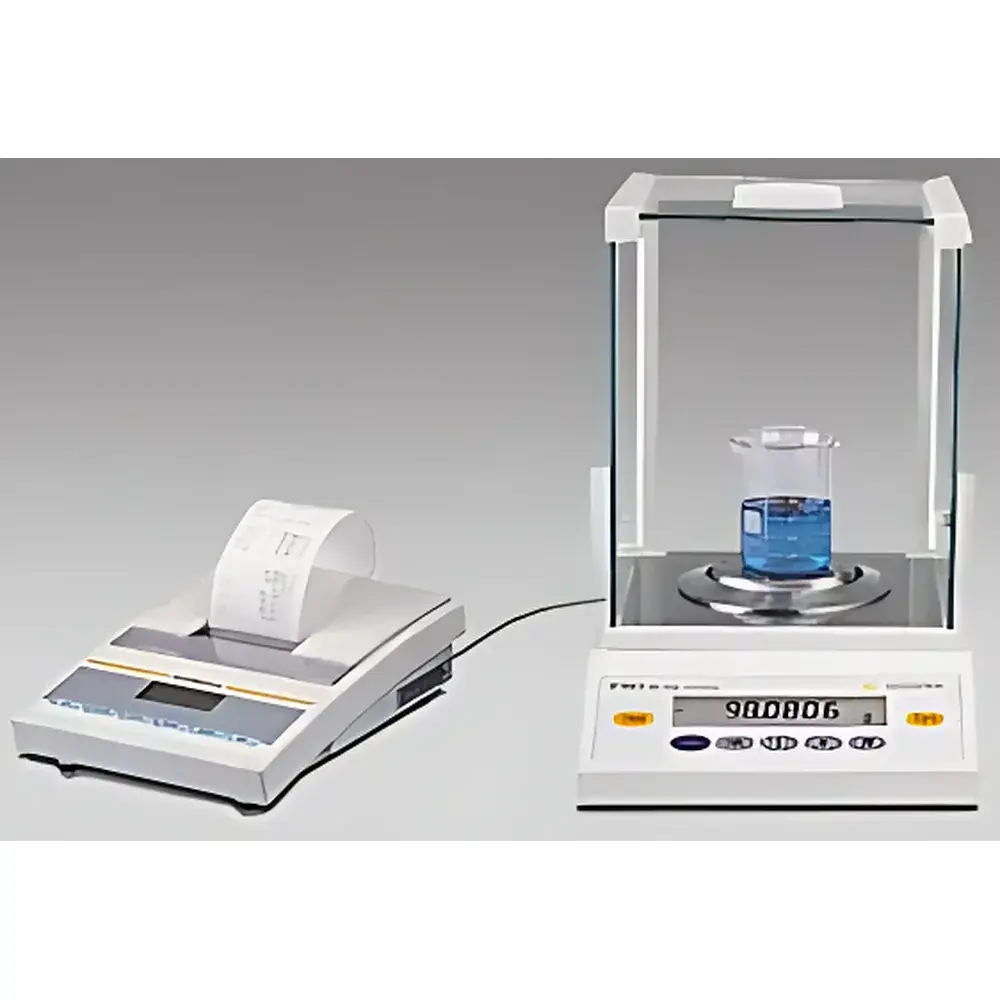
Sartorius BT224S Analytical Balance
| Brand | Sartorius |
|---|---|
| Origin | Germany |
| Type | Imported Analytical Balance |
| Readability | 0.1 mg |
| Capacity | 220 g |
| Pan Diameter | 80 mm |
| Repeatability | ≤ ±0.1 mg |
| Linearity | ≤ ±0.2 mg |
| Internal Calibration | Motorized Automatic |
| Connectivity | RS232 (GLP-compliant) |
| Draft Shield | Anti-static Coated Glass |
| Processor | MC1 40 MHz Microcontroller |
| Environmental Compensation | Dynamic Temperature Compensation |
| Shock Protection | 4-Level Vibration Damping |
| Applications | Counting, Percentage Weighing, Animal Weighing, Net Summation, 19 Unit Conversions |
Overview
The Sartorius BT224S Analytical Balance is a high-precision mass measurement instrument engineered for demanding laboratory environments where accuracy, repeatability, and regulatory compliance are non-negotiable. Built upon Sartorius’ proprietary monolithic dual-lever electromagnetic force compensation sensor architecture, the BT224S delivers stable, drift-resistant measurements under variable ambient conditions. Its core transduction principle relies on real-time null-balance feedback control—where the electromagnetic force required to restore the weighing pan to its zero-position is directly proportional to the sample mass. This method ensures traceable, SI-unit–referenced results with minimal mechanical hysteresis. Designed and manufactured in Germany, the BT224S adheres to stringent ISO/IEC 17025 metrological requirements and integrates seamlessly into quality-controlled workflows governed by GLP, GMP, and ISO 9001 frameworks.
Key Features
- Monolithic dual-lever electromagnetic force compensation sensor for enhanced stability and long-term calibration retention
- MC1 40 MHz microcontroller enabling sub-millisecond response time and optimized signal processing for rapid stabilization (typically <2 s)
- Dynamic temperature compensation algorithm continuously adjusts internal gain and offset parameters across operational ambient ranges (10–30 °C)
- Four-stage mechanical damping system mitigates low-frequency vibrations from bench resonance, HVAC systems, or footfall—critical for microgram-level determinations
- Anti-static coated glass draft shield minimizes electrostatic interference, especially during handling of dry powders or low-conductivity materials
- Motor-driven internal calibration routine triggered manually or scheduled automatically—fully traceable and compliant with ASTM E898 and USP <41> requirements
- RS232 serial interface with full GLP data logging support: timestamps, operator ID, balance status, calibration history, and environmental metadata
Sample Compatibility & Compliance
The BT224S accommodates diverse sample geometries via its 80 mm diameter stainless-steel weighing pan and optional under-hook weighing capability for suspended or oversized specimens (e.g., volumetric flasks, density kits). Its sealed sensor housing and conformal-coated PCBs meet IP42 ingress protection standards for resistance to dust and incidental splashes. All firmware and hardware configurations comply with EU Directive 2014/30/EU (EMC), 2014/35/EU (LVD), and RoHS 2011/65/EU. For regulated industries—including pharmaceutical QC, reference standard preparation, and contract research organizations—the balance supports 21 CFR Part 11–compliant audit trails when paired with Sartorius LabX software (optional upgrade).
Software & Data Management
While the BT224S operates autonomously via its intuitive front-panel interface, its RS232 port enables bidirectional communication with external systems. Raw weight data—including tare values, net/gross modes, and unit conversions—is transmitted in ASCII format with configurable delimiters and prefix/suffix identifiers. When integrated with Sartorius LabX software, the balance contributes to fully electronic lab notebooks (ELN) with role-based access control, digital signature enforcement, and automated report generation aligned with ISO/IEC 17025 clause 7.7. All calibration events, fault logs, and environmental deviations are archived with immutable timestamps and user authentication—supporting internal audits and regulatory inspections without manual transcription.
Applications
- Quantitative analytical chemistry: preparation of primary standard solutions, gravimetric analysis, and titrant standardization
- Pharmaceutical formulation: active pharmaceutical ingredient (API) dispensing, excipient blending verification, and content uniformity testing per USP <905>
- Materials science: density determination using Archimedean principles, powder flow characterization via mass-based feed rate monitoring
- Environmental testing labs: filter weighing for PM2.5/PM10 particulate matter analysis per EPA Method IO-4.2
- Academic research: stoichiometric reagent dosing in synthetic organic chemistry, catalyst loading precision, and isotopic tracer mass balancing
FAQ
Does the BT224S support external calibration with traceable weights?
Yes—the balance accepts external calibration using Class E2 or better certified masses, with full documentation of deviation and adjustment records stored internally.
Is the RS232 interface compatible with modern Windows/macOS systems?
Yes—when used with a USB-to-RS232 adapter and appropriate driver, the interface supports direct integration with Excel, LabX, or custom Python/Node-RED data acquisition scripts.
Can the BT224S perform statistical calculations such as standard deviation or coefficient of variation?
No—statistical functions require external software; however, the balance exports sequential readings with timestamps, enabling post-processing in validated statistical packages.
What is the recommended recalibration frequency under GLP conditions?
Per Sartorius Application Note AN-128, daily performance verification using a check weight is mandatory; full internal calibration should occur at least once per shift or after significant environmental changes.
Does the anti-static coating require special cleaning agents?
No—routine cleaning with deionized water and lint-free cellulose wipes is sufficient; avoid alcohol-based or abrasive cleaners that may degrade the conductive layer.