Sartorius CC/CCT Series High-Capacity Mechanical Mass Comparator
| Brand | Sartorius |
|---|---|
| Origin | Germany |
| Model | CC/CCT Series |
| Construction | Stainless Steel Monocoque Frame |
| Sensor Architecture | Strain-Gauge Based Load Cell Array |
| Windshield | Integrated Standard |
| Compliance | Designed for OIML R111 & ASTM E617 Class F1/F2 Reference Mass Calibration |
Overview
The Sartorius CC/CCT Series High-Capacity Mechanical Mass Comparator is an engineered metrological instrument designed for primary and secondary calibration laboratories performing mass comparison of reference standards up to 3,000 kg. Unlike conventional industrial scales, this comparator operates on the principle of differential force measurement using precision strain-gauge load cells arranged in a mechanically optimized configuration—eliminating reliance on electromagnetic compensation or servo feedback loops. Its core function is to determine mass differences between test and reference weights under controlled environmental conditions, supporting traceable calibrations compliant with ISO/IEC 17025, OIML R111 (Class F1 and F2), and ASTM E617. The device is not a weighing scale per se but a comparator: it measures relative mass deviation with high resolution and minimal drift, enabling uncertainty budgets below 10 µg/kg at sub-100 kg levels and scalable repeatability down to 1 g readability across multi-ton ranges.
Key Features
- Monolithic stainless steel frame construction minimizes thermal expansion effects and eliminates magnetic interference—critical when comparing stainless steel or nickel-plated reference masses.
- CC Series employs a four-point strain-gauge sensor array mounted in a symmetrical “sandwich” geometry, delivering robust eccentric load immunity and consistent repeatability even with non-central placement of heavy weights.
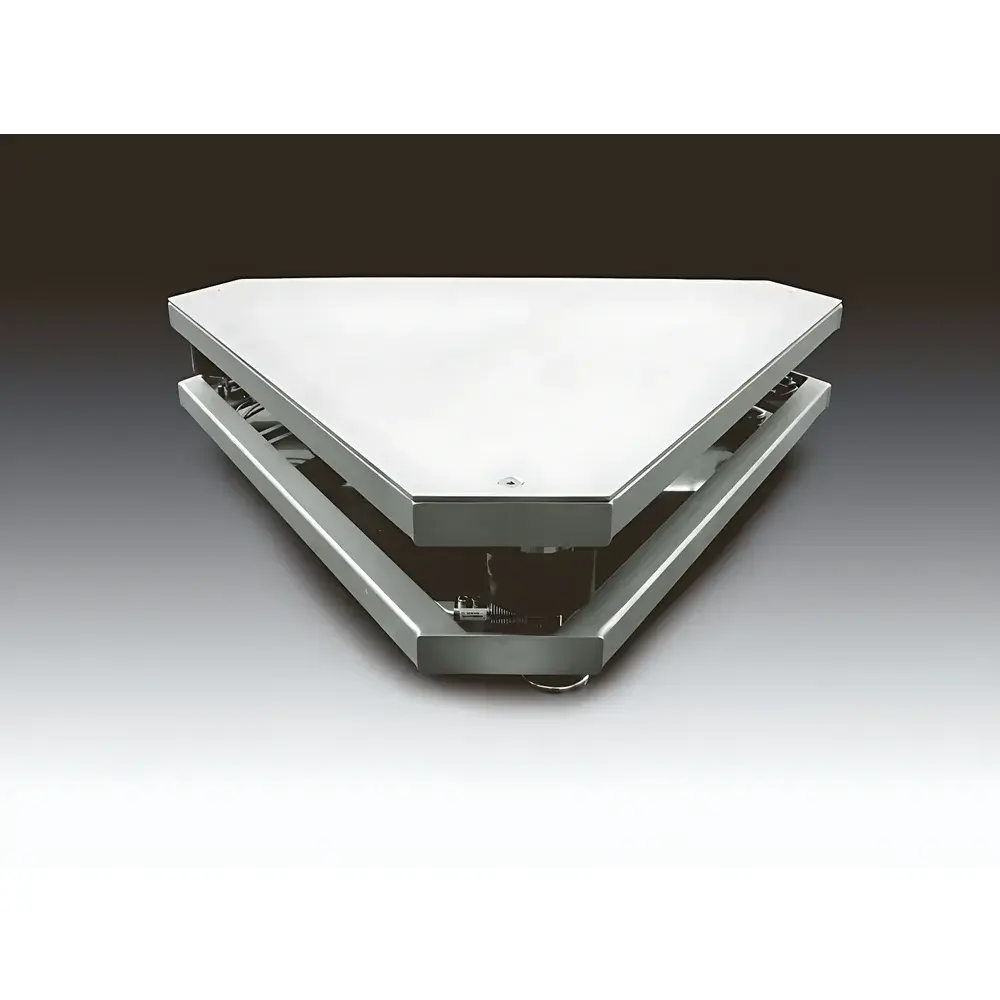
- CCT Series utilizes a patented three-point rigid frame architecture with wide-base triangular support; sensor spacing exceeds 400 mm, reducing moment-induced torsional error and enhancing long-term mechanical stability.
- Integrated draft shield as standard equipment maintains stable air density and suppresses convective disturbances during comparative weighing cycles—essential for achieving ≤2 g typical repeatability at 2,100 kg capacity.
- No internal moving parts or motorized mechanisms: purely passive mechanical design ensures zero maintenance downtime and intrinsic compliance with GLP audit requirements for calibration infrastructure.
Sample Compatibility & Compliance
The CC/CCT comparators accommodate cylindrical, rectangular, and annular reference masses conforming to OIML R111 geometric specifications—including 1 kg to 500 kg cast-iron or stainless-steel standards, as well as 1,000 kg–3,000 kg large-format calibration masses used in national metrology institutes. All models meet mechanical safety requirements per EN 14411 and are certified for use in temperature-controlled laboratories maintained within ±1 °C and <50 % RH. The comparators support formal accreditation pathways under ISO/IEC 17025:2017 Clause 6.4 (Equipment) and Annex A.2 (Metrological Traceability), and are routinely deployed in facilities undergoing FDA 21 CFR Part 11 readiness assessments due to their deterministic analog signal path and absence of embedded software logic.
Software & Data Management
These comparators operate in standalone mode without integrated digital interfaces; measurement outputs are delivered via analog voltage signals (±10 V) compatible with external DAQ systems such as National Instruments PXI chassis or Keysight 34970A data loggers. Users implement custom acquisition protocols aligned with EURAMET cg-18 guidelines for mass comparison data reduction. Optional Sartorius-certified third-party software packages (e.g., Mettler Toledo LabX-compatible modules) enable automated sequence control, uncertainty propagation per GUM Supplement 1, and electronic record generation with full audit trail—including operator ID, timestamp, environmental logs (via optional PT100/thermohygrometer integration), and raw sensor output history. All data files comply with ALCOA+ principles for regulated environments.
Applications
- Primary calibration of Class F1 and F2 reference weights in NMIs and accredited calibration labs.
- Verification of large-capacity load cells prior to installation in weighbridges or hopper scales.
- Inter-laboratory comparison studies organized under CIPM MRA frameworks.
- Periodic verification of in-service working standards in pharmaceutical manufacturing sites operating under EU GMP Annex 11 and USP .
- Validation of mass-based dispensing systems used in nuclear fuel fabrication where traceability to SI kilogram is mandatory.
FAQ
Is the CC/CCT series suitable for dynamic weighing or process control applications?
No. These instruments are strictly static comparators intended for laboratory-grade mass intercomparison under stabilized conditions—not for real-time or conveyor-based weighing.
Does the comparator require periodic recalibration by Sartorius service engineers?
No scheduled factory recalibration is mandated; however, users must perform interval verification using certified reference masses traceable to national standards, documented per ISO/IEC 17025 Clause 7.7.
Can the analog output be connected to a PLC or SCADA system?
Yes—provided the receiving system supports high-impedance voltage input and implements appropriate low-pass filtering to reject 50/60 Hz line noise and mechanical vibration harmonics.
What environmental conditions are required for optimal performance?
Ambient temperature stability of ±0.5 °C over 24 h, humidity control between 40–60 % RH, and vibration isolation via granite slab or active damping platforms meeting ISO 25378 Class 2 specifications.
Are replacement sensors field-serviceable?
Sensor modules are sealed and calibrated as a matched set at the factory; field replacement requires return-to-factory service and full re-characterization per OIML R111 Annex D.